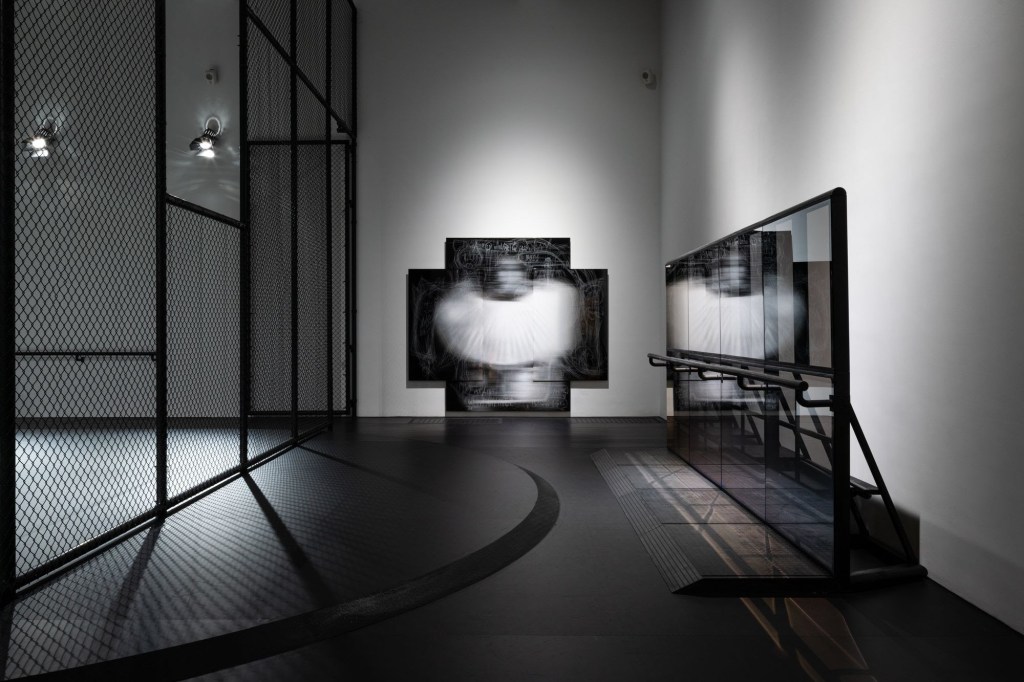
At Tai Kwun Contemporary in Hong Kong, Anne Imhof transforms the gallery into a space of tension, discipline and transformation. Running until 3 January 2027, House of Swans is the artist’s first major solo exhibition in Asia, bringing together a newly commissioned four-act ballet, an original score, video installations, paintings and sculptures in an immersive environment where choreography extends beyond the body and into architecture itself. Curated by Ying Kwok and Tiffany Leung, the exhibition is featured as a sequence of encounters, moving between monumental installations and more intimate spaces, reminiscent of Imhof’s presentation at Palais de Tokyo in Paris.
Building on her 2025 performance DOOM: House of Hope too, Imhof constructs a world of chain-link fences, crowd barriers and lockers, punctuated by paintings, bronze reliefs and figurative drawings. These familiar structures of control and containment become the framework for an exploration of the body, and its limits.
In a new series of paintings, Imhof traces the gestures of an absent body, scratching into the surfaces to create lines, shades and forms that register movement without depicting it directly. Elsewhere, a jumbotron lies crashed on the gallery floor, counting down to the exhibition’s closing while screening footage from DOOM. Two expansive cloud paintings hover nearby, evoking the stillness before a storm. It’s visceral and very poetic.
In a smaller gallery, salvaged archival film reels from Hong Kong’s Clear Water Bay Film Studio sit inside a glass vitrine, bringing the history of the city’s cinematic imagination into dialogue with Imhof’s own visual language. Across the exhibition, past and present, figuration and abstraction, permanence and impermanence remain in a state of suspension. Nothing feels entirely fixed; every image, object and gesture seems poised between collapse and renewal.
On the third floor, two connected spaces evoke both an urban sports field and a dance studio. Here, the gallery becomes a stage shaped by the tension between freedom and discipline, with performers and visitors occupying a shared environment. Above them, a moving array of speakers travels along a track, carrying an original score that shifts between classical and electronic music. Sound becomes an architectural presence, directing attention and altering the atmosphere as the exhibition rolls out.
In an adjoining room, mirrored crowd barriers frame paintings inspired by the Mad Scene from the 1841 ballet Giselle, in which the discovery of betrayal fractures reality. The reference resonates with Imhof’s recurring interest in moments when established orders break down, making space for new forms of consciousness. Beautiful!
At the heart of the exhibition is the ballet House of Swans, a four-act work following Amalia, a young woman raised within a society governed by discipline and routine. Her encounter with the Swans, a group whose movements and ways of living challenge the established order, unsettles the world she has always known. Caught between desire, conviction and loyalty to her family, Amalia is forced to confront the possibility of another life. The narrative becomes a framework through which Imhof examines the body as a site of resistance.
Developed with Devon Teuscher, Michael Dé La Nuez, Remy Young, Toon Lobach and Daniil Simkin, alongside Qingxin Wang, Ryo Kato, Gouta Seki and the corps de ballet of Hong Kong Ballet, the production brings together international dancers and local performers. Composer Jacob Madden created an original score in close collaboration with Imhof.
During the opening week, from 24 to 26 September, dancers and musicians performed live, with Madden accompanying the work alongside a solo by Levi Strasser and prerecorded contributions from Ville Haimala and Luke Hülsmann. Adapted performances by Hong Kong Ballet dancers on selected weekends in October and November continue to reveal fragments of the ballet’s narrative.
Control and freedom, presence and absence, structure and rupture coexist without resolution, Anne Imhof continues to bring poetry and darkness to the fore.

