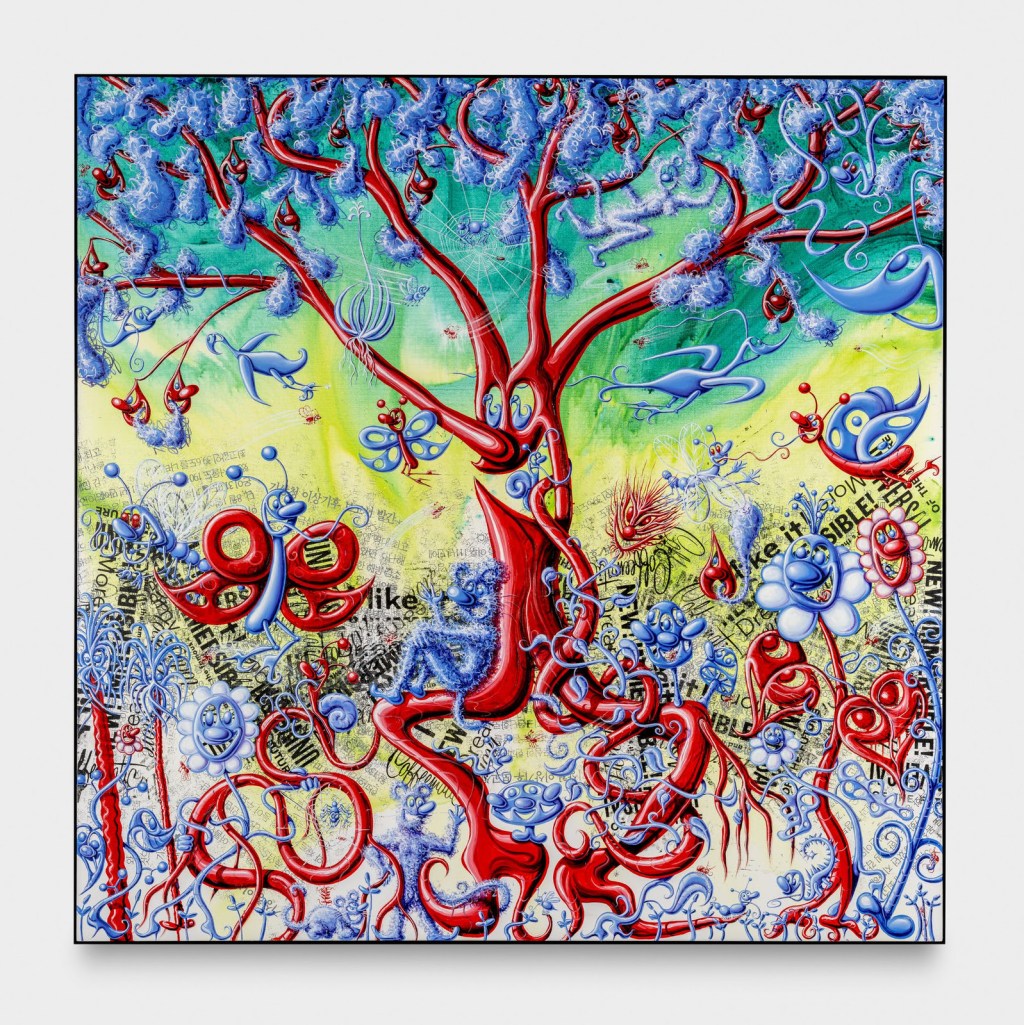
Few artists have captured the irreverent energy of New York in the 1980s quite like Kenny Scharf. A leading figure of the East Village art scene, alongside Jean-Michel Basquiat and Keith Haring, Scharf developed a visual language in which cartoon characters, science fiction, consumer culture and Surrealism collide in exuberant bursts of colour. The artist is mentioned in Madonna’s amazing song Danceteria.
This autumn, the Museo Nacional Thyssen-Bornemisza brings his fantastical universe to Madrid in an exhibition presented as part of the programme devoted to the Blanca and Borja Thyssen-Bornemisza Collection. The show is on view until 17 January 2027.
Born in 1958 in Los Angeles, Scharf emerged at a moment when the boundaries between high art, street culture, music, fashion and commercial imagery were becoming increasingly porous. In downtown Manhattan, artists were experimenting with new ways of making and showing work, transforming streets, clubs, studios and abandoned spaces into sites of creative exchange. Scharf was at the heart of this restless environment, sharing with Haring and Basquiat an instinct for art that could speak beyond the confines of the traditional gallery. His relationship with Andy Warhol, whom he regarded as a mentor, further connected his practice to the legacy of Pop Art and its fascination with the images circulating through everyday life.
Yet Scharf’s world is unmistakably his own. Where Pop Art often appropriated the recognisable symbols of consumer society, he sends them spiralling into an exuberant, sometimes psychedelic universe. Familiar cartoon-like figures acquire strange, anthropomorphic forms; domestic objects become portals into the surreal; and vivid, almost hallucinatory compositions seem to move across the canvas. His imagery draws on the visual language of television, comics and popular entertainment, but refuses to remain within its familiar boundaries. Instead, it transforms the ordinary into something strange, playful and unexpectedly subversive.
Colour is central to this experience. Acidic pinks, electric blues, luminous yellows and saturated greens compete for attention, creating compositions that appear to vibrate with their own energy. Beneath their apparent lightness lies a more ambitious proposition: that art need not respect established distinctions between the sophisticated and the popular, the serious and the playful, or the gallery and the street. Scharf’s practice embraces painting, sculpture, installation, murals, performance and fashion, consistently challenging the hierarchies that have traditionally defined artistic expression.
His inclusion in the 1985 Whitney Biennial helped establish his international reputation, bringing the unruly spirit of the East Village into wider institutional recognition. In the decades since, Scharf has continued to develop an artistic universe that is both instantly recognisable and difficult to categorise. His work retains the immediacy of street imagery while inviting a more immersive encounter, drawing viewers into a world where humour, fantasy and visual excess become tools for reimagining contemporary life.
At the Thyssen-Bornemisza, this encounter offers an opportunity to reconsider an artist whose exuberance can sometimes obscure the significance of his contribution to contemporary art. Scharf is more than a chronicler of 1980s New York or a purveyor of psychedelic colour.
In a cultural landscape increasingly shaped by images, screens and rapidly circulating visual references, Scharf’s fantastical compositions feel particularly resonant. They invite us to look again at the images we consume, to embrace the unexpected and to rediscover the liberating possibilities of play. His universe may be joyfully chaotic, but its underlying ambition is serious: to make art that escapes convention and remains alive to the boundless possibilities of imagination.

