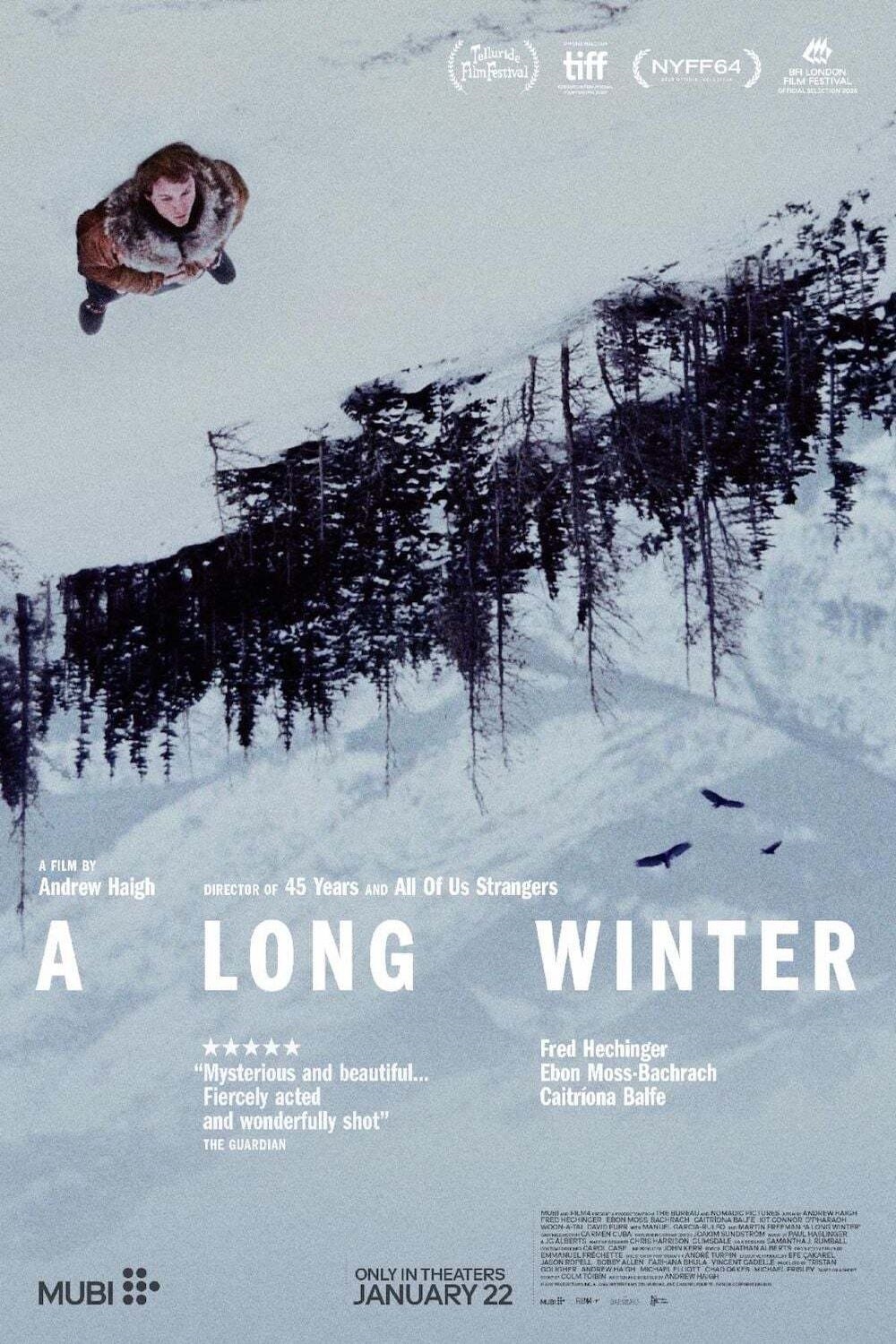
Some landscapes seem to carry sorrow in them. In A Long Winter, Andrew Haigh returns to the territory he knows best: loneliness, family politics, and the ache of wanting a different life.
The film is set on an isolated homestead in the Colorado Rockies in the early 1950s. One winter, Louise (Caitríona Balfe) vanishes, leaving her husband Lester (the spectacular Ebon Moss-Bachrach) and their sons to make sense of a household suddenly broken. Chief among them is Mike (Fred Hechinger), a young man trying to understand who he is and what he wants inside a rigidly patriarchal home.
Adapted from a Colm Tóibín short story (set in the Pyrenees in the book), the film cares little about where Louise has gone. What interests Haigh is what her absence opens up: how the collapse of a family’s settled order lets long-buried feelings and possibilities rise to the surface. But that freedom is never clean. Even the chance of change carries a cost, and the film feels that loss throughout.
Haigh’s greatest strength here is his refusal of the easy option. Lester is not made a villain, and Mike’s relationship with aide Jimmy is not offered as a simple escape. Affection and repression, desire and disappointment sit side by side, mostly unresolved. The film finds sorrow not only in what is forbidden, but in the emotional limits of the people who live within those prohibitions. Without a conventional dramatic arc or tidy answers, it gains a quiet complexity.
The setting does a great deal of the work. Vast, snow-covered mountains make a stark contrast with the cramped emotional life of the house. The cinematography is gorgeous but bleak, and the endless winter becomes a metaphor for stagnation, passing time, and lives shaped by silence.
Haigh has always been attuned to what goes unsaid, and his characters speak through glances, gestures, and hesitations as much as through dialogue. These people share a home yet cannot reach one another. Hechinger is especially compelling as Mike, whose slow awakening is the film’s most affecting thread, while Moss-Bachrach gives Lester real depth as a man whose authority is slipping away through no fault of his own.
After All of Us Strangers, Haigh again examines the stories of human relationships, and how identity, desire, and memory shape the way we see ourselves and others. This film is more restrained and contemplative. It avoids grand gestures and easy sentiment, and works instead through silence, fleeting tenderness, and the sense that something precious is gone.
A Long Winter is about growing as an adult, breaking from our parents, the lives we inherit, the selves we hide, and the sadness that comes with time. It is a stunning film about belonging, about being misunderstood, and about how fragile freedom can be.
Haigh leaves room for layers of ambiguity, and what remains is a haunting meditation in which beauty and sorrow cannot be separated.

