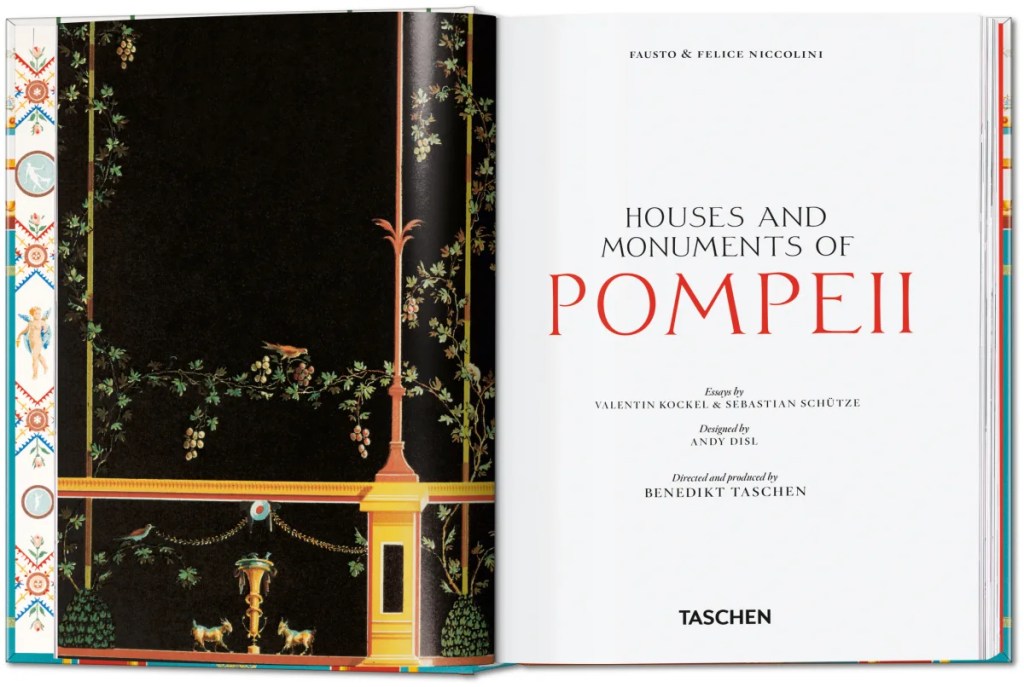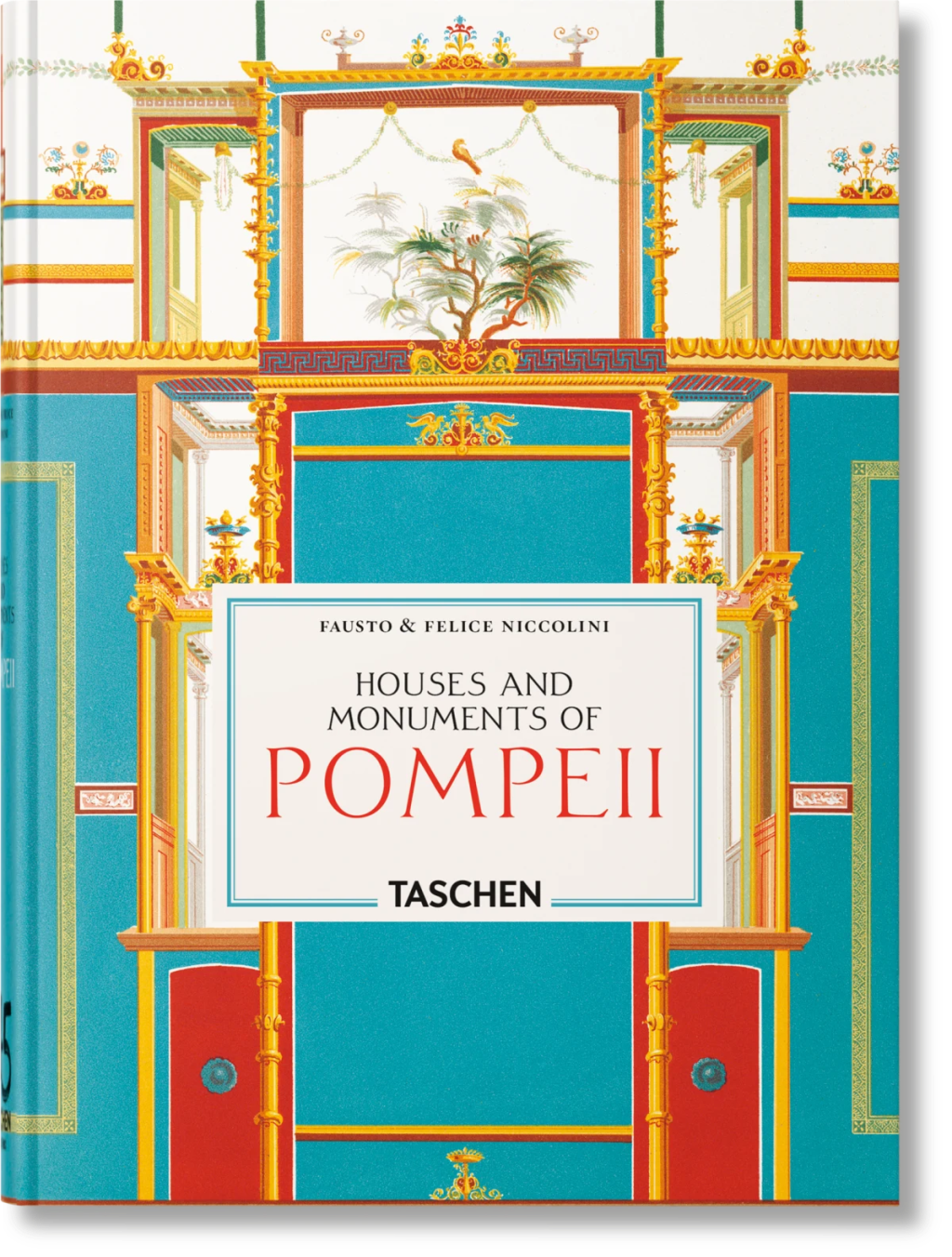
Pompeii is often imagined in shades of grey: weathered stone, faded frescoes and the haunting remains of a city frozen in time. Yet, for the 19th-century brothers, artists and documentarian Fausto and Felice Niccolini, the ancient Roman city was anything but monochrome. Through an extraordinary series of colour illustrations, they sought to restore Pompeii to its former vibrancy, revealing not simply an archaeological site, but a thriving world of domestic interiors, elaborate decoration, public spaces and everyday life. Now, this remarkable visual record returns in a beautifully produced facsimile edition. It is published by TASCHEN.
The city’s extraordinary history is inseparable from the catastrophe that brought it to an abrupt end. In AD 79, Mount Vesuvius erupted in one of the most devastating volcanic events in European history, burying Pompeii beneath layers of volcanic ash, pumice and debris. The eruption unfolded over several hours, with falling pumice accumulating on rooftops before devastating pyroclastic surges swept through the city. Thousands of inhabitants perished, while homes, shops, temples and public buildings disappeared beneath the volcanic deposits. Paradoxically, this destruction also preserved an astonishing record of Roman life. Buildings, decorative frescoes, mosaics, furniture and everyday objects survived beneath the ash, offering an unusually intimate glimpse into a civilisation nearly two millennia later. Excavations began in earnest in the 18th century, gradually revealing a city whose streets and interiors seemed to offer a direct encounter with the ancient world.
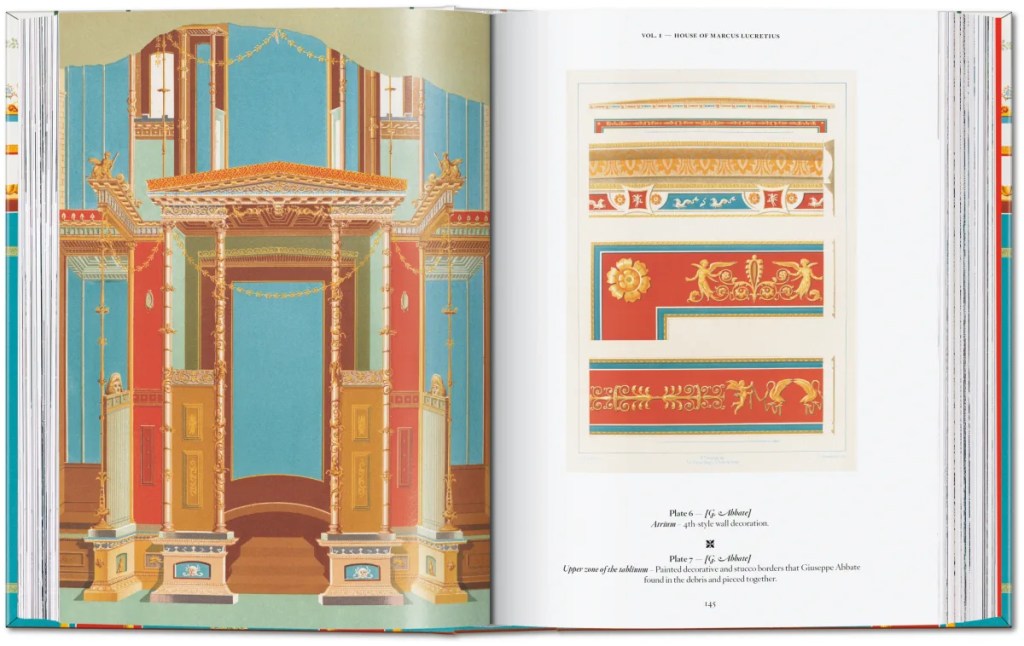
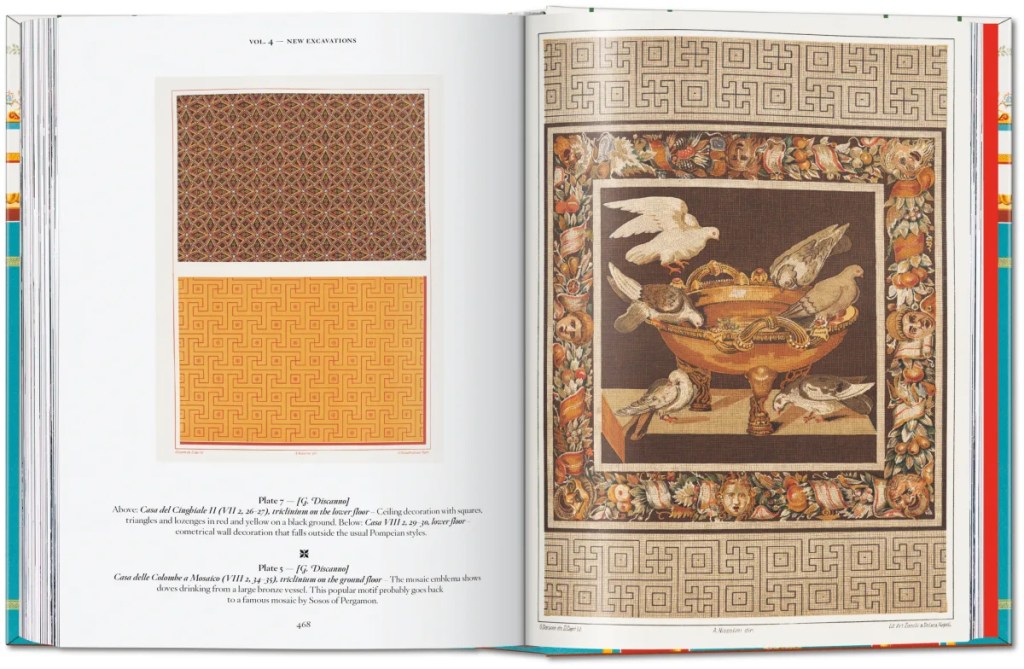
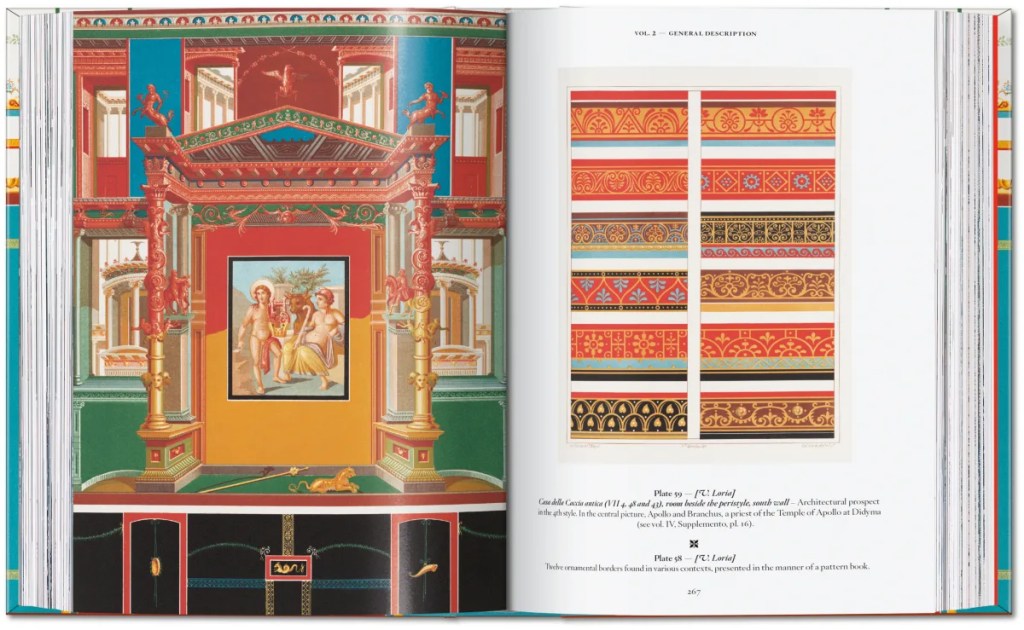
Originally published in instalments in Naples between 1854 and 1896 under the title Le case ed i monumenti di Pompei, the ambitious project, featured in this remarkable book, brought together more than 400 colour lithographs, employing a relatively new printing technique to capture the extraordinary discoveries emerging from the excavations. Its scope is fascinating, encompassing architectural plans, maps and monumental buildings alongside the interiors of private residences, richly painted walls, sculptures and objects of everyday use.
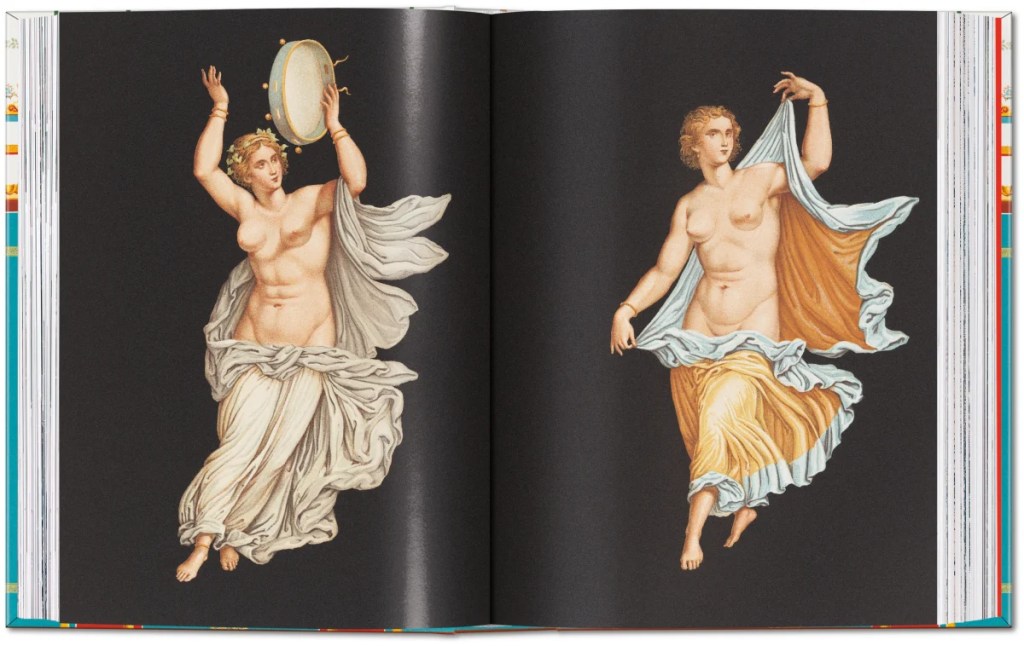
Among the most extraordinary discoveries were Pompeii’s frescoes, whose colours and compositions reveal the sophistication of Roman decorative art. Far from being merely ornamental, these paintings offered windows into mythology, religion, literature and the aspirations of their owners. Rich reds, deep blacks, ochres and delicate architectural illusions transformed domestic walls into elaborate theatrical settings, where scenes from Greek mythology unfolded alongside portraits and glimpses of everyday life. They’re reproduced in this fantastic title!
Perhaps the most celebrated example is the magnificent fresco cycle at the Villa of the Mysteries, where almost life-size figures stretch across three walls against an intense Pompeian red background. Dating to the first century BC, the monumental composition is widely interpreted as depicting an initiation ritual associated with Dionysus, the Greek god of wine, theatre and ecstatic celebration. Women, attendants and mythical figures participate in a mysterious sequence of gestures and ceremonies, creating an extraordinary sense of movement and psychological drama. Its precise meaning remains debated, but its scale and remarkable preservation make it one of the masterpieces of ancient Roman painting.
Equally fascinating are the frescoes of the House of the Vettii, one of Pompeii’s most luxurious residences. Its richly decorated rooms feature elaborate mythological narratives, including scenes of gods, heroes and tragic lovers, framed by fantastical painted architecture. At the entrance, an altogether more provocative image depicts Priapus, the god of fertility and abundance, weighing his enormous phallus against a bag of money. The striking composition was a symbol of prosperity and good fortune, reflecting the wealth and social ambitions of the home’s owners.
The city’s artistic treasures continue to surprise archaeologists. In 2024, excavations revealed extraordinary paintings in the so-called Black Room, a lavishly decorated banqueting hall with dramatically dark walls. Among the scenes are Paris encountering Helen of Troy, the episode that would lead to the Trojan War, and Apollo’s pursuit of Cassandra. These newly uncovered paintings demonstrate the enduring fascination with Greek mythology among Pompeii’s wealthy inhabitants, as well as the remarkable range of subjects that decorated their homes.
Other celebrated works offer a more intimate portrait of Roman society. The famous portrait often referred to as Sappho, now housed in Naples’ National Archaeological Museum, depicts a young woman holding a writing tablet and stylus.
Particularly evocative are the Niccolini brothers’ so-called animated scenes, in which human figures populate workshops, taverns, shops, temples, theatres and baths. These images transform archaeological documentation into something far more compelling: an attempt to reconstruct the rhythms and atmosphere of a civilisation. Rather than presenting Pompeii as a city of ruins, the brothers invite us to imagine it as it once was, alive with colour, activity and human presence.
This 45th edition brings together a selection of the original plates, accompanied by two scholarly essays that place the work within its historical and archaeological context. Contributors Sebastian Schütze, an art historian associated with the Bibliotheca Hertziana in Rome and the University of Vienna, and Valentin Kockel, a classical archaeologist whose research includes excavations at Ostia Antica and Pompeii’s Forum, offer complementary perspectives on the artistic ambitions and archaeological significance of the project.
One of the most interesting sections explores Pompeii’s enduring influence on the visual imagination, tracing its presence across painting, sculpture and interior design. From Robert Adam, Anton Raphael Mengs, Angelika Kauffmann and Ingres to Alma-Tadema, Picasso and de Chirico, the city’s rediscovery inspired generations of artists and architects. Its legacy even extends to the unsettling plaster casts of the eruption’s victims and the later sculptural interpretations of Duane Hanson and George Segal. Pompeii emerges here not merely as a window onto antiquity, but as an inexhaustible source of artistic inspiration.
There is something particularly satisfying about the return of this landmark publication and the work by TASCHEN. The Niccolini brothers’ achievement lies in their ability to make archaeology feel immediate, restoring colour and human scale to a civilisation too often reduced to fragments and ruins.
This 45th edition is presented as a handsome hardcover volume of 512 pages, priced at £30. Beautifully illustrated and rich in historical detail, it is a volume to return to time and again, as well as a particularly lovely Christmas present for anyone with an interest in art, architecture, archaeology or the enduring beauty of the ancient world.
Although it does not reproduce the complete original collection, the selection is generous, while the accompanying essays and exploration of Pompeii’s artistic afterlife add considerable depth. An appealing volume for anyone interested in classical antiquity, the history of illustration or the enduring dialogue between ancient art and modern creativity.
–