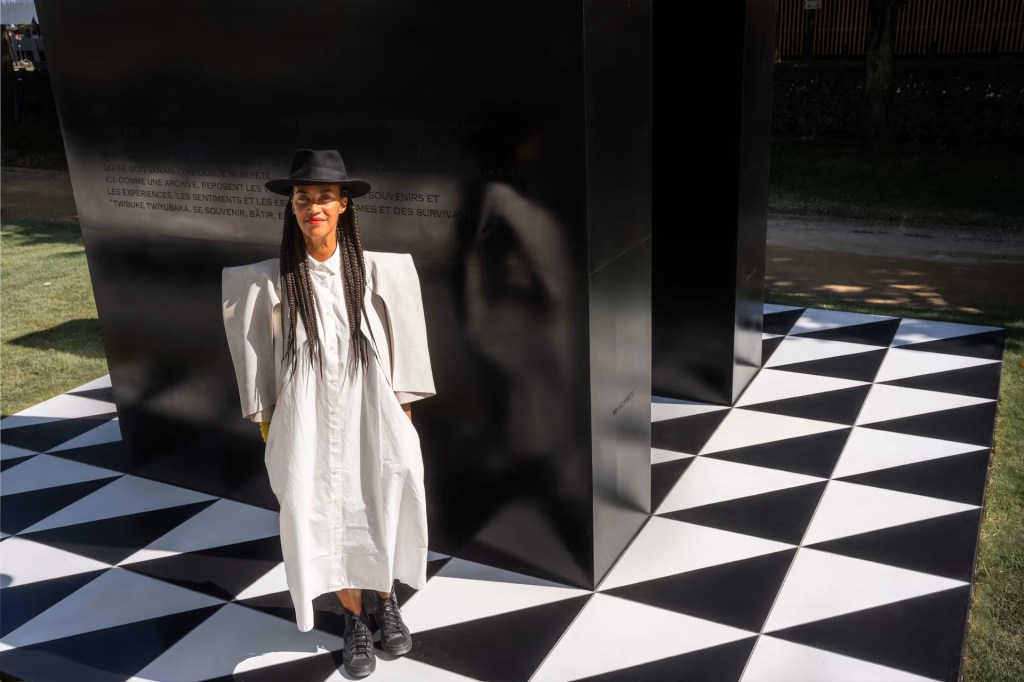
Last week, Grada Kilomba unveiled a new public memorial in Paris titled The Archive, dedicated to the victims of the 1994 Genocide against the Tutsi in Rwanda. The work was inaugurated on 2 June 2026 and marks a significant addition to the artist’s ongoing engagement with memory, history and collective trauma.
Installed in a public setting, The Archive consists of two parallel black brass structures set into an enamelled lava stone surface. A narrow void separates the forms, creating a physical and symbolic space that foregrounds absence as its central theme. The work avoids figurative representation, instead relying on reduction and spatial tension to address the scale of historical loss.
The memorial is inscribed in French, English, Swahili and Kinyarwanda, and references four major genocide memorial sites in Rwanda: Nyamata, Murambi, Gisozi and Bisesero. This multilingual approach places the work within both local and international contexts of remembrance, while also acknowledging the global dimensions of commemoration.
Kilomba, whose practice spans writing, performance, film and installation, has long explored how histories are constructed and who is granted authority to narrate them. Her previous works have addressed colonialism, migration and systemic violence, often through installations that combine text, space and participation.
With The Archive, the artist extends these concerns into the realm of public memorialisation. The work reframes the concept of the archive not as a static repository of records, but as an active space of engagement. Visitors are required to move around and between its forms, turning physical proximity into a condition of encounter.
The commission adds to a growing body of contemporary memorial practices that reject monumental figuration in favour of abstraction and spatial experience. In doing so, The Archive positions itself as both a site of remembrance and a reflection on the ongoing processes through which history is recorded, transmitted and contested.
In parallel, and running until 26th September, the artist presents her first major solo exhibition in Portugal in almost a decade at the Albuquerque Foundation. Known for her distinctive and subversive approach to storytelling, Kilomba gives form, voice and movement to narratives that have historically been silenced. “What stories are told? Where are they told? How are they told? And told by whom?” the artist asks. The exhibition brings together a significant selection of works, including several that have never previously been shown in Portugal.

