Curated by Fatoş Üstek, the 14th edition of the free outdoor exhibition examines hybridity through sculpture and installations. The presentation coincided with the successful editions of Frieze London and Frieze Masters this week.
Frieze Sculpture has returned to the English Gardens of Regent’s Park, London, with an exhibition of 11 international artists exploring the relationships between materials, cultural identity and the natural environment. Curated by Fatoş Üstek for the fourth consecutive year, the 14th edition runs from 16 September to 1 November 2026. The free, public exhibition is always a highlight of the Autumn calendar.
The exhibition’s central theme is hybridity: the merging of artistic media, cultural traditions and social and environmental contexts. Rather than treating sculpture as a collection of isolated objects, Üstek presents the works as an interconnected field of material and conceptual relationships. The exhibition also extends Frieze’s activities beyond its commercial fairs, placing contemporary art in a public setting accessible without charge.
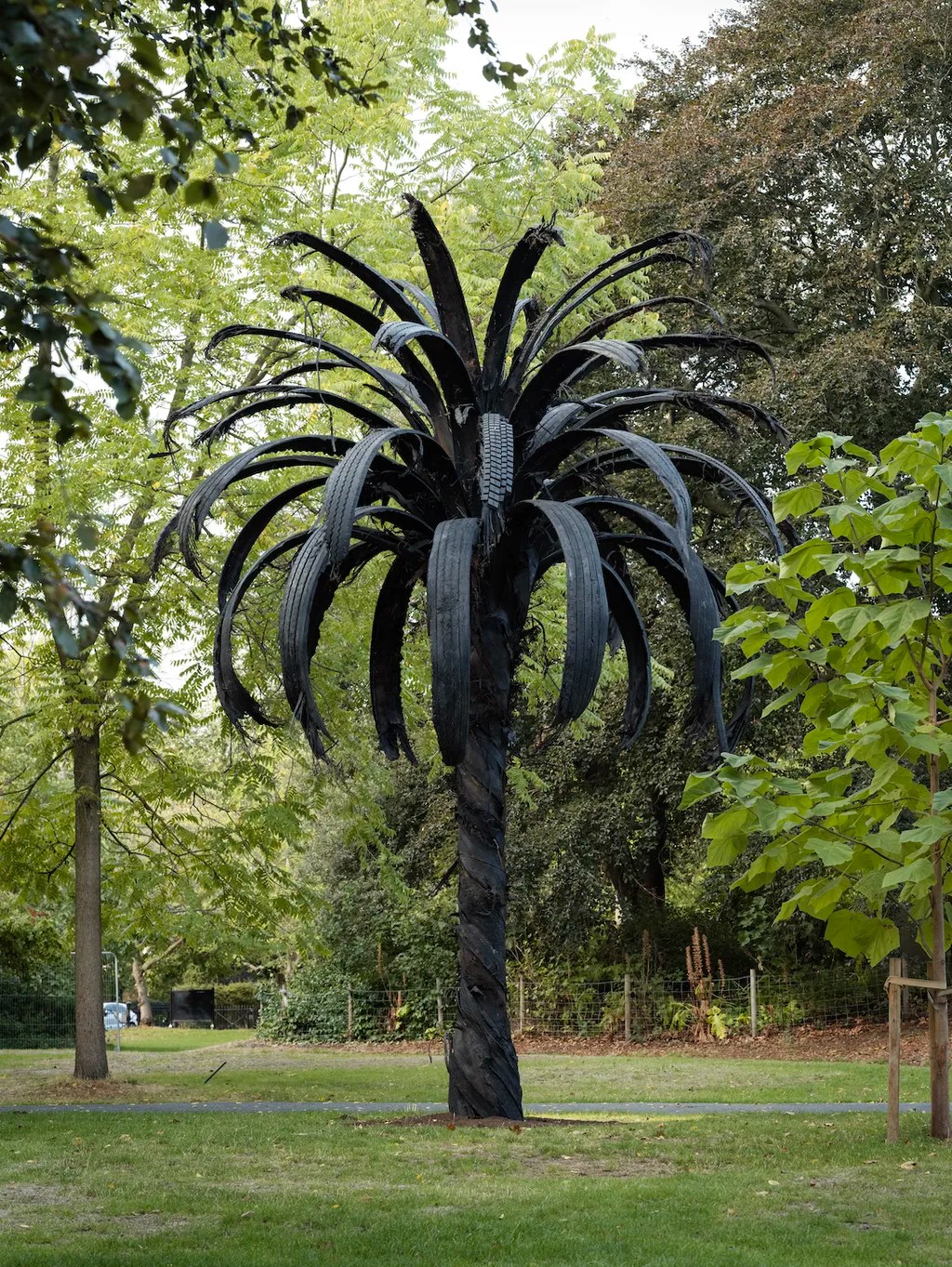
Among the featured works is Douglas White’s Black Palm (2026), presented by Leila Heller Gallery. Standing approximately seven metres tall, the sculpture transforms discarded truck tyres into the form of a palm tree, bringing questions of industrial waste and material transformation into the park’s landscape.
Environmental concerns also inform WYRM (2026) by Catriona Robertson, presented by The Muse Gallery. Made from papercrete, a mixture of concrete and recycled newspaper pulp, the work depicts worm-like forms that appear to move through the ground. Robertson imagines a future in which organisms consume industrial waste, reframing discarded materials as potential components of new ecosystems.
Angel Otero’s Dreams and Salt (2025–26), presented by Hauser & Wirth, addresses migration, memory and belonging. A partially buried door opens onto a staircase descending beneath the grass, creating an ambiguous threshold between the visible landscape and an unseen space below. Drawing on the artist’s experiences of growing up in Puerto Rico, studying in Chicago and living between Puerto Rico and New York, the work approaches displacement through the familiar architecture of a domestic entrance.
Memory and place are also central to Held (2026) by Carolina Aguirre, presented by Ruttkowski;68. The bronze sculpture divides around a white quartz stone collected from the artist’s family home in Uruguay. Drawing on the geological phenomenon of xenoliths, in which fragments of rock become enclosed within another rock, Aguirre juxtaposes two materials to consider the connections between personal history, belonging and place.
Ivana Bašić’s Metanoia (2025), presented by Albion Jeune, reinterprets the language of monumental sculpture. Made from concrete, glass and copper, the work incorporates vessels that inhale and exhale air through a system of exhaust pipes. Its form references the modernist war memorials built across the former Yugoslavia, including the Flower Monument at Jasenovac, recasting the commemorative structure as a breathing entity.
Other participating artists include Conrad Shawcross, Matyáš Chochola, Özlem Günyol and Mustafa Kunt, Ramesh Mario Nithiyendran, and Tarini Sethi. Their works extend the exhibition’s investigation of sculpture through different materials, formal strategies and cultural references. Sethi’s The Sun Bathes Its Friends and Neighbours (2026), for example, uses stainless-steel screens to construct scenes informed by utopian imagery, while Nithiyendran’s Warrior Figure (2026) engages with the visual language of the idol.
Together, the works question conventional distinctions between the natural and the manufactured, the historical and the contemporary, and the monumental and the personal. Their placement throughout Regent’s Park makes the surrounding landscape an active part of the exhibition, while allowing visitors to encounter contemporary sculpture outside a conventional gallery setting.
Frieze Sculpture 2026 is free to visit and requires no booking. An accompanying digital guide, produced in partnership with Bloomberg Connects, includes additional information and an audio tour featuring Üstek and the artists.
–
Image: Douglas White, ‘Black Palm’, 2026, (Image credit: Presented by Leila Heller Gallery)

