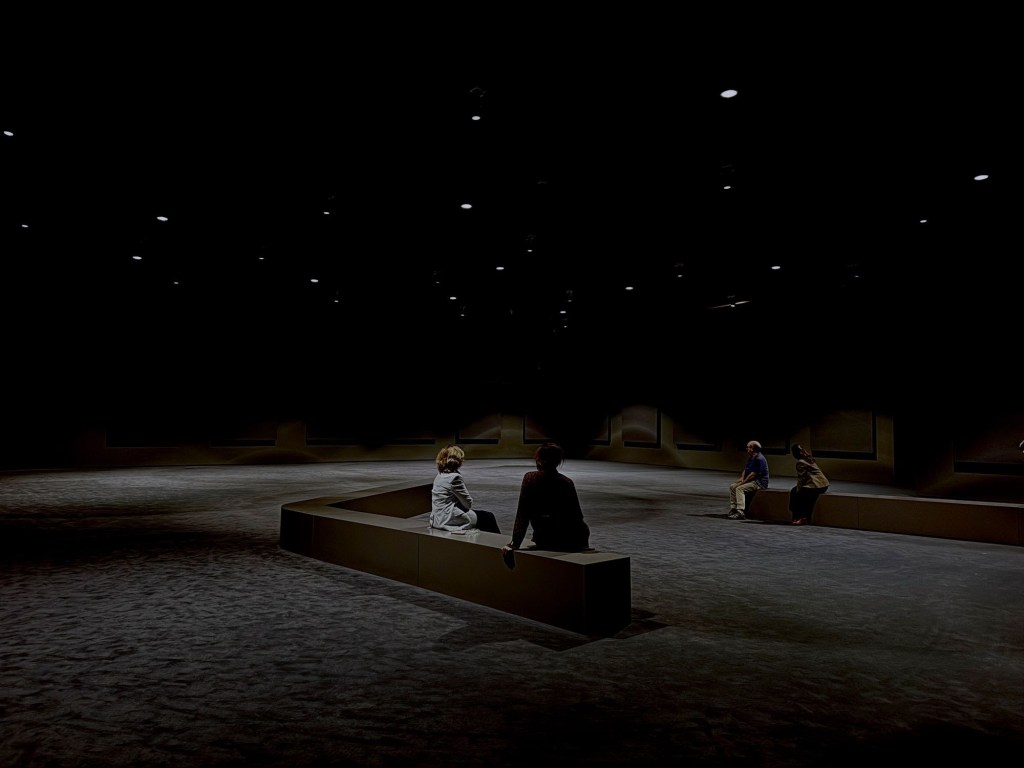
The Guggenheim Museum Bilbao is presenting 66–76–26, a new installation by Steve McQueen conceived specifically for the museum. The work combines two recordings of the song “Wild is the Wind,” written by Dimitri Tiomkin and Ned Washington: Nina Simone’s 1966 interpretation and David Bowie’s 1976 cover.
McQueen has removed the instrumentation from both recordings, so each is heard a cappella. The two voices are separated in a darkened gallery. Simone’s voice comes from one side of the space and Bowie’s from the other. As visitors move through the gallery, the voices are heard in dialogue across the architecture. The museum describes the result as neither a comparison nor a reconciliation, but a newly created work.
The title refers to the years in which Simone and Bowie recorded the song, 1966 and 1976, and to the year of the exhibition, 2026. The recordings are presented sixty and fifty years after they were made. Both were created during periods of upheaval, including the civil rights movement, the Vietnam War, and Watergate.
McQueen first heard Bowie’s recording in the mid-1990s, early in his career, and later discovered Simone’s version. He has returned to the song for more than three decades. He has said it never settles into a single interpretation, and he describes it as part love song, part lament, and part declaration of longing.
Steve McQueen was born in London in 1969 to a family with Grenadian roots. He studied at Chelsea College of Art and Design, Goldsmiths College, and New York University’s Tisch School of the Arts. He emerged in the 1990s with films and installations exploring the body, memory, and history. He won the Turner Prize in 1999 and represented Britain at the Venice Biennale in 2009.
His feature films include Hunger (2008), Shame (2011), and 12 Years a Slave (2013), which won the Academy Award for Best Picture, with McQueen among its producers. In 2020 he made Small Axe, an anthology of films about London’s West Indian community.
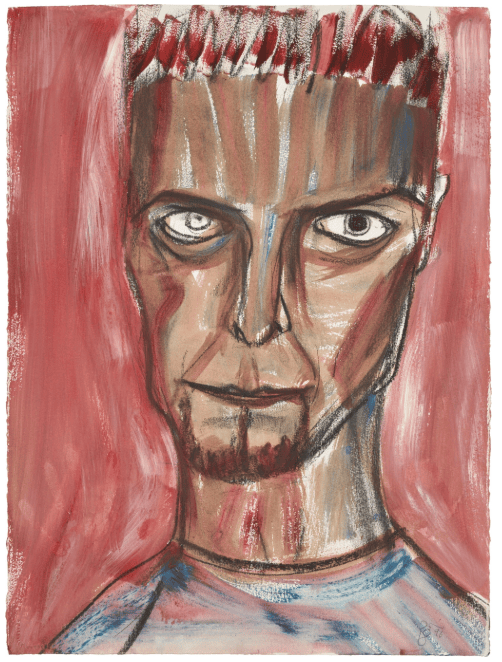
Meanwhile, a vivid 1996 self-portrait by David Bowie, unseen publicly for nearly three decades, is on view at Sotheby’s London ahead of its auction debut in the Modern British & Irish Art Day Auction on 15 October, with an estimate of £35,000-55,000. Gifted by Bowie to his St Ives gallerist and bought from the gallery soon after, it has stayed in the same private collection ever since, and it bears Bowie’s own handprints pressed into the lower corners.
The portrait shows him staring straight out, emphasising his famously asymmetric eyes, and is one of just eight large-scale portrait heads he made during a prolific mid-1990s period; it is considered among the most vibrant and expressive of them. Its bold colour reflects the influence of German Expressionism, which Bowie absorbed during his Berlin years, while its monumental, psychologically intense composition recalls School of London artists Frank Auerbach and Leon Kossoff, whom he admired and collected.
The sale continues Sotheby’s long association with Bowie, following the 2016 Bowie/Collector sales that raised £32.9 million, and offers a rare chance to encounter him through his own work rather than the art he collected. It is currently displayed alongside highlights from Sotheby’s autumn sales, including works by de Kooning, Rothko, Richter, Hockney and Banksy.
–