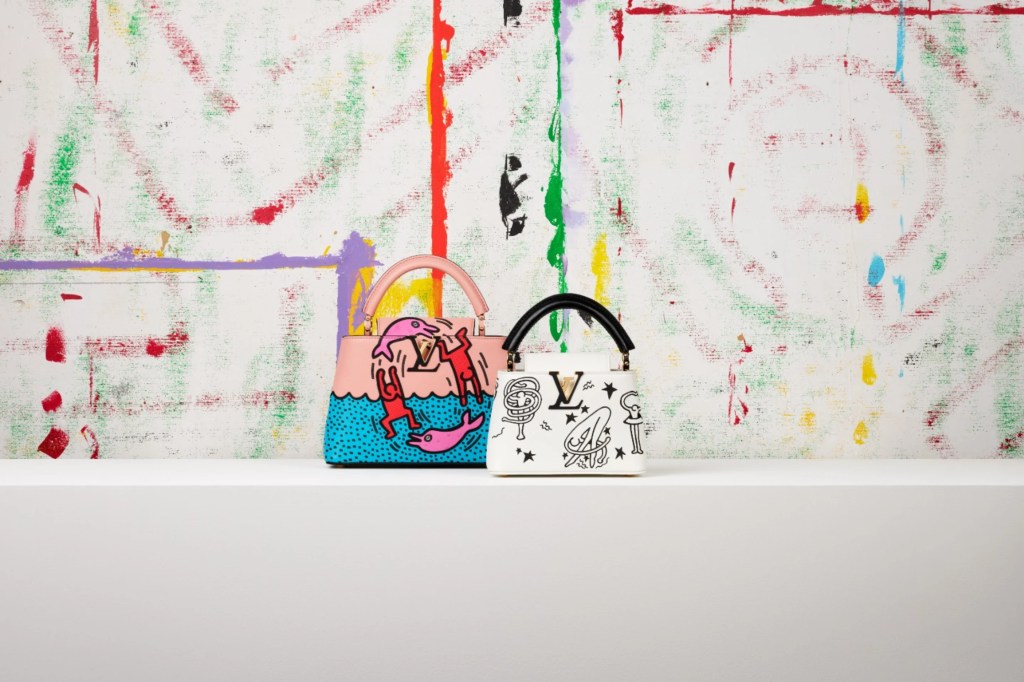
Keith Haring’s dancing figures, radiant babies and barking dogs were never meant to stay put. Born on the walls and subway platforms of 1980s New York, his graphic language moved freely between art and advertising, gallery and street, politics and pleasure. Now it has found its way into one of luxury’s most polished arenas.
Louis Vuitton has unveiled 13 new handbags devoted to Haring, the latest chapter in its Artycapucines series, created with the Keith Haring Foundation. The collection turns some of his best-known motifs, including the Running Heart, the Radiant Baby and those dancing figures, into objects of painstaking craft.
Haring made work for immediacy and access, while Louis Vuitton trades in rarity and exclusivity. But he was never precious about where art belonged. His images appeared on T-shirts, posters and merchandise as readily as on subway walls, and he deliberately blurred the line between fine art and everyday life. Louis Vuitton takes the same imagery and pushes it toward extreme craftsmanship.
The Capucines Nano Running Heart becomes a silver-toned minaudière covered in more than 12,000 hand-placed rhinestones. The Capucines East-West Mini Maze is worked in intricate bead embroidery. The Capucines BB Figures sets the dancing figures against white Taurillon leather, with Haring’s black contours folded into the structure of the bag itself.
Perhaps the most compelling piece is the Capucines MM Genesis, inspired by a Louis Vuitton suitcase Haring customised by hand in 1984. That original object ties the artist directly to the house, a conversation begun decades ago that now fills an entire collection.
It also follows Louis Vuitton’s recent embrace of his work. Earlier this year, his imagery appeared in the house’s womenswear show at New York’s Frick Collection, carrying that downtown energy into a far more formal setting.
For the brand, Haring is the next step in a well-established strategy of putting contemporary art at the heart of luxury. Since Artycapucines launched in 2019, it has welcomed Takashi Murakami, Tschabalala Self, Urs Fischer and Park Seo-Bo. Haring pushes the idea further, taking an artist once synonymous with the street and making him an object of desire.
Louis Vuitton’s relationship with the art world has become one of the most influential crossovers between luxury and contemporary culture. Under Marc Jacobs, the house turned collaboration into a creative strategy, inviting artists including Richard Prince, Takashi Murakami and Yayoi Kusama to disrupt and reinvent its most recognisable codes. These were more than designer collaborations: they turned the handbag into a cultural object, collapsing the distance between art, fashion and commerce.
That dialogue has since expanded from the product to the institution. The Fondation Louis Vuitton, designed by Frank Gehry, has established the house as a major patron and platform for art, presenting ambitious exhibitions by artists including David Hockney and Alexander Calder. Hockney’s vast 2025 survey brought together more than 400 works across seven decades, while Calder’s 2026 exhibition filled the Fondation with nearly 300 works, extending into its gardens.

