On the occasion of the 150th anniversary of Constantin Brancusi’s birth, Pace will present Matrix Muse, an exhibition examining the Romanian sculptor’s enduring fascination with the origins of life and the philosophical significance of the female figure. The exhibition coincides with Brancusi: The Artist and His Studio at The Museum of Modern Art in New York, on view until 27 February 2027. Together, the two presentations provide an opportunity to reconsider the legacy of an artist whose radical approach to form fundamentally altered the possibilities of modern sculpture.
Opening at Pace’s London gallery on 25 November 2026 and running until 30 January 2027, the presentation marks the gallery’s first solo exhibition of Brancusi’s work since announcing its representation of the artist’s estate.
Curated by Dr Jérôme Neutres, former president of the Musée du Luxembourg in Paris, the exhibition brings together four major sculptures, a selection of previously unexhibited drawings, personal writings, photographs and archival objects. Collectively, these works trace the development of a central preoccupation in Brancusi’s practice: the transformation of the human figure into an increasingly abstract expression of life, creation and metaphysical origins.
The exhibition takes its title from the multiple meanings of the word ‘matrix’, derived from the Latin māter, meaning mother. Historically associated with the womb, source and origin, the term provides a framework for considering Brancusi’s conception of the muse beyond its conventional association with female beauty or portraiture. In his work, the female figure becomes a more universal symbol, connected to fertility, regeneration and the fundamental principles of existence.
This pursuit of essential form was central to Brancusi’s radical redefinition of sculpture. Rather than reproducing the external appearance of his subjects, he sought to distil their defining characteristics into simplified volumes and highly refined surfaces. The resulting works often approaching the geometry of the egg, became a distinctive feature of his artistic language and a significant contribution to the development of modern abstraction.
Among the works presented is Le premier cri (The First Cry) (1917), a bronze sculpture that reflects the artist’s early interest in the representation of birth and the emergence of life. Portraits of children and newborns occupied an important place in his production between 1906 and 1910. As the artist’s practice developed, these figurative studies gradually evolved into the egg and cell-like forms that would become recurring motifs in his sculpture.
The female portrait underwent a comparable transformation. Beginning with recognisable facial features, Brancusi progressively reduced the human figure to its most essential elements. His Sleeping Muse series, initiated in 1909, became one of the principal vehicles for this investigation. He produced approximately fifteen versions during his lifetime, each exploring the relationship between portraiture, abstraction and the symbolic potential of the female form.
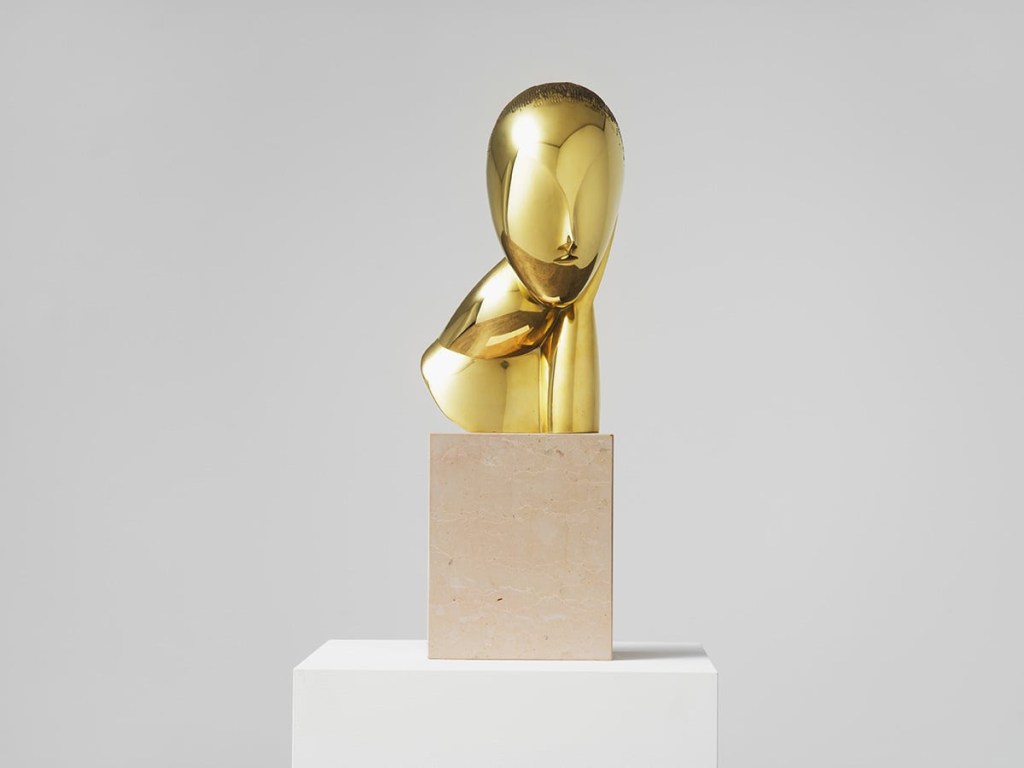
Two examples will be included in the exhibition: La muse endormie I (Sleeping Muse I) (1912), a plaster cast, and Une Muse (A Muse) (1918), a bronze sculpture mounted on a stone base. Their presentation offers an opportunity to consider Brancusi’s sustained experimentation with materials and the translation of an initial sculptural conception into different forms. His engagement with African and Cycladic fertility sculptures also provides an important historical context for understanding the symbolic dimensions of these works.
An additional focus is Brancusi’s graphic practice, represented by a group of previously unexhibited ink and gouache drawings dating from 1917 to 1925. Although he produced fewer than three hundred drawings throughout his career, these works constitute an important, if less frequently discussed, aspect of his output.
Personal notes, photographs and objects from Brancusi’s archive will further contextualise the exhibition, revealing the relationship between his artistic development and his continuing investigation of the muse. For Neutres, the concept of the ‘genetrix muse’ represents the central principle behind Brancusi’s search for an original artistic language, one whose influence continues to extend into contemporary artistic practice.
Image: Constantin Brancusi, Une muse, 1918 © Succession Brancusi – All rights reserved (ARS) / ADAGP, Paris.

