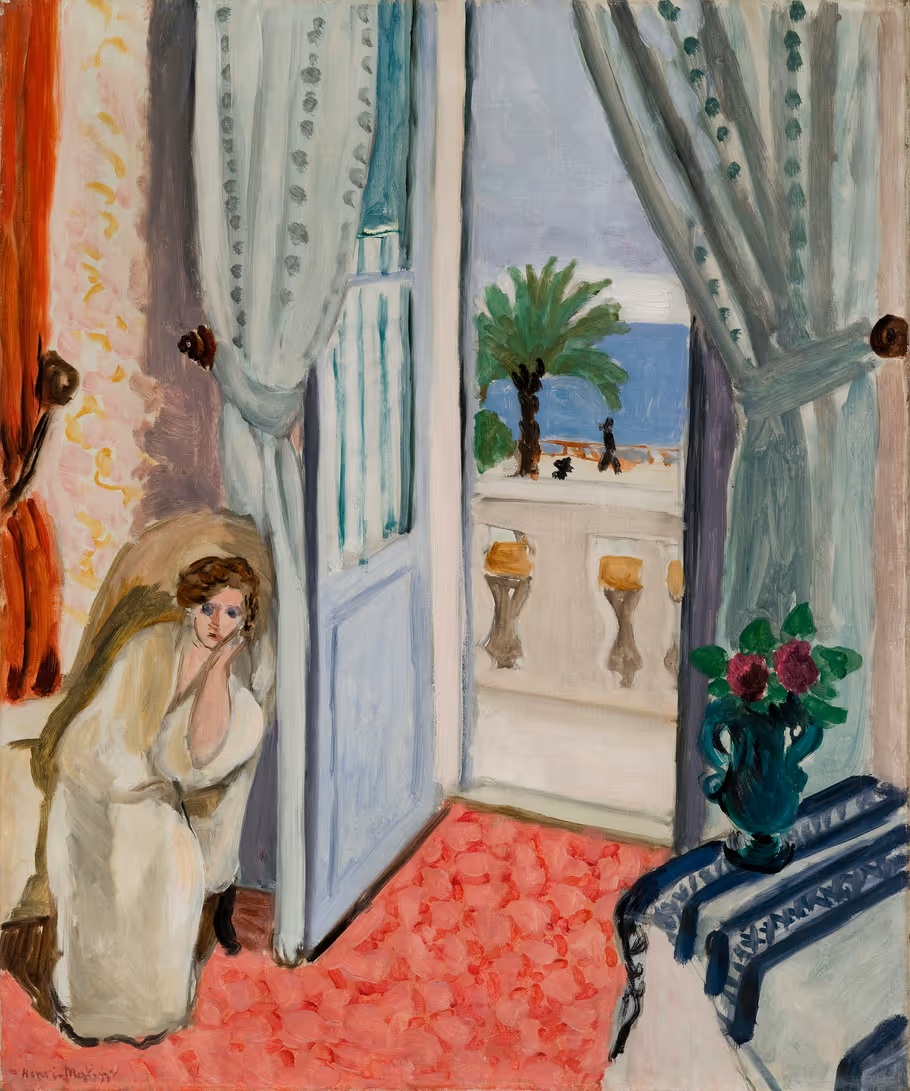
As London settles into its familiar grey winter skies, the Royal Academy of Arts offers a welcome escape to the sun-drenched shores of the Mediterranean with Painting the French Riviera, an extraordinary exhibition celebrating Provence and the Côte d’Azur and its enduring influence on modern art.
The exhibition opens brilliantly with Paul Cezanne, whose life in the South of France (he was from Aix en Provence and grew up to be friends with Emile Zola, also from Aix) would prove transformative for the history of modern painting. One of its great highlights is his masterpiece The Bathers (1890–92), a remarkable work that immediately establishes the artistic ambition and spirit of the exhibition. The human figures, the natural landscape and the interplay of colours come together in a composition that feels both timeless and strikingly modern. Rather than simply depicting nature, Cezanne reconstructs it through bold brushwork creating a new pictorial language that would profoundly influence generations of artists.
Cezanne began working in the small fishing village of L’Estaque, on the northwestern edge of the Bay of Marseille, in the 1860s. Drawn by the spectacular scenery, he found inspiration in the contrast between the calming beauty of the Mediterranean and the rugged, rocky hills of the Estaque mountain range. It was here that he began to develop the distinctive approach that would eventually change the course of modern art. Natural and architectural elements were reduced to geometric forms, while colour became a means of constructing volume, defining space and giving the landscape its extraordinary sense of solidity. His paintings were no longer simply representations of what he saw; they were investigations into how we perceive and experience the world.
The subject of the bather became particularly important to Cezanne during his years in L’Estaque, and would remain a recurring preoccupation until the end of his life in 1906. Reinterpreting a classical theme through an entirely modern sensibility, he placed the human figure within nature in a way that challenged traditional academic painting. The Bathers is a magnificent expression of this pursuit, revealing his fascination with the relationship between the body, landscape and pictorial structure. It is a wonderful way to begin an exhibition devoted to the artistic possibilities that the South of France would unleash.
Cezanne’s presence also attracted other leading artists to the region. In 1882, Pierre-Auguste Renoir joined him in L’Estaque, where the two painters worked side by side, each interpreting the surrounding landscape through a very different artistic language. Cezanne’s The Viaduct at L’Estaque (1882), with its angular forms, sharp diagonals and carefully constructed brushwork, offers an interesting contrast to Renoir’s softer, more fluid treatment of the countryside. On his return to Paris from Italy that year, Renoir wrote enthusiastically of the “lovely countryside”, and his paintings capture the gentle sunshine through a delicate palette of deep blues, greens and golden tones. He would later settle in Cagnes-sur-Mer, near Nice.
Claude Monet, however, would discover an entirely different world along this coastline, one that would challenge and excite him in equal measure. His first extended journey to the Côte d’Azur took place in January 1884. Completely captivated by the dazzling light, vivid colours and luxuriant vegetation, he spent the following ten weeks painting with extraordinary intensity. The result was an astonishing body of work: thirty-eight paintings in Bordighera, just across the French-Italian border, and a further eleven in and around Menton.
For Monet, this was a landscape unlike anything he had previously encountered. Accustomed to the shifting skies and cooler light of Paris, the Île-de-France and Normandy, he found himself confronted with a Mediterranean world of almost overwhelming brilliance. The intense blues, rich greens, warm earth tones and extraordinary clarity of the atmosphere demanded an entirely new approach to painting. His almost daily letters to his companion, and later wife, Alice Hoschedé, reveal his excitement at discovering this unfamiliar environment, but also his growing frustration at the difficulty of translating what he saw onto canvas. The Riviera offered an abundance of colour and light, yet capturing its fleeting effects proved a formidable challenge.
One of the particularly beautiful works in the exhibition is Cap Martin, near Menton (1884), painted during a two-week stay in April of that year. Monet found inspiration in Cap Martin, the pine-covered headland between Menton and Monte Carlo. The composition looks east across the bay towards the Maritime Alps, whose distant summits are barely suggested against the sky. Open ground, rocky shores and the movement of the wind are set against deep green foliage and the warm orange tones of the rocks. Much of the canvas is left remarkably bare, allowing the atmosphere and the light itself to become central to the composition.
Monet returned to the Côte d’Azur in 1888, this time travelling further southwest to Antibes (city where Nicolas de Staël committed suicide – later explored in the show), a small fortified town whose buildings and surrounding landscape appeared almost baked to a golden crust under the Mediterranean sun. The paintings produced during this visit are more expansive and serene, although behind their apparent tranquillity lay the artist’s continuing anxiety about his ability to capture the region’s extraordinary light and colour. Ultimately, however, Monet was pleased with what he achieved. Reflecting on his experience, he wrote: “What I will bring back from here will be sweetness itself, white, pink, blue, all of it enveloped in this fairy-like air.” It is difficult to imagine a more beautiful description of the Mediterranean atmosphere that runs through the exhibition.
Henri Matisse would also find a new artistic freedom in the South. His stay in Saint-Tropez in 1904, alongside his friend Paul Signac, proved particularly significant. The exhibition includes his Study for Luxe, calme et volupté (1904), a preparatory work for his Neo-Impressionist masterpiece of 1905. The title, meaning Luxury, Peace and Pleasure, is borrowed from Charles Baudelaire’s poem Invitation to the Voyage, immediately evoking the sensual atmosphere of an imagined Mediterranean paradise. Yet the landscape is not entirely imaginary: it is recognisable as the Bay of Saint-Tropez, where Matisse spent that summer.
The small dots of colour reveal the influence of Signac and the Pointillist technique, in which individual touches of colour combine to create a luminous whole. Matisse would soon find this approach too restrictive, moving towards the bold, expressive use of colour that would become the defining characteristic of Fauvism. The work is particularly fascinating because it captures an artist on the threshold of a major stylistic transformation, with the Riviera providing the setting for his experimentation.
Georges Braque’s Seascape, L’Estaque (1906) offers another compelling chapter in this evolution. Having met Matisse that year, Braque initially embraced the vivid, non-naturalistic colours pioneered by Matisse and André Derain during their time in Collioure. His Fauvist period was relatively short, however. Deeply influenced by Cezanne, he travelled to L’Estaque, returning to the landscape that had inspired his artistic predecessor. In this painting, bright Fauvist colours coexist with a strong underlying structure. The framing trees and receding planes create a sense of depth, while the composition already hints at the more radical developments that would soon follow. Cezanne’s influence would ultimately lead Braque and Picasso towards Cubism, making the Riviera an important starting point for one of the most significant artistic revolutions of the twentieth century.
Another wonderful discovery is Raoul Dufy’s Golfe Juan (1927). Having first travelled to the South of France in 1908 with Braque, Dufy returned after the First World War, increasingly fascinated by the Mediterranean light. He described its effect as leading naturally to “that feeling of calm, to that classical serenity” so different from the light of the North. During the 1920s, he developed a series of panoramic views, often looking out through windows onto the surrounding landscape. Golfe Juan is a particularly beautiful example: rather than offering a literal transcription of the view, Dufy uses colour and composition to capture the sensation of looking at the Mediterranean. The landscape becomes an experiment in light, atmosphere and perspective.
But the Riviera’s appeal extended far beyond the French avant-garde. For Pablo Picasso, who grew up in Málaga and Barcelona, the Mediterranean was an almost instinctive homecoming. Having moved permanently to France in 1904, he made his first visit to the Riviera in Saint-Raphaël in 1919, returning for holidays throughout the 1920s and 1930s before spending increasingly long periods in the South after the Second World War.
The exhibition beautifully evokes Picasso’s Mediterranean life, including photographs of the artist and his wife Olga Khokhlova, a dancer with the Ballets Russes, enjoying the beaches alongside the glamorous American socialites Gerald and Sara Murphy. Later, accompanied by his partner, the Surrealist artist Dora Maar, he became part of a more bohemian circle that included the poet Paul Éluard, photographer Lee Miller and writer Roland Penrose, who would later become his biographer. Their carefree summer holidays were even captured in an engaging amateur film by the Surrealist artist Man Ray.
For Picasso, the South of France was also a landscape filled with references to classical antiquity. The beaches became stages for imaginary scenes of nude bathers, sculptural busts and figures drawn from mythology. Fauns, centaurs, satyrs, goats and shepherds populated his imagination, appearing repeatedly in his paintings and works in other media. Speaking to Roland Penrose in the 1950s, Picasso remarked: “It’s strange, in Paris I never draw fauns, centaurs or mythological heroes like these… they always seem to live in these parts.” It is a charming insight into the almost magical relationship he felt with the Mediterranean landscape.
The exhibition also expands its perspective beyond the familiar names of French modernism, revealing how artists from across the world found inspiration, refuge and artistic freedom on the Riviera. Cosmopolitan Nice had been home to Russian communities since the mid-nineteenth century, when aristocrats helped establish its reputation as a fashionable destination. Following the First World War, the region became an important meeting point for artists whose backgrounds and experiences were as varied as their approaches to painting and sculpture.
The Finnish-born, Russian-trained Léopold Survage and his friend, the Ukrainian-born artist Alexander Archipenko, made significant advances in their Cubist paintings and sculpture. Chaim Soutine, who had emigrated from the Russian Empire, present-day Belarus, to Paris in 1913, found inspiration in the hillside landscapes of Cagnes-sur-Mer during the 1920s, translating them into dramatic compositions characterised by distortion and intense emotion. Marc Chagall, born in Russia, would spend the final thirty-six years of his life in the South of France, producing the colourful, poetic works for which he is so admired.
The Scottish Colourist John Duncan Fergusson, alongside African American artists William H. Johnson and Beauford Delaney, also found inspiration in the region. Their work demonstrates how the Riviera’s extraordinary light and landscapes could be interpreted through very different cultural experiences and artistic sensibilities. For many of these artists, the South offered not only a stimulating natural environment but also a sense of liberation from the cultural, religious, racial and political constraints they encountered elsewhere.
Yet one of the exhibition’s most delightful dimensions is its exploration of the Riviera beyond the canvas. As the region evolved from a winter retreat for wealthy aristocrats into an international summer playground, its influence extended into cinema, literature, fashion and popular culture. The Côte d’Azur gradually became synonymous with a particular vision of effortless sophistication: elegant hotels, glamorous beach clubs, sun-soaked terraces and the romance of Mediterranean living.
A dedicated Chanel room is a particularly charming highlight, transporting visitors into the world of Riviera fashion. Costumes and swimming suits evoke an era when the beach became as much a stage for style as the grand hotels and fashionable promenades. The display captures the relationship between fashion and the changing culture of leisure, recalling the freedom, elegance and understated chic that became synonymous with the South of France.
The exhibition’s final rooms are, however, perhaps its most memorable. A spectacular presentation of works by Nicolas de Staël offers an extraordinary finale, bringing together the intensity of Mediterranean colour and the emotional power of abstraction. Born in St Petersburg in 1914 into an aristocratic family that fled Russia following the Revolution of 1917, de Staël studied art in Brussels before travelling extensively throughout Europe. During the Second World War, from 1940 to 1943, he lived in Nice, alongside other artists seeking refuge in the so-called Free Zone of occupied France, before returning to Paris.
In the early 1950s, de Staël rediscovered the South. In 1952, he spent several weeks in Le Lavandou, a fishing village west of Saint-Tropez, where the Mediterranean light had an immediate and powerful effect on his work. “The light here is simply dazzling, much more so than I remembered,” he wrote to his art dealer Jacques Dubourg. His studies of the beach and surrounding landscape became the foundation for larger compositions that he subsequently developed in his Paris studio.
His Landscape (1952), shown in the exhibition, is a wonderful expression of this renewed fascination with the Mediterranean. Built from expressive passages of colour, the painting conveys the energy of the landscape without relying on conventional representation. De Staël’s distinctive technique, with its thickly applied paint and bold, architectural blocks of colour, gives the composition an extraordinary physical presence.
In 1953, he bought a house in Ménerbes, Provence, before moving to Antibes between the autumn of 1954 and the spring of 1955. It was an extraordinarily productive period: he created more than 350 paintings, responding to the sea, the surrounding landscape and the ever-changing quality of the light. Yet these final works also reveal a remarkable transformation in his artistic language. The thick impasto and vibrant tones of his earlier paintings gradually give way to quieter, more contemplative compositions, with fluid washes of cooler colour. His View of Marseille (1954) borrowed from LACMA, is another important work in this final chapter.
Tragically, it was in Antibes that de Staël took his own life in 1955, aged just forty-one. Knowing this lends the paintings an additional emotional intensity. There is something deeply moving about encountering these works in the context of the landscape that inspired them, and witnessing the extraordinary productivity and artistic evolution of his final years.
The presence of Yves Klein adds another extraordinary dimension to this closing encounter. His unmistakable blue, so intimately associated with the Mediterranean imagination, creates a striking dialogue with de Staël’s expressive treatment of colour and landscape. Together, the two artists bring the exhibition to a breathtaking conclusion, leaving visitors with a renewed appreciation of the Riviera’s capacity to inspire radically different artistic visions. The final room is spectacular, and one of those rare exhibition experiences that stays with you long after you have left. Yves Klein is associated to the city of Nice which has a museum dedicated to the artist.
What makes Painting the French Riviera so compelling is precisely this dialogue between art and life. It reveals how a stretch of Mediterranean coastline became a crucible for modernism, a meeting point for international artists and, ultimately, one of the world’s most enduring cultural fantasies. The artist that’s missing, though is, Van Gogh who travelled and painted the nearby city of Les Saintes Maries de la Mer.
An invitation to travel through more than a century of artistic history, and undoubtedly one of the Royal Academy’s most captivating exhibitions this winter. A stunning show!
–
Image: Oil on canvas. 66.7 x 54.9 cm. Saint Louis Art Museum, Museum Purchase. © 2026 Succession H. Matisse / Artists Rights Society (ARS), New York

