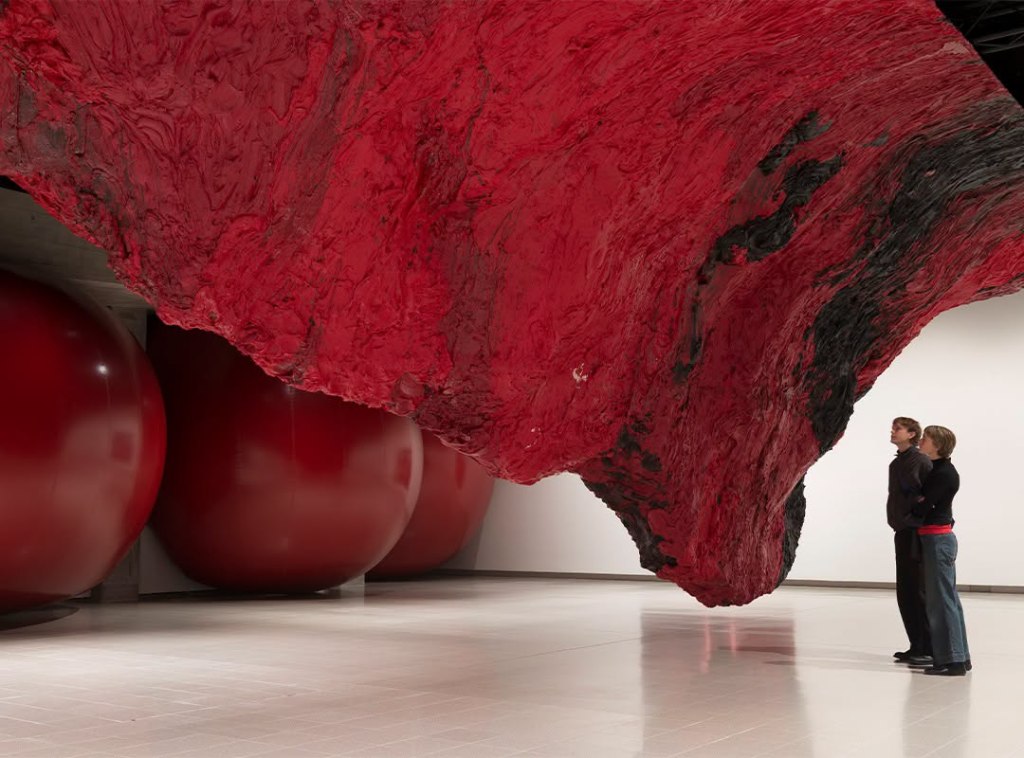
Only a few more days to visit the remarkable Anish Kapoor exhibition on view at Hayward Gallery until 18 October 2026. Curated by Ralph Rugoff, the exhibition brings together new and seminal works across the gallery’s exhibition spaces and terraces, offering a focused look at Kapoor’s continuing investigation into scale, perception, material and space.
Kapoor is one of the most internationally recognised artists of his generation. Over more than four decades, he has worked across sculpture and painting, experimenting with materials including stone, steel, pigment, resin, silicone and, more recently, Vantablack, the exceptionally light-absorbing material that has become closely associated with some of his work.
At the Hayward, several monumental sometimes scary, works dominate the exhibition. One of the most striking is a new installation consisting of an enormous inflated PVC membrane that fills a six-metre-high gallery. Its scale changes the proportions of the room and creates an immediate relationship between the sculpture and the viewer.
Another new work places a dark, mountainous form within a large field of red pigment. The installation demonstrates Kapoor’s longstanding interest in creating environments in which sculpture moves beyond the boundaries of a conventional standalone object.
Among the key works in the exhibition is Mount Moriah at the Gate of the Ghetto (2022), which is suspended from the ceiling and positioned just above the Hayward’s floor. This is one of the first monumental works in the exhibition, following a room dedicated to black works that play with viewers’ senses. The exhibition includes works exploring Kapoor’s use of optical illusion. His void sculptures appear to contain extraordinary depth despite their physical limitations, challenging the viewer’s perception of surface and space. Other works are coated in Vantablack, a material capable of absorbing almost all visible light. Seen from certain angles, the resulting surfaces appear almost completely flat, making the underlying three-dimensional form difficult to perceive.
Outside on the Hayward’s terraces, large mirrored stainless-steel sculptures extend this investigation into perception. Their reflective surfaces incorporate the surrounding architecture, sky and city, changing according to the viewer’s position and the conditions around them. It’s always a pleasure to be on the gallery’s terrace overlooking the National Theatre and London’s landscape.
Alongside these large-scale installations, the exhibition presents paintings and sculptures made over the past decade using silicone, resin and pigment. These works are notably more visceral, with forms that suggest flesh and internal anatomy recalling wounds and human forms. Both mesmerizing and disgusting.
The exhibition demonstrates how consistently Kapoor has used materials not simply for their visual qualities, but for their ability to affect the viewer’s perception. A black surface can appear to become a void; a mirrored sculpture can alter the surrounding landscape; an object suspended above the floor can challenge our expectations of weight and gravity.
The Hayward itself plays an important role in this presentation. Its distinctive concrete architecture, large galleries and outdoor terraces provide Kapoor with a particularly appropriate setting for works that depend on scale and their relationship with architectural space. Rather than treating the gallery simply as a neutral backdrop, the exhibition makes the building an active part of the viewing experience. Kapoor himself spent time on the navigation in the building for the show.
The exhibition demonstrates his continuing interest in the fundamental questions of sculpture: how an object occupies space, how materials affect perception, and how the relationship between artwork and viewer can be altered through scale, colour, light and form. A must-see before it closes this season!
–
Image: Anish Kapoor, 2026. © Anish Kapoor. All rights reserved, DACS, 2026. Photo: Dave Morgan.

