The relationship between fashion and art is at the centre of Schiaparelli: Fashion Becomes Art, the exhibition at the Victoria and Albert Museum dedicated to the Italian couturier Elsa Schiaparelli. Tracing the history of the house from its beginnings in the 1920s to its contemporary incarnation under creative director Daniel Roseberry, the exhibition examines a practice that consistently challenged the boundaries between clothing, sculpture, photography and design. This show, is an absolute must-see!
Born in Rome in 1890, Schiaparelli established her fashion house in Paris, where she developed a distinctive visual language informed by the artistic avant-garde. Her designs challenged conventional ideas of elegance through unexpected forms, experimental textiles and an engagement with Surrealism. For Schiaparelli, fashion was not simply a question of silhouette, but a means of exploring the relationship between the body, and visual expression.
Her collaborations with artists were central to this approach. Salvador Dalí, Jean Cocteau, Man Ray, Meret Oppenheim, Leonor Fini, and René Magritte were among the figures whose work intersected with her own, creating a dialogue between haute couture and the artistic movements that shaped interwar Paris.
Among the exhibition’s highlights are the Skeleton Dress and Tears Dress, created in collaboration with Dalí in 1938. The former uses padded anatomical forms to outline the human skeleton against black fabric, while the latter employs trompe-l’œil imagery to suggest torn material and exposed flesh. Both demonstrate Schiaparelli’s interest in disrupting conventional perceptions of the dressed body.
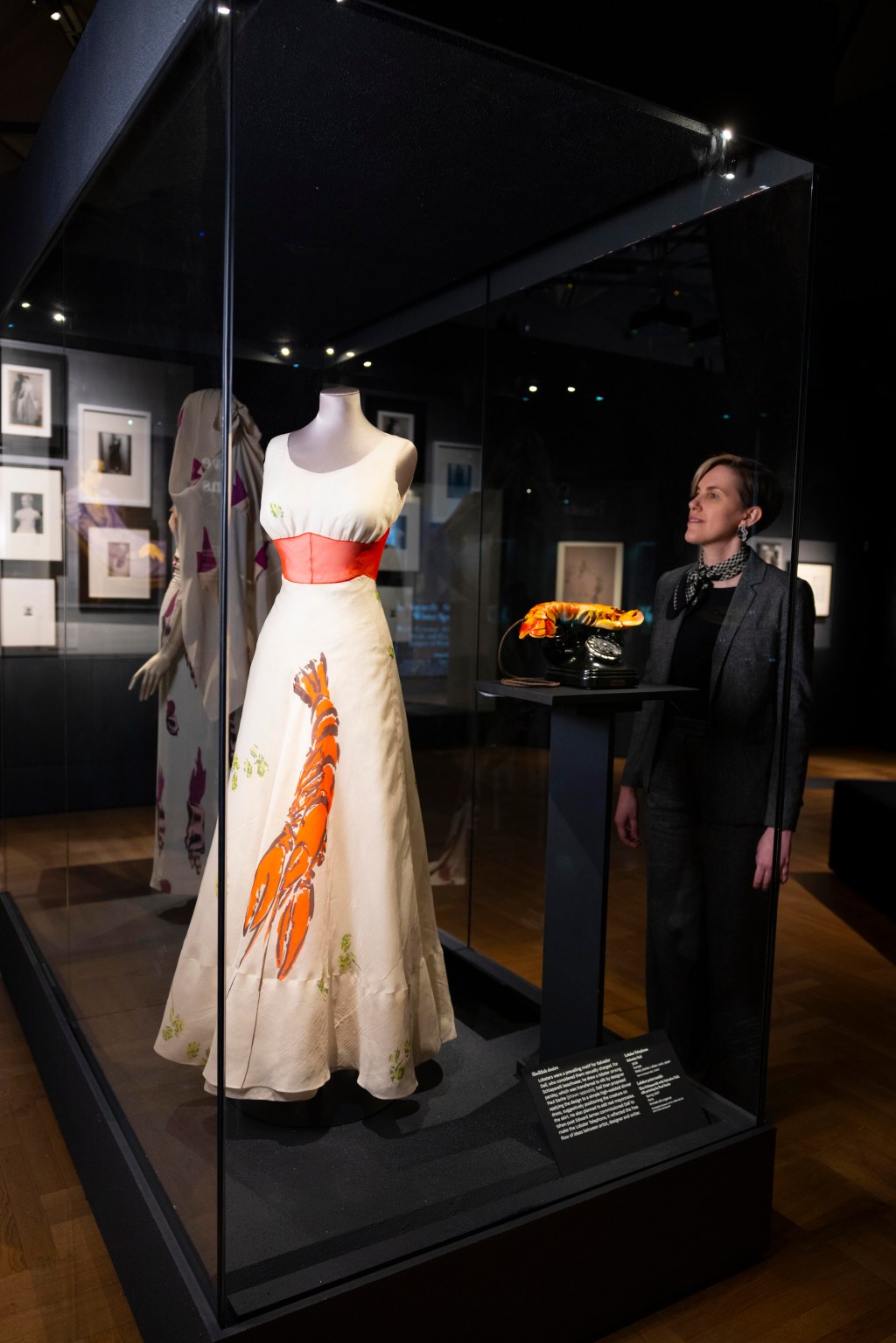
Central to the show are Schiaparelli’s Lobster Dress (1937) and Salvador Dalí’s Lobster Telephone (1936). Created in collaboration with Dalí, the dress features a striking red lobster printed on white silk organza and was famously worn by Wallis Simpson for a photograph by Cecil Beaton in Vogue. Dalí’s telephone, meanwhile, transforms an everyday object into a Surrealist sculpture by placing a lobster across its receiver. Together, the works illustrate how Schiaparelli and Dalí challenged conventional boundaries between fashion and art, transforming an unexpected motif into two enduring icons of Surrealist creativity.
Yet the exhibition extends beyond these celebrated garments to reveal the breadth of Schiaparelli’s artistic network. When she moved her couture house to 21 Place Vendôme, she commissioned the designer Jean-Michel Frank to create its interior. Frank, in turn, invited sculptor Alberto Giacometti to contribute the light fixtures. Their shell-like forms, positioned atop simplified Doric columns, became dramatic focal points within a modernist setting. The episode reveals how Schiaparelli’s interest in artistic collaboration extended into the architecture and interiors of her business, making the fashion house itself part of her creative vision.
The human body remained a recurring subject throughout her work. Schiaparelli’s gloves, in particular, exploited the uncanny resemblance between a glove and a disembodied hand. She first introduced gloves with faux fingernails in 1928, returning to the idea for her Winter 1936 collection after Man Ray photographed hands painted to resemble gloves by Pablo Picasso. The motif also appeared in her jewellery. In a striking portrait of photographer Dora Maar, Man Ray superimposed a Schiaparelli brooch depicting two entwined hands, echoing the position of Maar’s own hand while disrupting the viewer’s sense of scale. These images demonstrate how fashion accessories could become integral to a wider Surrealist exploration of the body and its representation.
Photography was an essential part of Schiaparelli’s visual language, with figures including Man Ray and Irving Penn helping to establish the distinctive imagery associated with her creations.
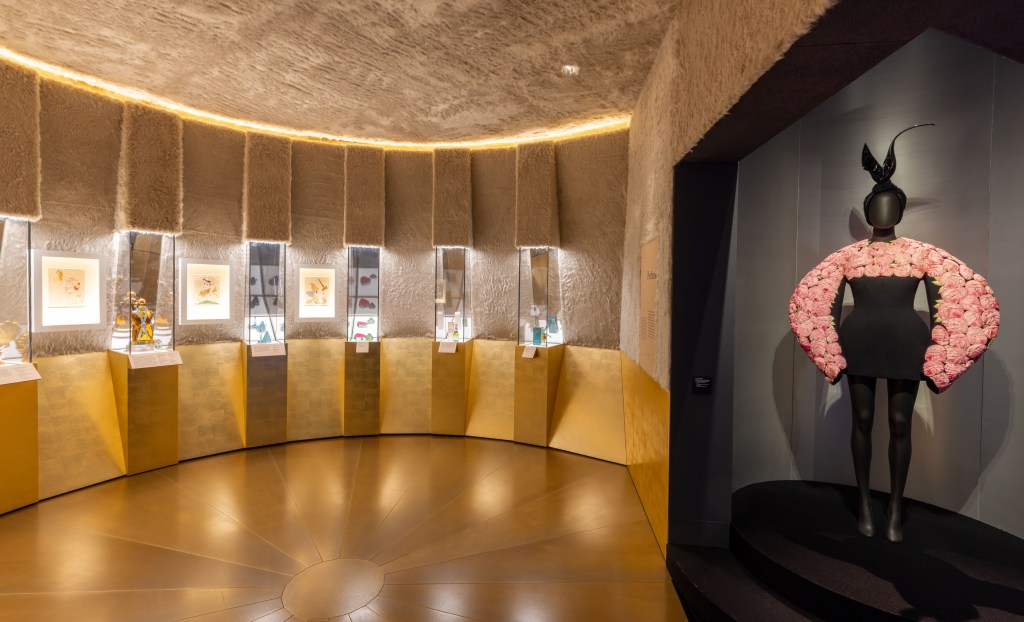
This approach extended to her perfumes. Snuff, Schiaparelli’s only fragrance for men, was presented in a pipe-shaped bottle and sold in a tobacco box. The design alludes to Magritte’s 1929 painting The Treachery of Images, which depicts a pipe accompanied by the words “This is not a pipe”. By translating the artist’s questioning of representation into a commercial object, Schiaparelli brought Surrealist ideas into everyday life. The perfume room, which showcases all of Schiaparelli’s designs with artists is a highlight of the show.
Her most famous perfume, Shocking, offered another example of the intersection between art, fashion and commercial design. Schiaparelli commissioned her friend, the artist Leonor Fini, to design its bottle, whose shape was inspired by the dress form of actress Mae West, which stood in the couturier’s atelier. A measuring tape encircled the shoulders, connecting the object directly to the world of dressmaking. Although Fini was disappointed when small flowers were added to the design by Schiaparelli’s commercial director, the bottle became an enduring expression of the house’s unconventional approach.
Illustrator and costume designer Marcel Vertès subsequently created advertisements for Shocking, introducing humour and theatricality to the campaign. His illustrations placed the perfume bottle in unexpected settings, including a painter’s studio and a horseracing track, extending Schiaparelli’s Surrealist sensibility into the world of graphic design and advertising.
The exhibition also considers the wider cultural context in which her work circulated, including the opening of the London International Surrealist Exhibition in 1936. Artist Sheila Legge marked the occasion with a performance in Trafalgar Square, appearing in a white silk dress, long black gloves and a mask of paper roses. Photographed by Claude Cahun, the image of Legge as a Surrealist phantom evokes the dreamlike and unsettling imagery associated with the movement, illustrating how fashion, performance and photography could converge in the public sphere. The relationship with London is cleverly presented in the show.
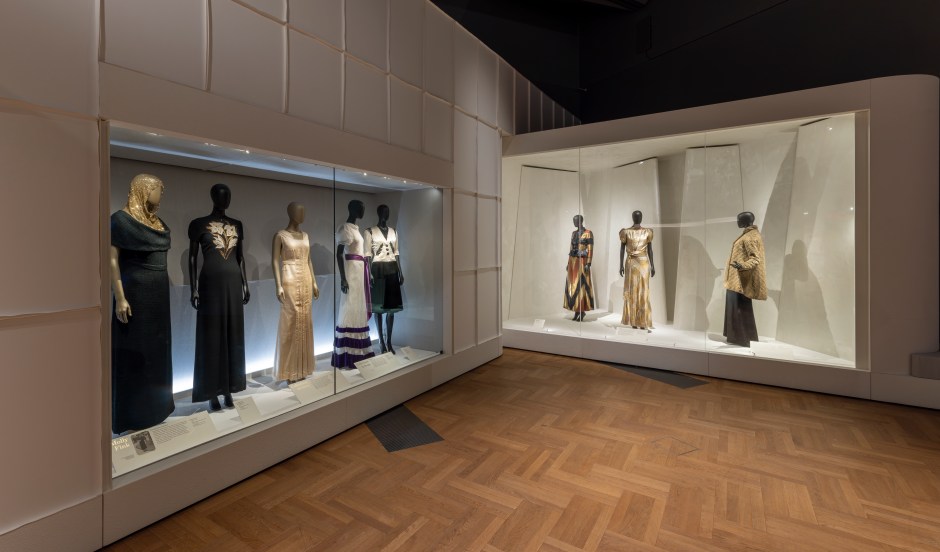
The exhibition also traces Schiaparelli’s influence through the women who wore her designs. Historic garments associated with Marlene Dietrich and Vivien Leigh sit within a wider story of the house’s appeal to performers and public figures. The presence of dresses worn by contemporary stars including Ariana Grande, Dua Lipa and Cardi B demonstrates the continuing relevance of its theatrical approach to dressing. From Hollywood’s golden age to the spectacle of contemporary music and performance, Schiaparelli’s creations have offered a means of constructing a distinctive public image.
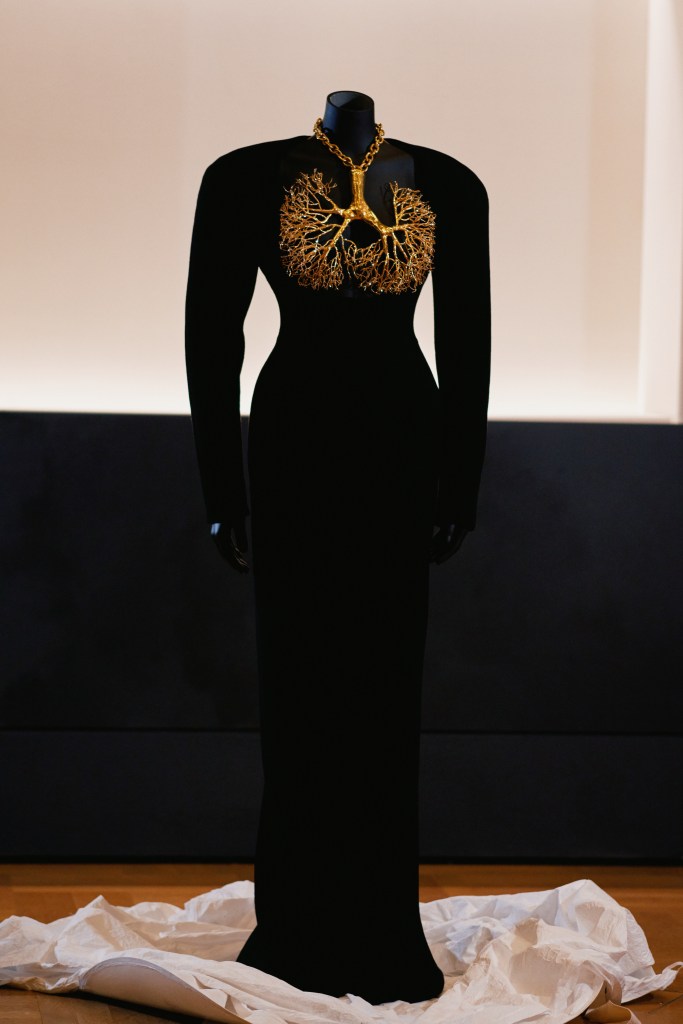
The final chapter brings the story into the present with a majestic final room, through Daniel Roseberry, who has led the house since 2019. His sculptural silhouettes, exaggerated anatomical forms and elaborate gilded embellishments draw on the Surrealist foundations established by Schiaparelli while introducing a contemporary sensibility. His designs continue to position the body as a site for artistic experimentation, demonstrating how the house’s original codes can be reinterpreted for a new generation.
What emerges from the exhibition is a portrait of a designer whose ambition extended far beyond the production of clothes. Schiaparelli cultivated relationships with artists, photographers, sculptors and illustrators, bringing their ideas into contact with the techniques of haute couture. Whether through a glove transformed into an uncanny hand, a perfume bottle inspired by a painting or a couture interior conceived with leading figures of modern design, her work consistently challenged the distinctions between art and everyday life.
Her enduring significance lies in Schiaparelli’s ability to transform the familiar into something unexpected, establishing a legacy that continues to shape the visual language of contemporary couture.
Schiaparelli: Fashion Becomes Art is on view at the V&A South Kensington, London, until 15 November 2026.
–