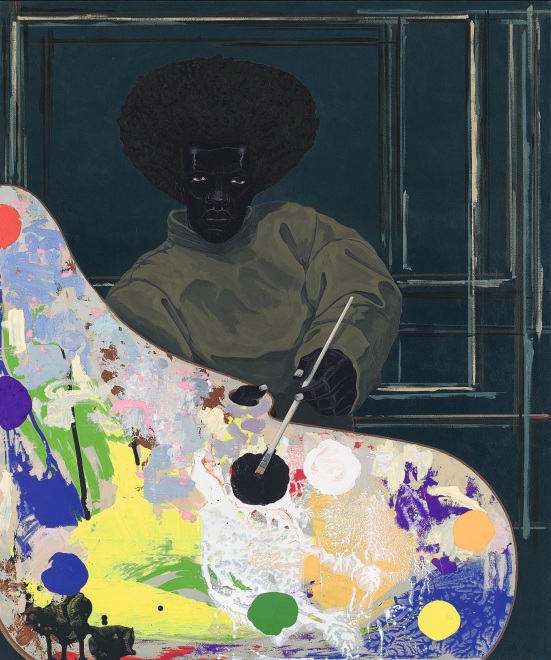
Kerry James Marshall: The Histories is the first exhibition in France devoted entirely to the American artist, bringing together seventy works spanning more than four decades of his practice, including eight new paintings made specifically for this show. Taken as a whole, the exhibition circles one central concern: who has historically been included in the story of art, who has been left out, and what happens when those omissions are addressed at full scale. The show, reincarnated here, was a huge success when presented in London.
Marshall was born in Birmingham, Alabama, in 1955, and has spent his career placing Black figures at the center of subjects and painting traditions from which they were long excluded. His works tend to be large, theatrical, and meticulously composed: people relaxing in parks, getting their hair done, sitting in domestic interiors, occupying classrooms, sharing quiet moments of closeness. In his hands, these everyday scenes are elevated to vibrant scenes.
Organised by the Royal Academy of Arts in London together with the Kunsthaus Zürich and the Musée d’Art Moderne de Paris, the show is structured both chronologically and thematically, unfolding across eleven groupings of work. Instead of walking through his career as a tidy, linear progression, it lets recurring ideas resurface throughout, questions about representation, memory, art-historical inheritance, and how images themselves get built.
The exhibition opens with pieces from the 1980s, among them Invisible Man (1986), a response to Ralph Ellison’s 1952 novel. Already here, one of Marshall’s defining techniques is visible: his use of black pigment isn’t flat or uniform but built from layered mixtures of black with other colors, giving his figures an unusual density and visual charge. These early works pose a question that runs through the rest of the show, what does it mean to paint people who have so often been sidelined, caricatured, or simply absent from art history?
A recurring strategy throughout the show is Marshall’s engagement with nineteenth- and early twentieth-century European painting, particularly Manet, Caillebotte, and Seurat, whose scenes of modern urban life become reference points for his own monumental paintings of salons, parks, and public space. The implicit question is what these familiar genres of painting might have looked like had Black life been granted the same central, monumental treatment all along. Crucially, these aren’t simple homages or quotations, Marshall adopts the conventions of the canon and reassigns who gets to occupy them: a park scene becomes an assertion of presence, a hair salon is rendered with the gravity of grand history painting, a couple is painted with the visual language once reserved for eighteenth-century European portraiture.
Later galleries turn to art education itself. In The Academy (2012), a nude model posing for a life-drawing class raises his fist in the Black Power salute, turning a familiar academic setup into something charged and unexpected. Elsewhere in the show, Marshall’s references widen further, pulling in Afro-futurism, comic books, and science fiction alongside his art-historical touchstones, so that Manet, and speculative futures all coexist within the same body of work. Stunning works!
Kerry James Marshall: The Histories runs September 18, 2026 – January 24, 2027 at the Musée d’Art Moderne de Paris, 11 Avenue du Président Wilson, Paris 16th.
–
Image: Untitled — Acrylique sur panneau de PVC — Harvard Art Museums/Fogg Museum, Cambridge, MA. Richard Norton Memorial Fund, acquis grâce à la générosité de Nancy B. Tieken — © Kerry James Marshall Photo © President and Fellows of Harvard College

