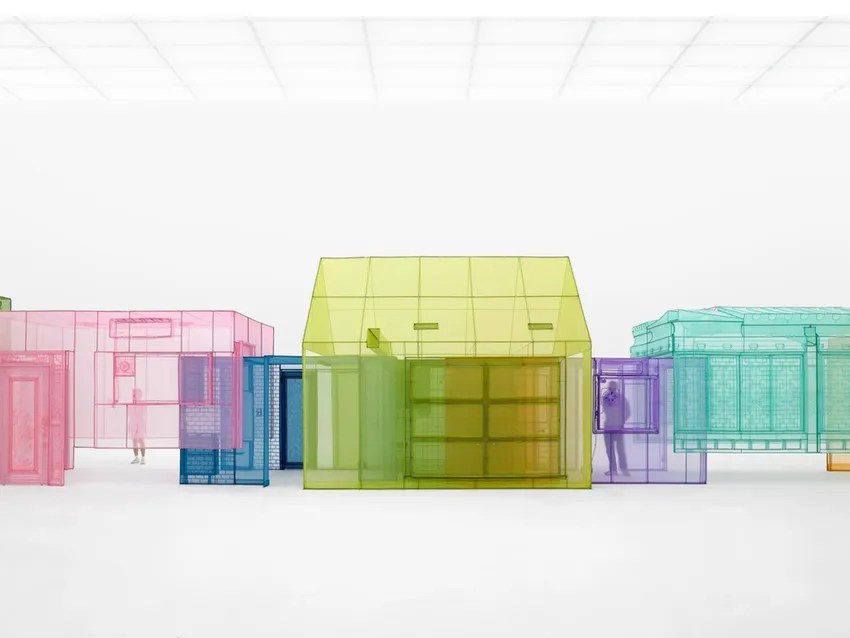
Do Ho Suh returns to Seoul this season with the largest survey of his career to date, opening at the National Museum of Modern and Contemporary Art (MMCA) Seoul running to 9 February 2027. Spread across Galleries 3, 4 and 5, the Seoul Box and the MMCA Studio, the exhibition traces four decades of a practice built almost entirely around a single question: what does it mean to carry the idea of home with you when home itself keeps changing?
Suh’s early paintings, rarely shown in this context, open the exhibition and reveal an artist working through ink, watercolour and acrylic on mulberry paper well before the fabric architecture he later became known for. From there, the show moves into the small, wry gestures that run through his career, a rubber doormat printed with the words “Leave Me Alone,” a pair of hand-painted circular panels titled Cake, before arriving at the muslin-and-zipper room construction Room 516/516-I/516-II, an early study in the translucent, tent-like structures that would come to define his signature style.
The exhibition’s centre of gravity, though, is the artist’s ongoing engagement with the houses he has actually lived in. Rubbing/Loving: Seoul Home, worked on between 2013 and 2022, reproduces a traditional Korean house at full scale in graphite rubbed onto mulberry paper, mounted on stainless steel wire and lit from within, a ghost of a building rendered solid enough to walk through. Its counterpart, Rubbing/Loving: Company Housing of Gwangju Theater, applies the same rubbing technique to a very different structure, its blackened graphite panels arranged in the format the artist developed for a presentation at Tate Modern in 2025.
Perfect Home: London, Horsham, New York, Berlin, Providence, Seoul, a vast 2024 installation in polyester and stainless steel, extends this idea outward, stitching together the floor plans of every home the artist has occupied into a single continuous structure large enough to walk into, less a single house than a map of a life spent moving between them. Nearby, works on paper such as Blueprint, Staircase and Haunting Home use thread embedded in handmade STPI cotton paper to trace the architecture of memory in a more fragile register, while the 2025 marker drawing Walk the House distills the same preoccupation into a single, spare gesture.
The exhibition also makes room for Suh’s video and print work, including Bridge Project, a 2024 single-channel video installation first shown at the Art Sonje Center in Seoul, and the digital vinyl print Who Am We?, a 2000 work whose surface, made up of thousands of tiny individual faces, rewards close inspection as much as distance.
Taken together, the works on view in 서도호 (Do Ho Suh) make the case that this is an artist less interested in buildings than in what buildings hold onto: the residue of the people who lived in them, and the strange, portable weight of a place we no longer live but never quite leave.

