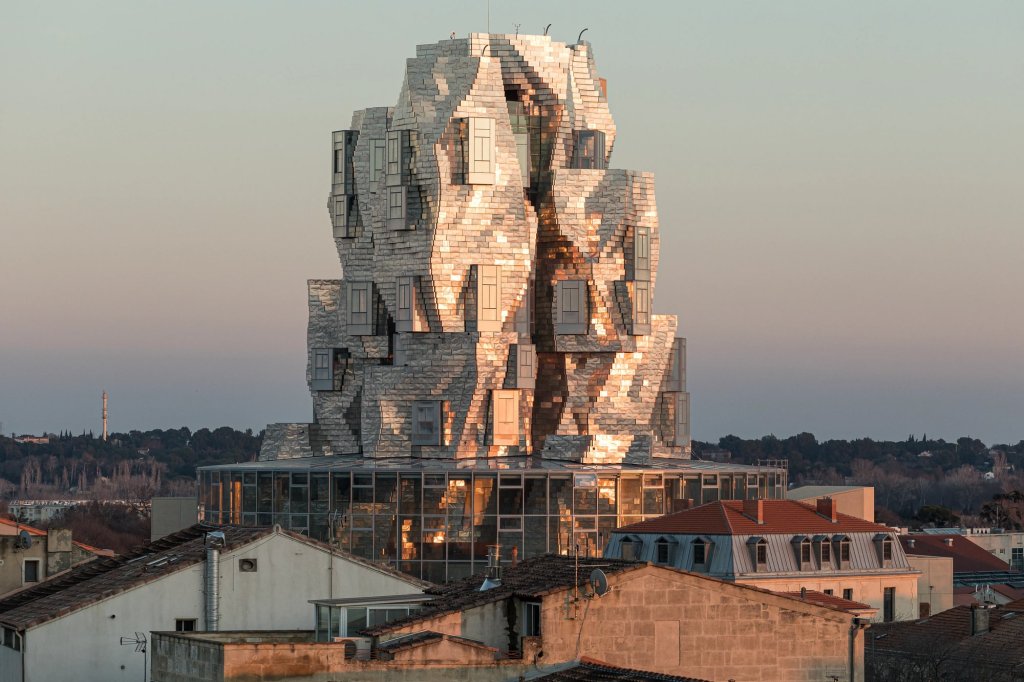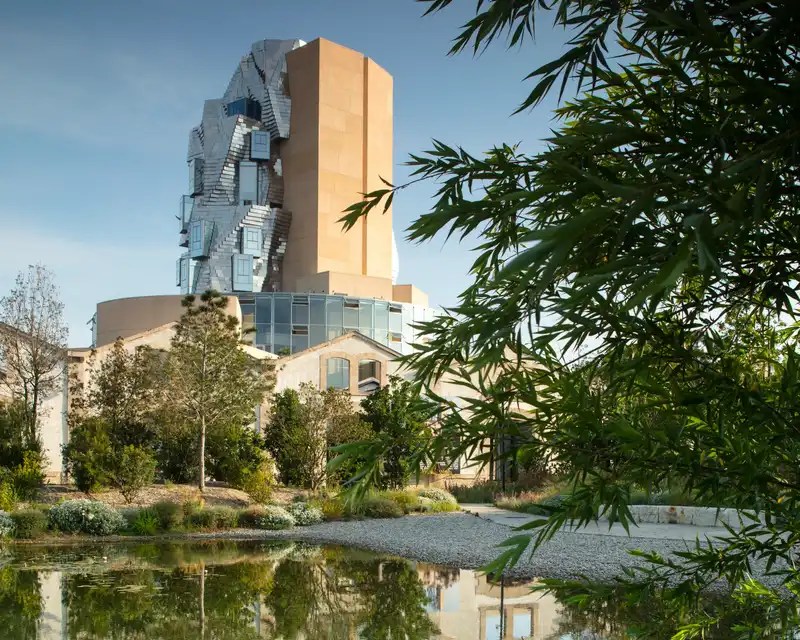
This season, LUMA Arles brings together a diverse programme spanning contemporary art, photography, architecture, film and publishing. Across the Parc des Ateliers and Frank Gehry’s golden distinctive tower, the LUMA Foundation presents exhibitions by Camille Henrot, Julianknxx and Gerhard Richter, alongside a centenary exhibition dedicated to Cahiers d’Art, an archival project focused on Zaha Hadid, a display honouring Stan Douglas, and CORRESPONDENCES, an immersive collaboration between Patti Smith and Soundwalk Collective. The programme is one of the best this summer.
Running through many of the exhibitions is an interest in memory, transmission, ecology and the ways artists respond to a rapidly changing world in the wonderful city of Arles; perfect for a long weekend or a proper holiday.
Julianknxx: Memory and Transmission
Among the season’s highlights is In Search of… Incredible by Julianknxx, a multidisciplinary artist and filmmaker whose work explores migration, diaspora, memory and cultural identity through film, sound, sculpture and poetry.
Developed during the artist’s LUMA Arles residency, the exhibition considers how memories and traditions are passed between generations. Its starting point is a personal story: Julianknxx’s mother sent him a sculpture based on drawings created through an exchange between them in The Gambia. Made by local carpenters from rosewood, the sculpture travelled from The Gambia to London, becoming both an artwork and a physical record of their relationship.
This idea of transmission runs throughout the exhibition. Julianknxx works with sculpture, found objects, film and sound to explore how cultural memory changes as it moves between places and generations. Rather than presenting heritage as something fixed, he approaches it as something continually transformed through storytelling, through personal experience.
Sound is particularly important. Songs, oral histories and recordings function as forms of cultural preservation, including lullabies developed with the Boras Choir in Marseille that draw on Comorian traditions and histories of migration. A performance with the Choir will be staged in early September.
Materials also carry symbolic meaning. Salt, which appears throughout the exhibition, refers to preservation, the sea, tears and labour, while also evoking the history of colonial trade, resonating with the Camargue region. Through these materials and stories, In Search of… Incredible considers what survives when people and cultures are separated by geography and time.
The exhibition is ultimately an exploration of memory as a living process: something that is carried, adapted and passed on rather than simply preserved. The film, the sound and installations are stunning and one of the best shows of this summer’s programme at LUMA.
Camille Henrot: Ecology and Care
Camille Henrot’s In the Veins takes a very different approach to the question of inheritance, focusing on the relationship between parenthood, childhood and the climate crisis. Henrot remains one of the most famous French artists today.
The film examines what it means to raise children at a time of environmental uncertainty and mass extinction. Henrot uses familiar images from childhood, including animals found in books, toys and educational material, to consider the disconnect between the natural world children are taught to imagine and the increasingly fragile ecosystems they will inherit. A simple yet so efficient idea.
The work explores ecological grief, reflecting on the emotional consequences of witnessing environmental degradation. Rather than focusing on climate change through statistics or large-scale political imagery, Henrot approaches it through everyday experiences of care.
Wildlife rehabilitation centres feature in the film, providing a direct connection between environmental damage and acts of protection and recovery. For Henrot, caring for children and caring for the natural world share a similar structure: both require patience, attention and repeated acts of responsibility. The parallels are striking and clearly genius.
Time is another central theme. Childhood develops gradually, while ecological change can also occur incrementally, making both difficult to perceive in the moment. Henrot uses this parallel to reflect on what one generation passes to the next.
In the Veins acknowledges ecological loss while focusing on the possibility of care rather than simply presenting a narrative of catastrophe. And it’s powerful.
Patti Smith and Soundwalk Collective: CORRESPONDENCES
In the spectacular Grande Halle of the campus, LUMA presents CORRESPONDENCES, the ongoing collaboration between Patti Smith and Soundwalk Collective’s Stephan Crasneanscki. The project, which has developed over more than a decade, brings together field recordings, moving images and Smith’s poetry to explore landscapes shaped by artistic creation, political struggle and environmental change. It echoes the local landscape of Arles and Saintes Marie de la Mer.
For LUMA Arles, the project includes the complete body of film works created to date, alongside a new commission focused on the Camargue. The region becomes a sonic landscape in its own right, explored through recordings that reflect the ways environmental and human forces continue to reshape it.
Smith’s role extends beyond music. A writer, artist and performer, she brings literature, personal memory and spoken word into dialogue with Soundwalk Collective’s immersive soundscapes. The installation creates connections between distant places and histories, using sound as a means of carrying memory and drawing attention to landscapes and cultures at risk of disappearing.
The exhibition opened on July 4 and continues until November 8, 2026. It was accompanied by live performances by Smith and Soundwalk Collective during the opening weekend, extending the project from installation into performance with literal references to Pasolini and his death, Marie Madeleine’s journey throught to the nearby Sainte Baume Mountain and Camargue’s incredible natural landscape.
Smith also appeared at LUMA in July for a book signing marking the publication of her memoir Bread of Angels, adding a literary dimension to a programme already concerned with memory, personal history and the passage of time. She was also featured in this year’s Vatican Pavilion at La Biennale de Venezia.
Gerhard Richter and the Question of the Image
Gerhard Richter’s Overpainted Photographs explores the relationship between photography and painting. Richter works directly onto photographic prints, applying paint that partially obscures or transforms the original image.
The resulting works sit between documentation and abstraction, questioning the reliability of photography as a record of reality. The exhibition also reflects Richter’s long-standing interest in memory, perception and the limits of representation. This show is presented in one of the most important rooms of the LUMA Foundation.
100 Years of Cahiers d’Art
LUMA also celebrates the centenary of Cahiers d’Art, the influential French art journal and publishing house founded in 1926.
The exhibition draws on the publication’s extensive history and archives, exploring its role in documenting and shaping modern and contemporary art. It forms part of LUMA’s broader interest in the idea of the “living archive”, in which historical material is revisited and placed in dialogue with the present.
Zaha Hadid: Experimentation and Architecture
The Hans Ulrich Obrist Archives presents I Think There Should Be No End to Experimentation, dedicated to Zaha Hadid.
The exhibition focuses on Hadid’s drawings, paintings, notebooks, films and archival material, highlighting the experimental side of a practice better known for its radical buildings. Her early paintings, influenced by Suprematism and Constructivism, allowed her to explore fragmented perspectives, movement and unconventional approaches to architectural space. Drawings, archives and other material showcase the genius of the architect.
Stan Douglas
Stan Douglas’s Bodies Never Lie brings together photography and moving image to explore the ways history is constructed, represented and remembered. At its centre is Exquisite Corpse, a new multi-channel video installation commissioned by LUMA Arles and set in 1950s Francoist Spain. Drawing on flamenco as both a cultural tradition and a tool of political representation, Douglas examines how the regime censored and reshaped the genre as part of a standardised vision of Spanish national identity. Arles celebrates Flamenco every April and September with La Ferias.
Through staged imagery, sound and performance, the artist looks at the tension between official narratives and lived experience, while the body becomes a form of historical record. The exhibition also features three photographic series, extending Douglas’s interest in the relationship between image, performance and collective memory. On view at La Mécanique Générale to January 10, 2027, Bodies Never Lie offers a compelling reflection on how cultural and political histories are shaped.
Taken together, the 2026 programme reflects LUMA Arles’s interest in the connections between different artistic disciplines and forms of knowledge.
Julianknxx considers how cultural memory survives through objects, sound and storytelling. Henrot examines the ecological inheritance being passed to future generations. Patti Smith and Soundwalk Collective use sound, poetry and film to connect memory with changing landscapes. Richter questions the authority of the photographic image, while Cahiers d’Art turns an archive into a record of a century of artistic exchange. Hadid’s drawings, meanwhile, reveal architecture as a space for continual experimentation and Stan Douglas’ show explores political resonance.
–