For more than half a century, Les Rencontres d’Arles has made the city its exhibition space, placing photographs in former churches, cloisters, industrial buildings and other historic sites across the centre. Founded in 1970 by Lucien Clergue, Michel Tournier and Jean-Maurice Rouquette, the festival has played a significant role in establishing photography as a major field of contemporary artistic practice. Its 57th edition continues that legacy while looking insistently at the ways images shape our understanding of history, politics and the present. This year is particularly strong!
Worlds in View, sets out an ambitious proposition: at a moment when images are produced and consumed at unprecedented speed, photography can provide a means of looking again. The 2026 programme is less concerned with photography as a singular medium than with its ability to document, reconstruct and complicate our understanding of the world.
History is one of its strongest threads. Ghana! Dreaming Independence 1957–1976, presented at the Palais de l’Archevêché, revisits the period surrounding Ghana’s independence and considers photography as both historical record and instrument of nation-building. Highlights include the wonderful shots of James Barnor, recently featured in a solo exhibition at Serpentine in London. Elsewhere, the work of Ivorian photographer Paul Kodjo and Congolese artist Sammy Baloji expands the festival’s focus on African photographic histories, moving beyond the familiar European canon to examine how images have participated in the construction of political and cultural identities. The venue is particularly grand.
Baloji’s Landscape Lens: A Katangese Crossing, at the Église des Trinitaires, is particularly characteristic of the festival’s interest in photography as an excavation of history. His practice frequently brings together archival material and contemporary imagery, exposing the political histories embedded within landscapes and visual records. Rather than treating the archive as fixed evidence, the work demonstrates how it can be reopened and reinterpreted.
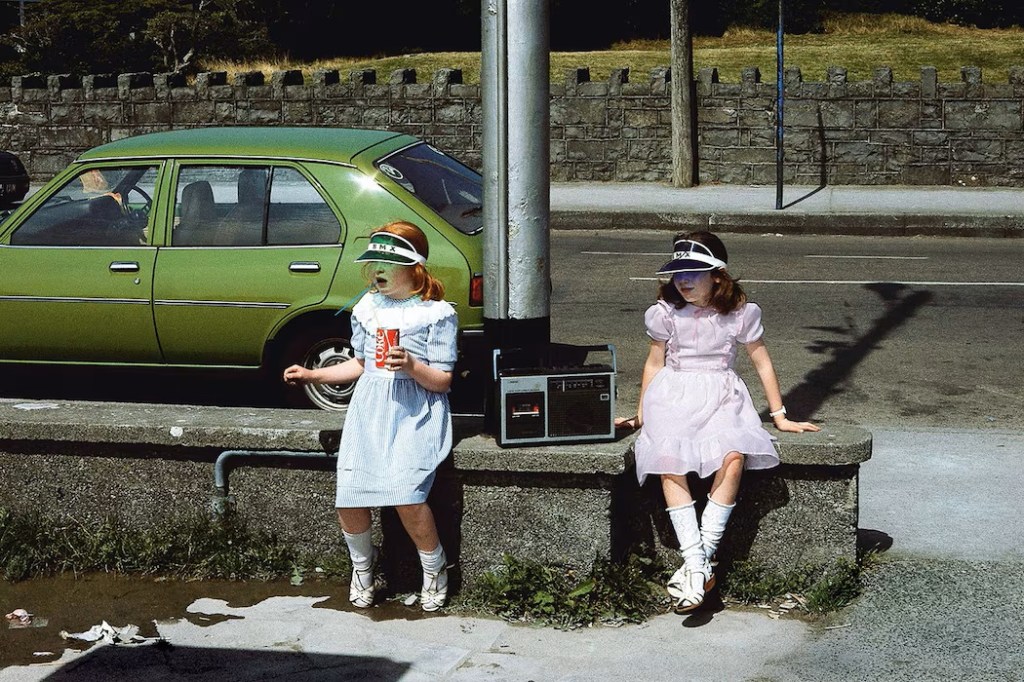
The festival’s historical perspective is balanced by a series of exhibitions devoted to photographers whose work has helped redefine the possibilities of the medium. William Klein, whose restless images of cities, fashion and street life challenged conventional photographic composition, receives a significant presentation; sadly this venue had to shut due to the building’s derelict roof. Harry Gruyaert’s colour photography at Le Mejan, demonstrates the medium’s capacity to transform everyday observation into something formally precise and psychologically charged. This is probably the best exhibition of this year’s festival. The proximity to Actes Sud is another bonus. Martine Barrat’s photographs of New York provide another view of urban life, with the city understood not simply as a backdrop but as a social environment shaped by its inhabitants.
One of the more compelling aspects of this year’s programme is its refusal to keep photography confined to human experience. Several exhibitions consider the relationship between image-making, nature and scientific observation. The inclusion of Edward Steichen’s botanical photography (with his Sunflowers resonating with Arles’ Van Gogh) is particularly revealing: work made within an earlier photographic tradition is placed alongside contemporary practices that question how the natural world is represented. Other projects turn towards animals, microscopic life and ecological systems, widening the festival’s definition of what, and who, can occupy the photographic frame. Kurt Hutton’s Porter’s Dog from 1938 and a shot of David Hockney are highlights.
This expansion of the subject matter is important because it reflects a broader change within contemporary photography. The medium is increasingly being used not simply to represent an existing reality but to investigate systems of knowledge: archives, scientific processes, colonial histories, ecological change and personal memory. Photography becomes evidence, interpretation and construction at once.
The political dimension of the programme is equally pronounced. Across the exhibitions, questions of independence, migration, identity and representation recur without being reduced to a single curatorial argument. The emphasis on African and Mediterranean histories is especially welcome, offering a more geographically expansive account of photographic modernity.
The festival’s programme of talks and encounters extends these questions beyond the gallery. During the opening week, conversations organised with Le Point, a partner of Les Rencontres d’Arles since 2007, address subjects including the relationship between photography and the living world, identity, American society, African independence and the contemporary image. The discussions acknowledge a central paradox of photography today: never has the world been so extensively photographed.
That paradox gives the 2026 edition its contemporary relevance. Photography no longer occupies a privileged position in a culture of images; it exists alongside film, social media (cat videos is a highlight in the animal-focused display), artificial intelligence and an almost continuous stream of digitally produced visual information. The question is therefore not simply what photography can show, but what kind of attention it can demand, what it is.
At its best, Les Rencontres d’Arles continues to make that attention possible. Its greatest strength remains the encounter between image and place: a photograph encountered inside a centuries-old building acquires a different physical and historical presence from the same image viewed on a screen. Moving between exhibitions also creates unexpected correspondences, allowing photographic histories, political narratives and contemporary practices to speak to one another.
After more than five decades, that remains the festival’s most important achievement. Les Rencontres d’Arles does not attempt to define photography once and for all. Instead, it continually reopens the question. In 2026, its answer is that photography remains valuable precisely because it can make familiar worlds unfamiliar again: by returning to archives, shifting perspectives, recovering overlooked histories and asking us to look more carefully at the images through which we understand the world.
Alongside the main Rencontres d’Arles programme, Dior maintains its presence in the city through the Dior Photography and Visual Arts Award for Young Talents, presented at LUMA Arles. Established in 2018 by Christian Dior Parfums in partnership with LUMA Arles and the École nationale supérieure de la photographie, the award supports emerging photographers and artists, with its ninth edition centred on the theme “Face-to-Face.” The 2026 jury, chaired by British photographer David Sims, selected Japanese artist Akari Takenobu for Threshold, a series exploring the space between memory, perception and the invisible. Her work is presented alongside that of nine other finalists at La Lampisterie, adding a younger, more experimental perspective to the broader festival landscape.
The festival continues through to 6th October 2026.
–
Image: Galway, Ireland, 1988© 2015 Harry Gruyaert / Magnum Photos

