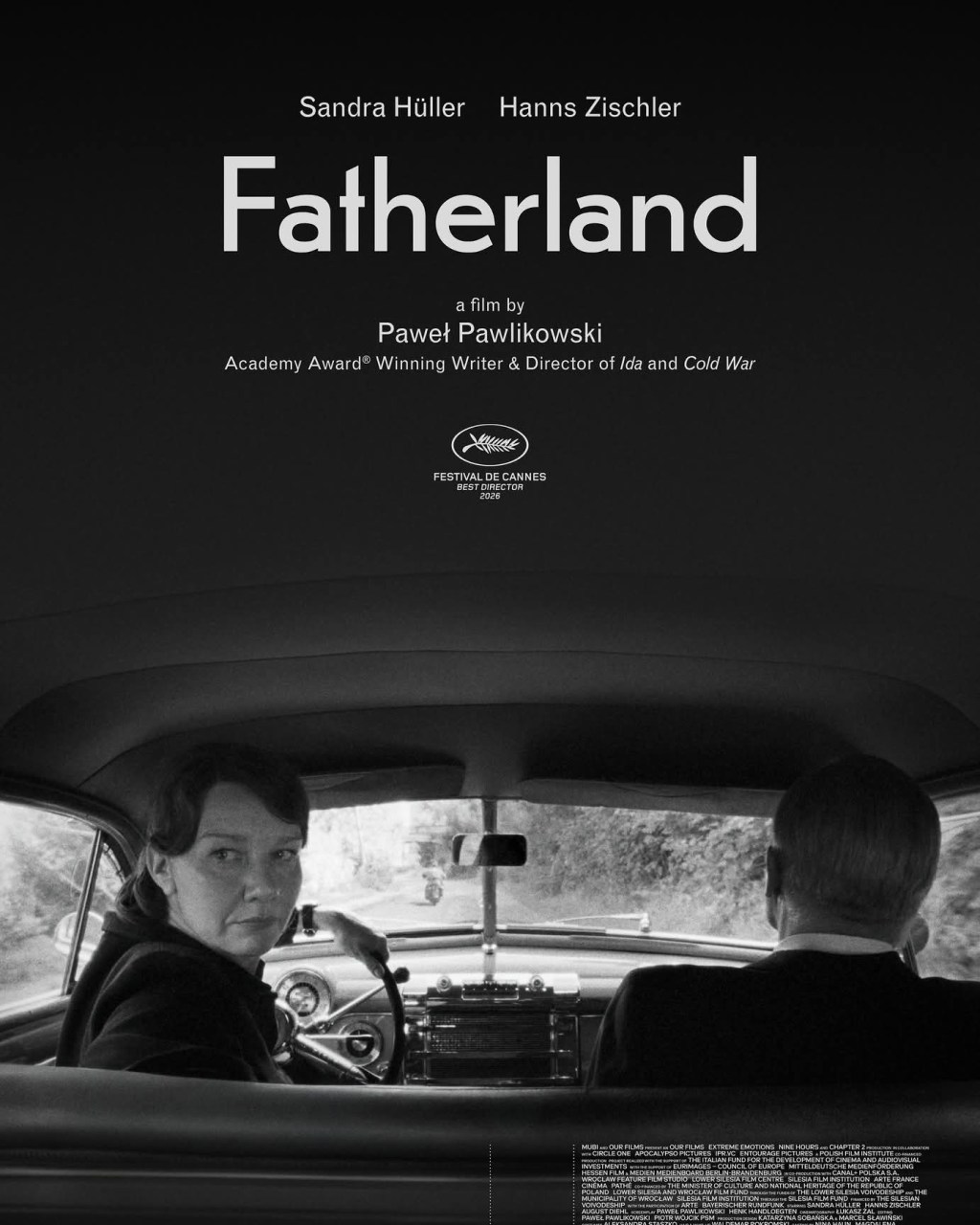
In Fatherland, his first feature since Cold War (2018), Polish director Paweł Pawlikowski turns to post-war Germany, exploring family, exile and national identity through the relationship between writer Thomas Mann and his daughter Erika.
Set in 1949, the film follows Thomas Mann (Hanns Zischler), the Nobel Prize-winning author, as he returns to Germany after sixteen years in American exile. Accompanied by Erika (Sandra Hüller), a writer, actress and former war correspondent, he travels between Frankfurt in the West and Weimar in the Soviet-controlled East. His visit coincides with the bicentenary of Goethe’s birth, with both German states keen to welcome the celebrated author.
Rather than offering a conventional historical biography, Pawlikowski focuses on the tensions between father and daughter. Thomas represents Germany’s literary heritage and international cultural standing, while Erika is more troubled by the country’s recent past and the return to public life of figures associated with the Nazi regime and the tragedy of her brother’s suicide.
Sandra Hüller is the film’s central presence. Her restrained performance captures Erika’s intelligence, independence and complicated relationship with her father, balancing affection with growing frustration at his decisions. Hanns Zischler offers an equally measured portrayal of Thomas Mann, a celebrated intellectual confronting the contradictions of returning to his homeland and losing a child.
Visually, the film continues Pawlikowski’s distinctive approach, with cinematography by Łukasz Żal. Shot in black and white, its carefully composed frames contrast the architectural and political environments of East and West Germany. Music by Bach, Mozart and Messiaen further reinforces the film’s engagement with European cultural heritage.
At 82 minutes, Fatherland is an intimate and deliberately understated historical drama. Its concise structure occasionally leaves aspects of the story unexplored, but its focus on the relationship between two generations gives it emotional depth.
The film is as much about the meaning of home and belonging as it is about Germany’s difficult post-war reconstruction. Hüller’s performance also brings renewed attention to Erika Mann, a remarkable figure whose contribution to literature, theatre and anti-Nazi journalism deserves recognition in its own right. A stunning film that follows another amazing film Ida.
The film premiered in competition at the 79th Cannes Film Festival on 14 May 2026, where Pawlikowski received the Best Director award. It was widely praised for its direction, cinematography and performances, before its theatrical release in Poland on 19 June 2026. Fatherland was subsequently selected as Poland’s submission for Best International Feature Film at the 99th Academy Awards.

