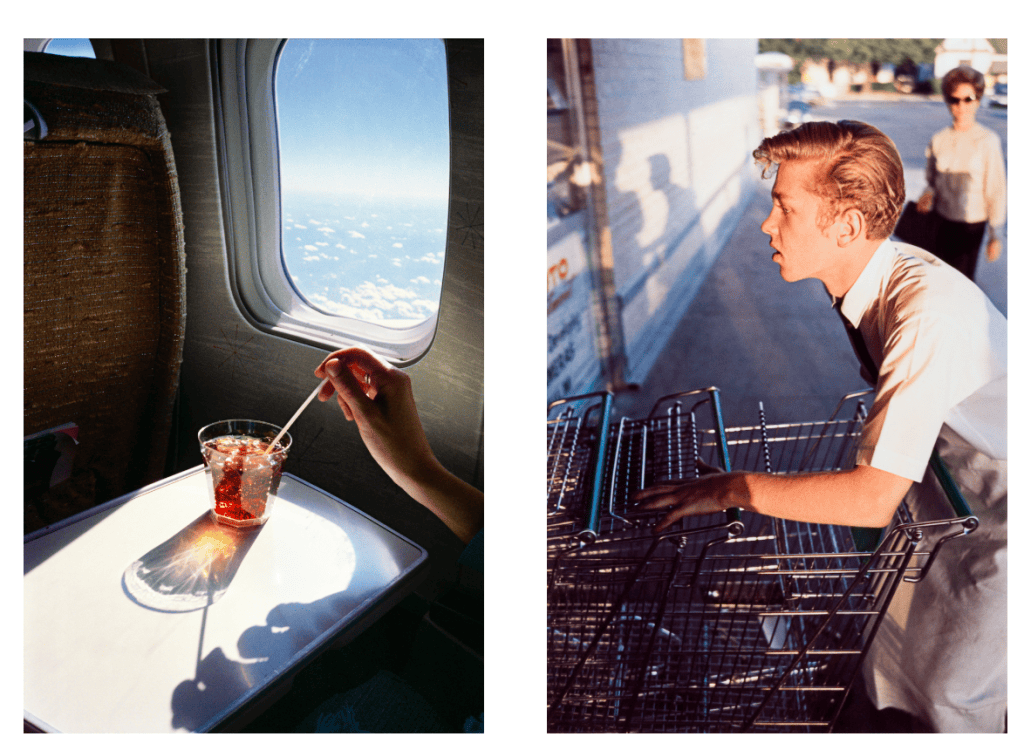
Half a century after William Eggleston’s Guide helped bring colour photography into the art-world mainstream, The Photographers’ Gallery in London, is marking the anniversary with William Eggleston: All That Goes Unnoticed, a wide-ranging survey that runs alongside Sanlé Sory: Colour Years. Both exhibitions opened on 14 October and remain on view until 21 February 2027.
The Eggleston show takes as its starting point the 1976 exhibition Photographs by William Eggleston at the Museum of Modern Art in New York, and the publication that accompanied it. The museum had shown colour photography before, but the presentation of 75 photographs by the Memphis-born artist, then 37, opened an intense debate about the artistic value of colour and helped change its status within the medium. The Guide, which contained 48 photographs, became MoMA’s first publication devoted entirely to colour. Critics were divided. Some recognised a new way of working with photography; others saw only banal, snapshot-like images of ordinary subjects, or work they considered deliberately provocative. The argument, as the exhibition makes clear, was about more than colour. It raised the question of which subjects, techniques and visual languages belonged in an art museum at all. Contemporary reviews are displayed in a vitrine in the opening room, allowing visitors to follow the controversy as it unfolded.
Eggleston, who declared himself ‘at war with the obvious’, made photographs that are deceptively simple. Petrol stations, roadside diners, suburban streets, parked cars and domestic interiors are treated with equal attention, with no apparent hierarchy between people, architecture, objects and landscape.
Before many of the photographs became dye-transfer prints, they existed as small colour transparencies, or ‘chromes’: positive images on transparent film, designed to be viewed with light passing through them. Kodak introduced the film in 1936 and stopped producing it in 2009. The Chromes portfolio, selected and produced in 2012, draws on thousands of transparencies Eggleston made decades earlier. Of the roughly 5,000 Kodachrome images, only a small selection was chosen for the 1976 exhibition and the Guide, and the portfolio opens up the wider body of work. Across it, subjects return repeatedly: family and friends, interiors, everyday objects, roads and cars. Seen alongside the photographs made public in 1976, they reveal recurring colours and compositional ideas, as well as experiments with scale, viewpoint and framing.
The exhibition also traces the artist’s development before colour became his defining medium. Between the late 1950s and 1972, working with a small handheld 35mm camera, Eggleston photographed the streets and interiors of Memphis in black and white. Influenced by Henri Cartier-Bresson and his 1952 book The Decisive Moment, he moved freely between suburban landscapes, diners, interiors and portraits, observing everyday life from shifting perspectives, inside and outside, in close-ups and wider views, with careful attention to angles, lines and surfaces. His subjects appear absorbed in their own activities rather than performing for the camera, caught in moments of stillness. The pictures also register a region undergoing change: new suburbs, shining cars and signs of mass production on one side, older neighbourhoods and diners with a quieter, more solitary mood on the other. Eggleston does not fold these contrasts into a single narrative; they exist side by side. Lesser-known black-and-white photographs and images made with a Brownie camera are also included, giving a fuller sense of his early instincts for composition and perspective.
A further section is devoted to Los Alamos, made on colour negative film, one of several colour processes Eggleston experimented with during the period, on journeys across the southern and western United States between 1965 and 1968 and again from 1971 to 1974. In 1973, driving through New Mexico, he stopped in the town that was home to the Manhattan Project and the development of the atomic bomb. Although the title alludes to the military ambitions of post-war America, the photographs themselves do not directly document the place. Eggleston described the series as fragments of a novel, inviting viewers to construct a narrative from images that remain deliberately disjointed, with seemingly insignificant details recurring.
Though made before the 1976 MoMA exhibition, the Los Alamos photographs remained largely unknown for decades. In 2002, the art historian Thomas Weski came across several of them in the magazine Grand Street, published by the curator Walter Hopps, who had accompanied Eggleston on a few of his road trips. Weski’s research led to the discovery of further missing negatives and brought the body of work to light.
Fifty years after the Guide challenged established photographic conventions, Eggleston’s influence remains difficult to overstate. His approach helped open the door for generations of photographers to treat colour not simply as a means of recording reality but as an essential component of artistic expression. What once appeared banal has become one of the most recognisable visual languages in contemporary photography.
The companion exhibition, Colour Years, introduces British audiences to a rarely seen chapter in the archive of Sanlé Sory, one of West Africa’s most prolific photographers. Born in 1943 in Burkina Faso, Sory is estimated to have taken more than a million portraits over six decades. He is best known for the black-and-white studio photographs he made in the 1960s and 1970s, but began producing colour portraits at his Volta Photo studio in Bobo-Dioulasso in the mid-1980s. The show brings together meticulously restored colour prints from his archive, offering an intimate view of a community undergoing profound social and cultural change.
Families, couples, friends, musicians, traders and shopkeepers appear throughout, each bringing personality and presence before the camera. Fashion, hairstyles, clothing and carefully considered poses become expressions of individuality, aspiration and belonging. The sitters are not simply being documented but are actively presenting themselves, shaping how they wish to be seen.
Music and youth culture are central to Sory’s visual world. The exhibition also features Volta Jazz album covers incorporating his portraits of the influential bands that emerged in the years after Burkina Faso’s independence, evoking a period in which music, fashion and photography became powerful forms of self-expression and helped articulate a new sense of identity. The photographs have an immediacy and an infectious energy, while the intimacy of the studio setting lends each portrait a personal dimension. They also serve as historical documents, preserving the appearance, attitudes and aspirations of a society navigating political change, international influences and modernity on its own terms.
Seen together, the two exhibitions present photography as both an artistic practice and a form of cultural memory. Eggleston turns to the psychological undercurrents of American life, finding beauty and ambiguity in familiar landscapes; Sory celebrates the individuality of a community through portraits that capture its evolving style, confidence and collective identity. Their approaches differ, but both artists show an acute sensitivity to the visual details through which a time and place can be understood.
At a moment when images are produced and consumed at unprecedented speed, the pairing makes a persuasive case for looking slowly.
William Eggleston: All That Goes Unnoticed and Sanlé Sory: Colour Years are at The Photographers’ Gallery, 16–18 Ramillies Street, London W1 to 21 February 2027.

