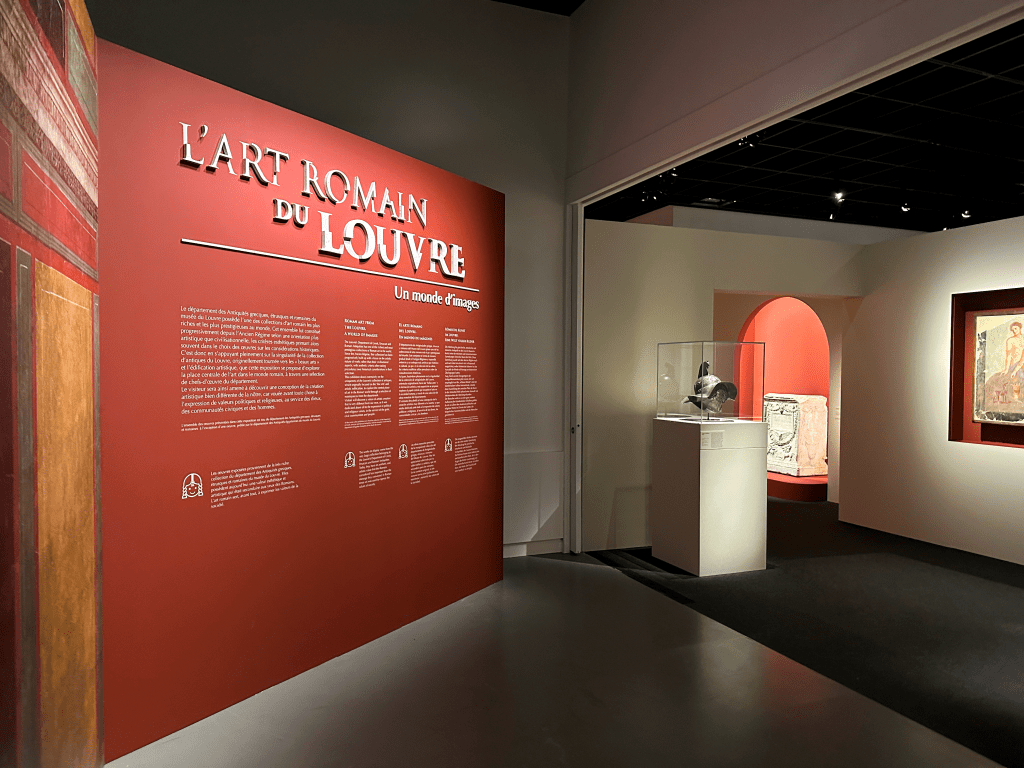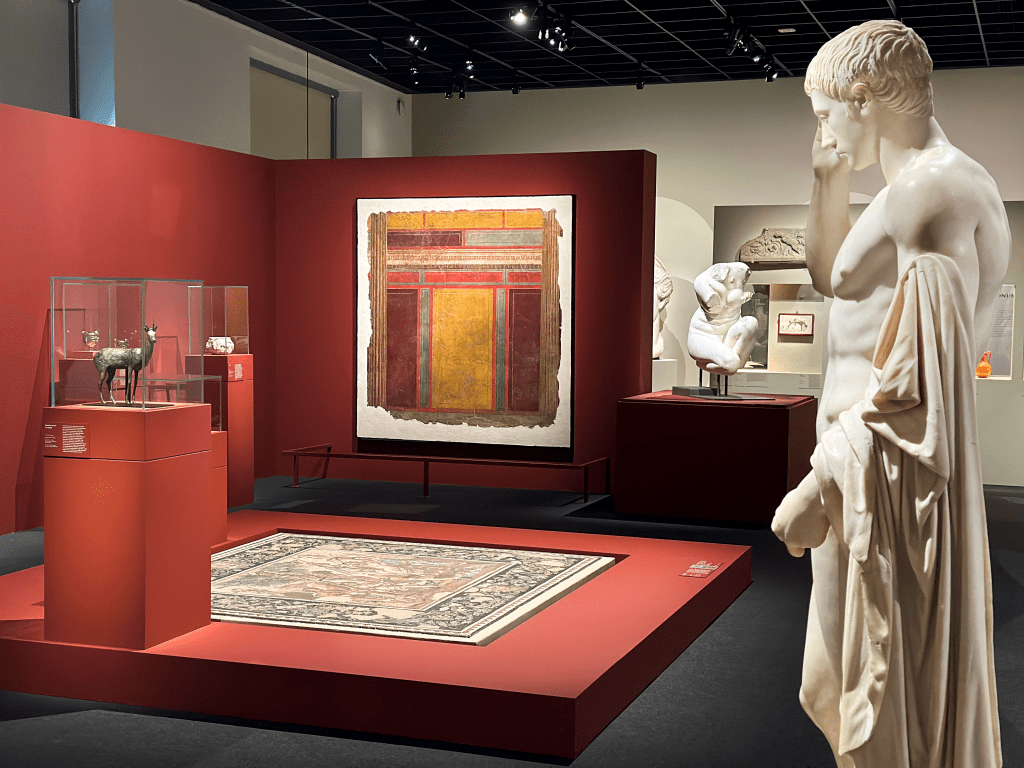
The Roman Art of the Louvre: A World of Images running until 10th January 2027, brings together an exceptional selection of masterpieces from the Louvre’s ancient collections, inviting visitors to look beyond the familiar categories of sculpture, painting and decorative art. Instead, it proposes a more fluid understanding of Roman visual culture, one in which beauty was inseparable from function, belief, status and everyday life. This is a rare opportunity to see these works outside of Paris as the exhibition features exceptional loans.
For the Romans, art was everywhere. Art appeared in the home, in the forum, in temples and sanctuaries, in places of entertainment and in tombs. It was embedded in rituals, politics, religion and social life. A finely made glass vessel could be an object of practical use and a display of sophistication. A portrait could preserve the memory of an individual while simultaneously communicating family lineage and social position. A monumental sculpture could honour an emperor, a god or a civic ideal. Jewellery, sculpture and luxury objects could therefore speak volumes without a single word. In Roman society, appearance was everything. This brilliant show explores these aesthetics and social dimensions in a fantastic display.
Art is an especially appropriate subject for the glorious city of Nîmes. Few cities outside Italy offer such a tangible connection to the Roman world (probably with the nearby Arles, in France). The Arena stands directly opposite the stunning Musée de la Romanité, while the museum itself, a striking contemporary building designed by Elizabeth de Portzamparc, provides a distinctly 21st-century setting for the city’s archaeological heritage. It’s a very interactive display with short videos, animated maps and clear navigation, bringing a great understanding of Roman life.
The exhibition begins with a simple but provocative premise. We tend to encounter Roman objects today as isolated works of art: a marble head behind glass, a fragment of fresco on a gallery wall, a mosaic carefully preserved for contemplation. But this was rarely how these objects existed in antiquity. They were part of a 360 vision which captured life, hierarchy and politics as a whole.
A gladiator’s helmet from Pompeii and a fragment of Roman wall painting highlight the gap between our modern idea of art and the way Romans experienced images: embedded in architecture, ritual and daily life. Busts, mosaics, sarcophagi and luxury objects likewise served to express status, belief, memory and belonging. Roman portraits were not simply likenesses, but a sophisticated social language; images of Victory functioned almost as visual slogans, celebrating imperial power and military success.
The exhibition also celebrates Roman craftsmanship, from marble carving and gilding to metalwork, glass and intricate inlay. While drawing heavily on Greek models, Roman artists adapted them to their own tastes, balancing naturalism with stylisation and ornament.
Discovered in 1823, the two-metre-high Apollo of Lillebonne is a fantastic example. Attributed to Gallo-Roman workshops and inspired by 4th-century BC Greek models, the gilded bronze depicts Apollo as a youthful, androgynous figure with long hair. His raised left hand suggests a now-lost lyre. Although ancient sources describe Apollo’s “golden hair”, fully gilded monumental bronze statues are exceptionally rare.
For the Romans, material refinement was itself a statement too and this is an interesting angle for this extensive exhibition. The quality of marble, precision of inlay or complexity of glass could signal wealth, knowledge and status. Even monumentality carried political meaning: grandeur made civilisation visible. It’s apparent everywhere in the city too with monuments such as the Maison Carrée temple and The Temple of Diana.
The exhibition concludes with the Roman practice of reuse, Greek statues were reworked, imperial portraits recarved and Egyptian vessels given new purposes. The past was not untouchable; it was continually absorbed into the present to make new objects.
This is ultimately what makes The Roman Art of the Louvre so compelling. It asks us to look beyond the museum display and remember that, for the Romans, art was never simply something to admire. It was part of how they worshipped, remembered, celebrated, communicated and understood their world. Art was politics!
At the Musée de la Romanité, that idea takes on a contemporary dimension. Upstairs in the collection, highlights are equally fascinating. An exceptionally well-preserved fresco depicts a resting male hero, probably Hippolytus, seated on drapery over a rock, with a colonnaded building in the background. Below, a frieze of caricatural figures includes comic scenes of lovers, Ajax dragging Cassandra during the sack of Troy, and Andromeda chained before a cave, awaiting rescue by Perseus. Andromeda is the only figure shown frontally. Simply beautiful.
Discovered in an elite Roman domus, an exceptional 35 m² mosaic, titled Pentheus Mosaic, decorated a reception room. Its 29 medallions surround a central scene depicting the murder of Pentheus, King of Thebes, by his mother Agave, driven mad by Dionysus, a scene from Euripides’ The Bacchae. Though Dionysus is absent, the mosaic evokes his cult through Maenads, theatrical masks, seasonal figures and wine vessels. Its elaborate design was intended both to impress guests and to display the owner’s learning.
Last but not least, an exceptional bronze head of Apollo follows the Greek style of the 5th century BC, much admired and copied by the Romans. The missing eyes, hair and laurel wreath were likely originally made separately; the eyes may have been silver. Once part of a statue nearly 2 metres tall, it is among the rare monumental bronzes to survive from Roman Gaul. Its original context is unknown, but its scale and quality suggest it belonged to an important public building.
Facing Nîmes’ ancient Arena and housed within Elizabeth de Portzamparc’s shimmering architecture and garden, the museum itself and the remarkable exhibition programme, create a dialogue between past and present, making the Roman world feel less like history than an impressively intelligent and sophisticated mark.
–