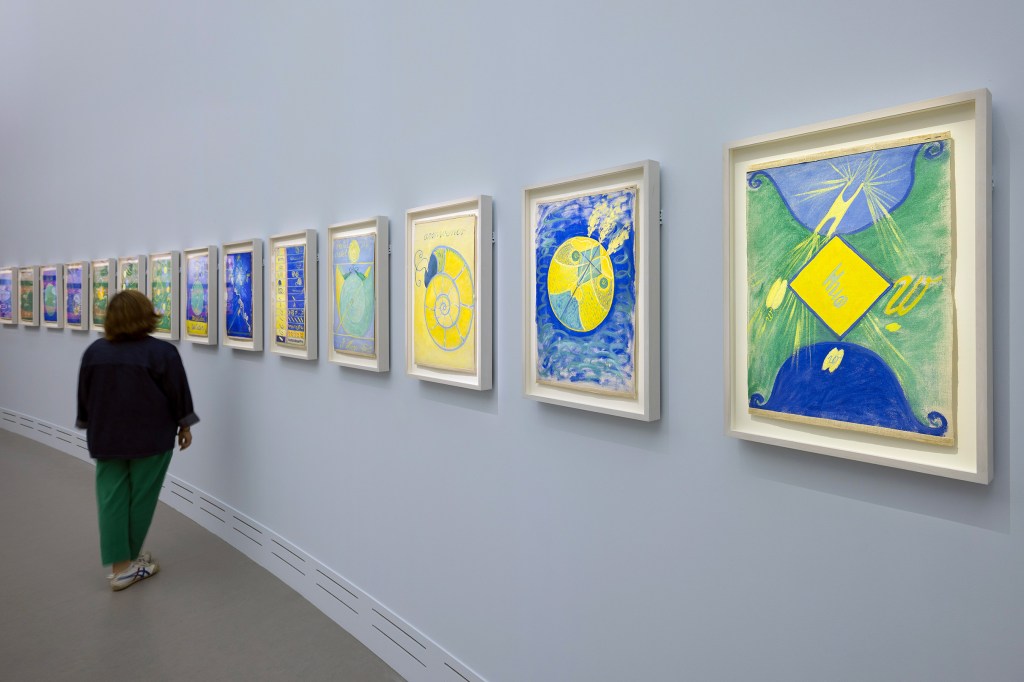
Last chance to catch this exceptional exhibition in Paris. At the Grand Palais, Hilma af Klint’s paintings feature spirals, flowers, geometric forms and luminous fields of colours, revealing a visual language through which the Swedish artist sought to make the invisible visible.
Hilma af Klint: The Temple Paintings (1906–1915) brings together more than 100 paintings and drawings from the artist’s monumental cycle of 193 works, the first major exhibition devoted to af Klint in France.
Af Klint lived a double artistic life. After graduating from the Royal Academy of Fine Arts in Stockholm in 1887, af Klint took a studio in the city, where she produced and exhibited traditional landscapes, botanical drawings and portraits. However, by 1896, she had abandoned the conventions she learned at the Academy in favour of painting the invisible worlds hidden within nature, the spiritual realm and the occult. She privately joined four other female artists to form a group called ‘The Five’. They conducted séances to encounter what they believed to be spirits who wished to communicate via pictures, leading to experiments with automatic writing and drawing, which pre-dated the Surrealists by several decades.
While she exhibited conventional portraits and landscapes, she secretly developed a radical abstract practice, influenced by science, Theosophy and spiritualism.
The exhibition traces this trajectory, through ten series, beginning with Primordial Chaos and culminating in the three Altarpieces. At its centre are The Ten Largest, ten monumental works painted in 1907. More than three metres high, their swirling forms and vibrant colours chart the four stages of life, from childhood to old age.
Her symbols draw as much from nature and Nordic traditions as from the occult. Flowers, spirals and geometric forms become a kind of private alphabet, while blue and yellow can suggest feminine and masculine principles, and green their union. A cabinet of Nordic folk objects in the exhibition reveals another, less expected source: embroidery, popular imagery and traditional motifs that af Klint transformed into abstraction.
What makes the exhibition particularly compelling is the tension between the paintings’ immediate visual power and the complex ideas behind them. Af Klint was producing abstract work from 1906, years before male artists Kandinsky and Malevich, yet she feared her contemporaries would not understand it. She stipulated that her abstract paintings remain hidden for twenty years after her death in 1944.
At the Grand Palais, the work finally emerges from that long silence. Colour, geometry and symbolism come together not simply as abstraction, but as an attempt to construct another way of seeing, a language for forces that, for af Klint, existed beyond the visible world.
Hilma af Klint: The Temple Paintings (1906–1915) is on view at the Grand Palais until 30 August 2026. Make sure to visit before it closes.
–
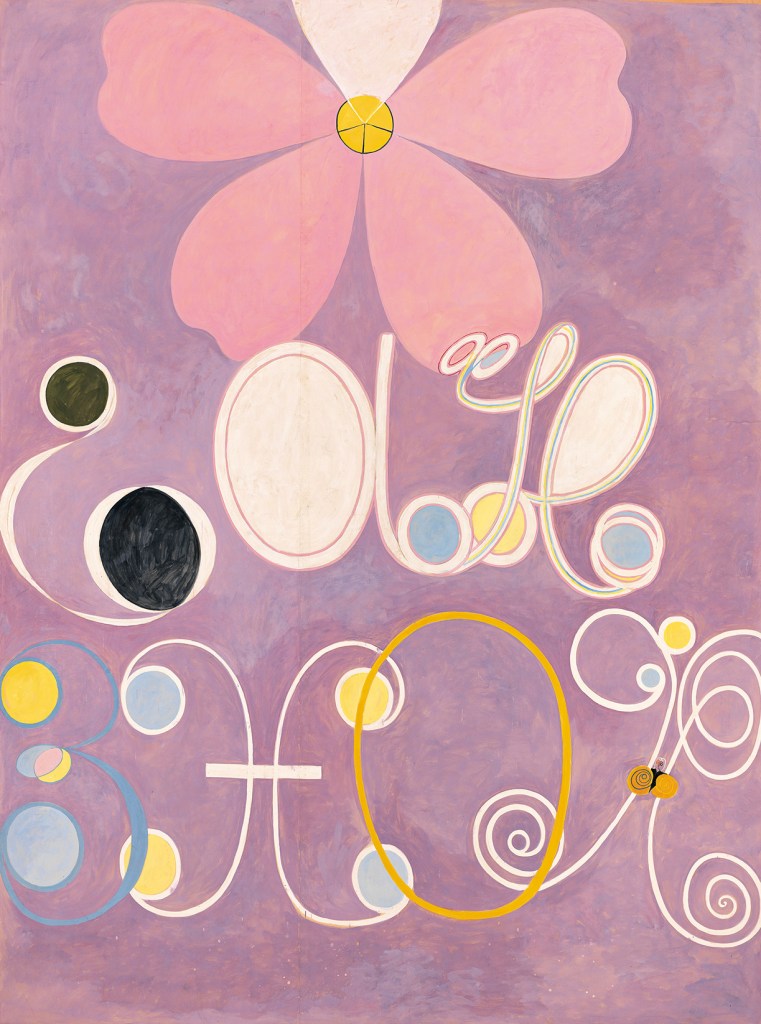
Images: Photo © Luc Castel, 2026 and © By courtesy of the Hilma af Klint Foundation / photo The Moderna Museet, Stockholm, Hilma af Klint, Les Dix plus grands, n° 5 (Âge adulte), 1907

