Set within a wider landscape where art and nature mix, Jupiter Artland operates as both exhibition site and community space. Located outside Edinburgh, the estate unfolds across woodland and pasture, where large-scale works by artists including Anish Kapoor, Antony Gormley, Anya Gallaccio, Charles Jencks, Christian Boltanski, Cornelia Parker, Helen Chadwick and others are embedded directly into the landscape.
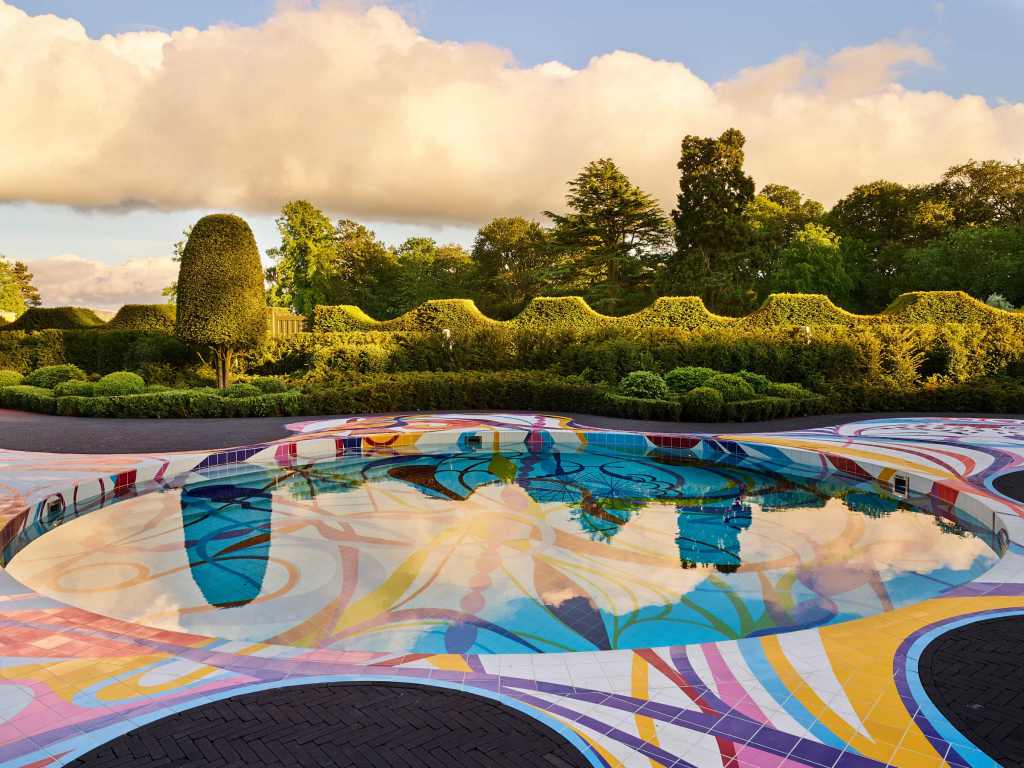
These works do not sit apart from the park but shape how it is experience, perceived. Alongside the sculpture park, Jupiter’s built environment, including its Glasshouse, seasonal hospitality spaces and informal social life of its Café and Restaurant, extends the space into a fantastic destination. Joana Vasconcelos’ Gateway is a fully immersive artwork integrated into a functioning swimming pool and landscaped garden. Measuring nine metres in diameter, the pool is lined with vibrant, hand-painted Portuguese tiles, transforming a familiar recreational space into a richly decorative and contemplative environment.
Within this ecosystem sits Café Party, an immersive environment shaped by the artist Nicolas Party. Patterns repeat across the walls: tropical shrubbery accumulates in dense foregrounds, while thin, clashing twigs and climbing plants reach upward in search of light, with fake vibrant cakes, and Party’s landmark characters, producing an effect that edges toward the psychedelic rather than the purely representational. The space becomes a kind of threshold where dining, viewing and immersion overlap – Alice in Wonderland-style. It’s fantastic!
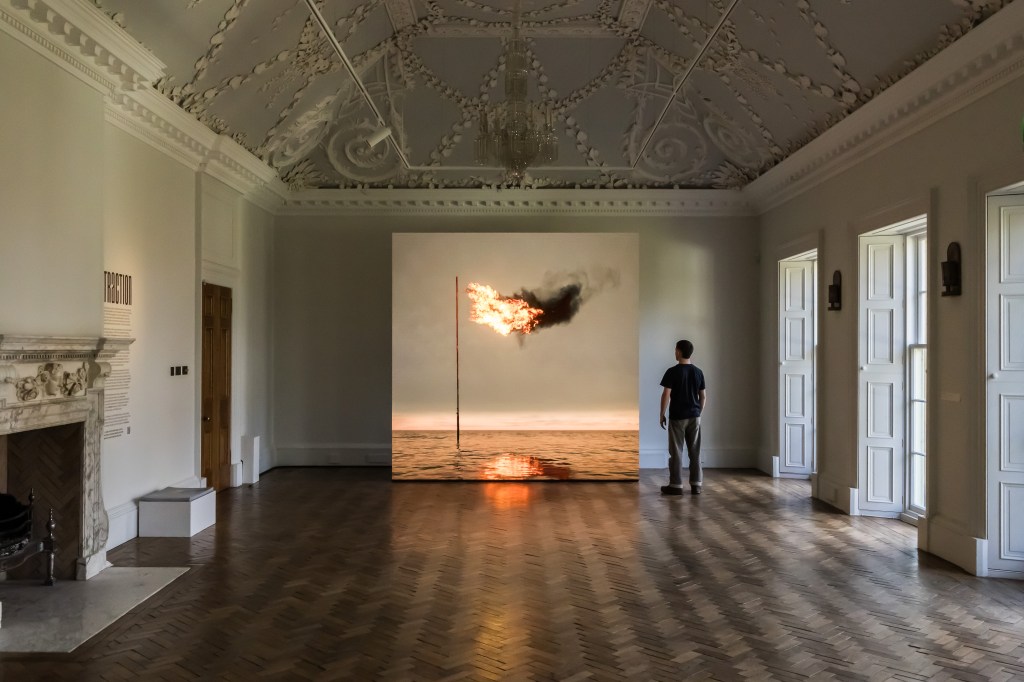
Within this broader context, Jupiter Artland also stages temporary exhibitions. Extraction on view now, brings together works by Carol Rhodes, John Gerrard, Marguerite Humeau, Siobhan McLaughlin and John Latham in a charged reflection on the afterlives of energy.
The exhibition explores the theme of extraction itself and reflects the state of the current world. Here, three energy worlds coexist without hierarchy: the nineteenth-century shale oil industry, the infrastructural ambition of North Sea petroleum, and the present tense of renewable transition. The show resists the language of urgency that often dominates discussions of energy transition. Instead, it turns toward something more unsettled: the emotional structures that underpin extraction economies.
In John Gerrard’s simulations, industrial flame and atmospheric collapse loop in perpetual present tense. His moving image has become a classic work now. Humeau’s speculative ecologies conjure futures where biology and system blur into myth. Latham’s conceptual detonations linger as philosophical residue, gestures that refuse closure. And the incredible site of Jupiter Artland itself becomes part of the exhibition’s background.
–