Julian Schnabel’s latest body of work returns to Italy, a place that has shaped his visual language since his early encounters with the frescoes of Giotto and the paintings of Caravaggio and Piero della Francesca. Across decades, Italy has functioned for him less as a subject than as a condition of seeing, where landscape, history, and painting seem to overlap in the same field of time. The exhibition is on view at Pace NY until 14th August.
This new series, developed between Rome near the Villa Borghese and the Tuscan coast of Ansedonia during and after the filming of In the Hand of Dante, focuses on the Pinus pinea, the umbrella pine that defines much of the Italian landscape. Schnabel first translated these trees into paintings on enlarged eighteenth-century maps of Italy, using cartographic lines as a structural underlay for gestural mark-making. The works feature a tension between geography and image: the map becomes a field of interruption where branches, sky, and terrain overlap.
“When I was in Ansedonia, the landscape was filled with umbrella pines. I had brought some maps with me, since I like to work wherever I go. I laid the maps out in the courtyard of the garden. I was surrounded by the pines. I began to paint the trees onto the maps, noticing the variety of shapes that came out of the branches, and the shapes of the pine bushes growing on them, and the way the sky looked at the end of the day as the light was leaving. It was changing its shape. The way that the light would hit the trees as they would become silhouetted in front of the light.
“When I was in Ansedonia, the landscape was filled with umbrella pines. I had brought some maps with me, since I like to work wherever I go. I laid the maps out in the courtyard of the garden. I was surrounded by the pines. I began to paint the trees onto the maps, noticing the variety of shapes that came out of the branches, and the shapes of the pine bushes growing on them, and the way the sky looked at the end of the day as the light was leaving. It was changing its shape. The way that the light would hit the trees as they would become silhouetted in front of the light.” Julian Schnabel said.
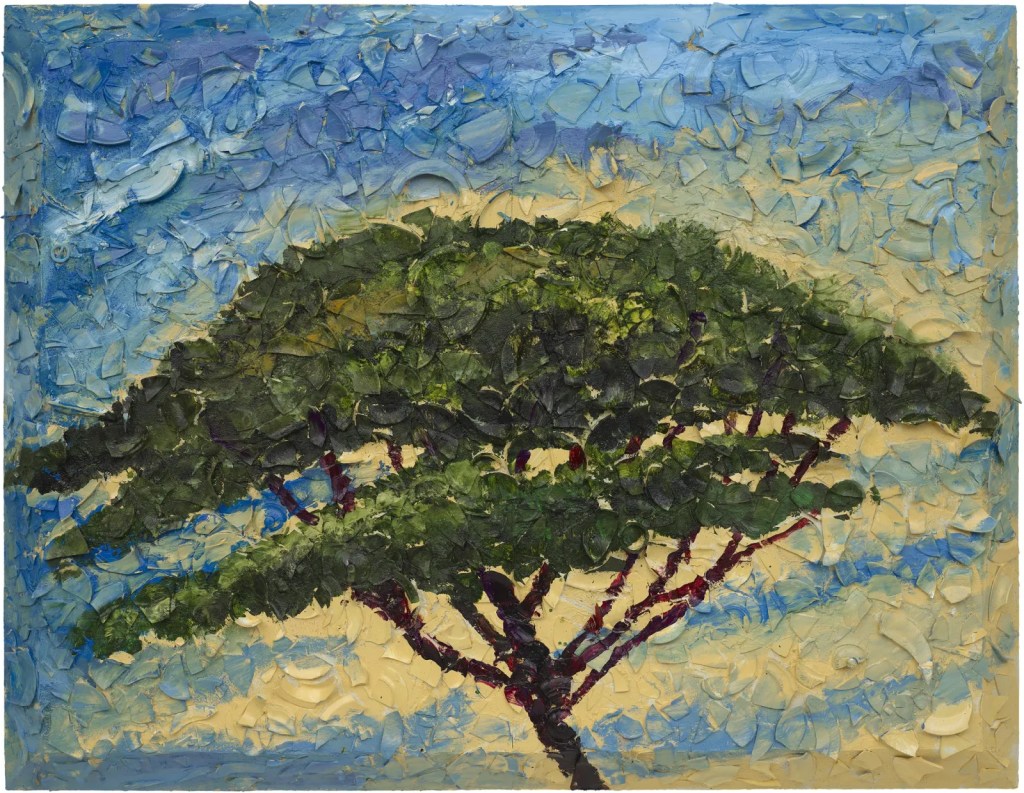
From these works emerged a new group of plate paintings, extending his long-standing engagement with broken ceramic surfaces. Painted on the floor and often with improvised tools, these works translate the map compositions into more immediate, physical structures. Naples yellow grounds, deep blues, and dense greens build atmospheric spaces that feel less depicted than assembled in real time.
Across both bodies of work, the umbrella pine becomes less a subject than a kind of perceptual device, an architecture for thinking about time, light, and persistence. Schnabel is not painting trees so much as the moment in which trees become visible: unstable, shifting, never fully resolved. In this sense, the works sit between image and abstraction, where form is always in the process of forming.
Image: Portrait of Italy Through Its Trees XVIII, 2026, Julian Schnabel

