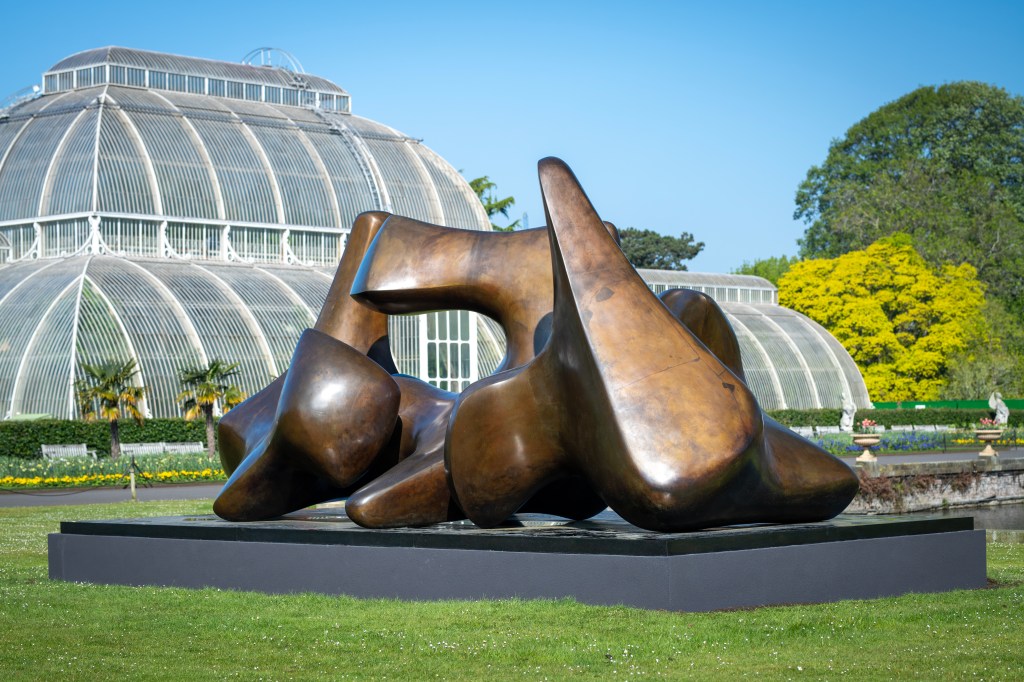
Kew Gardens has unveiled what is being billed as the largest-ever outdoor presentation of works by Henry Moore, and the most comprehensive staging of the British sculptor’s practice in a generation. Across the 320-acre UNESCO World Heritage Site, 30 monumental bronzes have been installed in dialogue with the landscape, while a parallel display in the Shirley Sherwood Gallery of Botanical Art brings together more than 90 works, including bronzes, drawings, prints, wood carvings and rarely seen studies. This is the show of the season and it’s running until 31st January 2027.
Kew has described the project as part of its wider ambition to integrate major contemporary art commissions within its living collections, following previous collaborations with artists including Marc Quinn, Dale Chihuly and Rebecca Louise Law.
Presented in partnership with the Henry Moore Foundation, Monumental Nature extends across the entirety of the gardens rather than being concentrated in selected zones, as in Kew’s earlier 2007 presentation. The exhibition also includes works installed inside the Temperate House, the world’s largest surviving Victorian glasshouse. The environment for the works is spectacular!
Moore’s tatement on outdoor sculpture anchors the curatorial approach in this fantastic ground: “Sculpture is an art of the open air. Daylight, sunlight is necessary to it, and for me its best setting and complement is nature. I would rather have a piece of my sculpture put in a landscape, almost any landscape, than in, or on, the most beautiful building I know.”
Kew describes the project as a “once-in-a-generation presentation” and the most extensive survey of Moore’s work to date in any single outdoor setting. The curatorial premise rests on Moore’s long-held belief in the primacy of landscape as a setting for sculpture. As the exhibition notes: “Henry Moore liked to work outside at his home in Perry Green. Although he also undertook many urban public commissions, he felt that his sculptures looked best when they were surrounded by nature.”
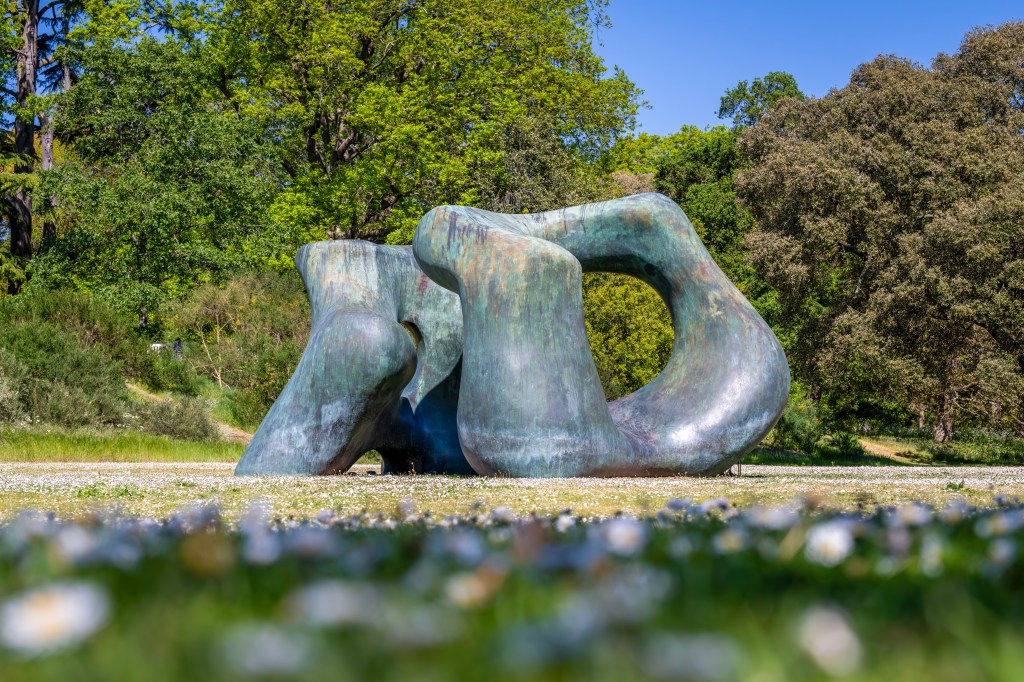
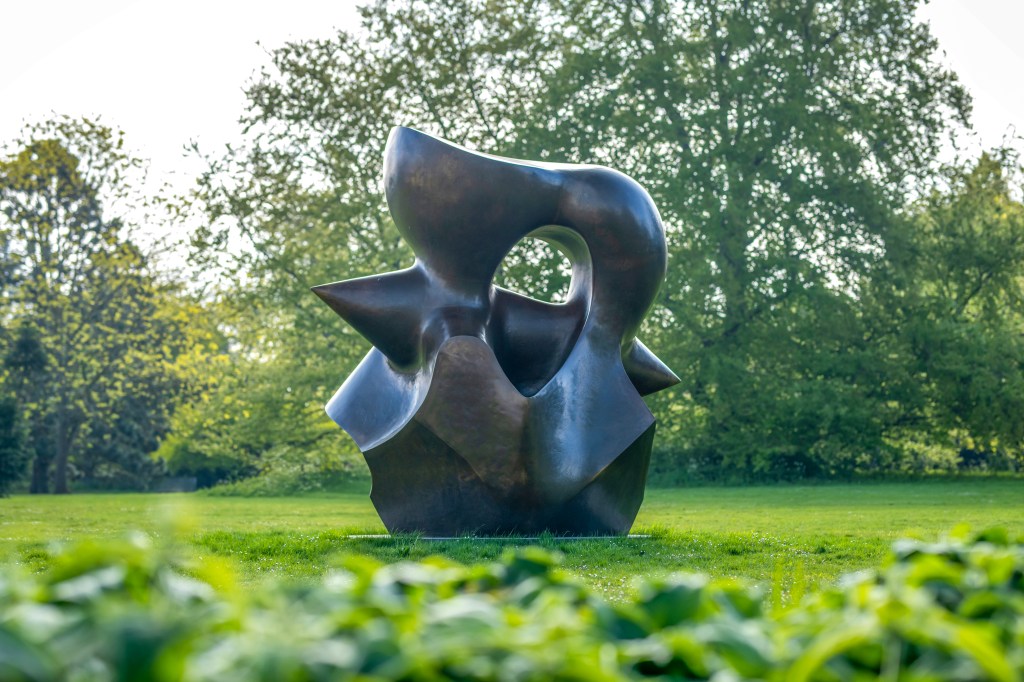
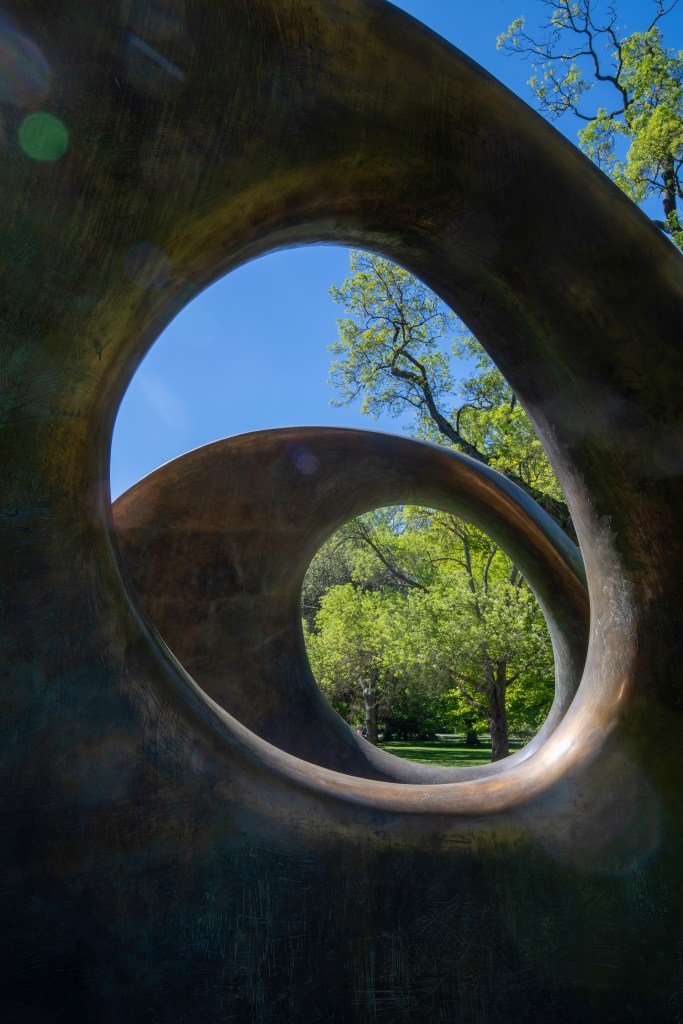
For Moore, nature is presented not as backdrop, but as active intelligence: a mirror for human experience and a constant point of return in his thinking. That position is reiterated across the curation, with works including Large Two Forms, Sheep Piece, Large Reclining Figure, Oval with Points, Reclining Woman: Elbow, Locking Piece and Three Piece Sculpture: Vertebrae distributed across lawns, water ponds and woodland edges. In Double Oval (1966), the relationship between object and environment becomes explicitly optical. The large openings in Double Oval 1966 frame different views across Kew’s landscape, merging the sculpture’s abstract shape with the natural environment. Truly beautiful.
A second thematic strand running through the exhibition is Moore’s sustained engagement with bone as both form and structural principle. Henry Moore became fascinated with bones while studying sculpture in the 1920s. Their form and strength influenced his work for decades after.
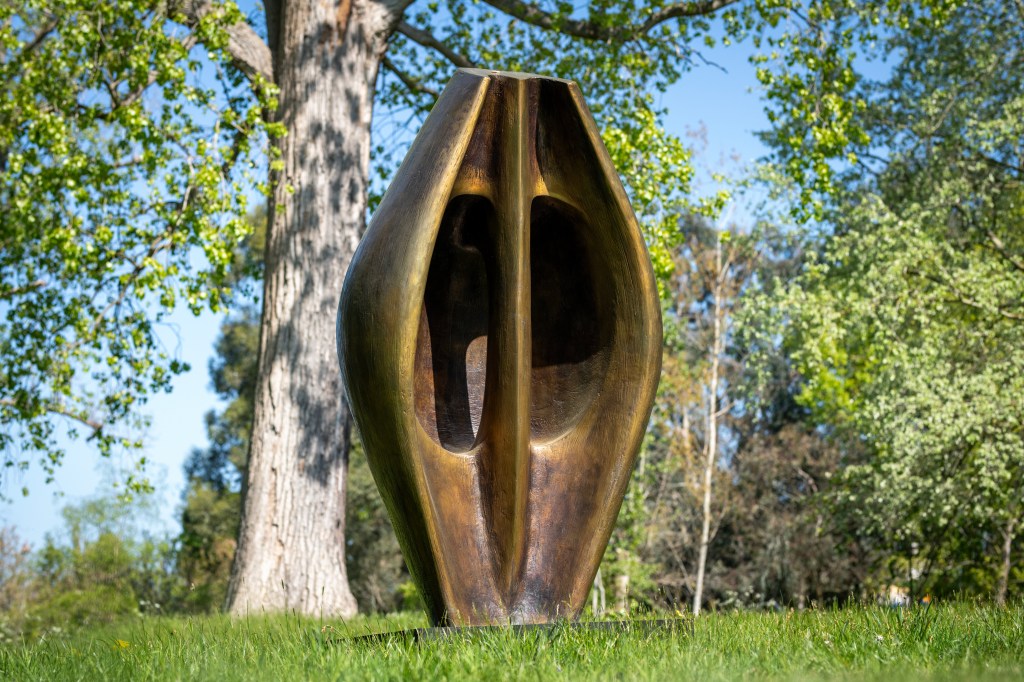
This interest is evident in Large Standing Figure: Knife Edge (1961), derived from a fragment of bird’s breastbone found in Moore’s garden. Nearby, Three Piece Sculpture: Vertebrae (1968–69), installed close to the Palm House, extends this anatomical vocabulary into sculpture. Three Piece Sculpture: Vertebrae 1968-69… features three bronze pieces designed to fit together, mimicking the sections of a backbone.
Moore described the origins of the work in explicitly observational terms: “Since my student days, I have liked the shape of bones, and have drawn them, studied them in the Natural History Museum, found them on sea-shores and saved them out of the stew pot.”
Alongside the outdoor installations, the Shirley Sherwood Gallery presentation showcases Moore’s working process, emphasising what Kew describes as his practice of “thinking through nature”. The display includes loans from Tate and the Sainsbury Centre for Visual Arts, as well as works from Kew’s own collections, and culminates in a focus on Moore’s carved wood sculptures.
Public programming includes After Hours events in June and July, transforming the Temperate House for performances marking the summer solstice, as well as family trails and limited-capacity sunset buggy tours of the exhibition. A parallel strand at Wakehurst, Sussex, titled Henry Moore and more, runs from 5 June 2026 to 23 May 2027 and presents four sculptures by Moore alongside contemporary commissions by Rana Begum, Rafael Pérez Evans and Paloma Varga Weisz. This is the Henry Moore season.
Taken together, the Kew and Wakehurst presentations position Moore not only as a canonical modernist sculptor, but as an artist whose work is increasingly framed through ecological and environmental concerns. As Sebastiano Barassi of the Henry Moore Foundation notes, Moore’s “deep affinity with the natural world” makes these sites particularly resonant at a moment when questions of landscape, ecology and human intervention have become newly urgent.
At Kew, however, the curatorial proposition remains primarily experiential. Sculpture is not isolated, but enhanced by weather, landscape and seasonal change.
Published alongside the exhibition, the accompanying monograph positions nature as a structural and philosophical force within Moore’s practice, one that shaped his understanding of form, humanity, and the interdependence of living systems.
Edited by Laura Bruni (Henry Moore Foundation), the publication brings together leading scholars and Kew experts across three thematic sections, tracing how Moore’s engagement with the natural world evolved across his career. Essays explore his work not only as sculpture, but as a broader inquiry into the connections between plant, animal, and human life. This remarkable book brings together more than 100 works, from monumental bronzes to drawings, maquettes, prints and carvings. The result is a richly illustrated volume that situates his work within ecological, anatomical, and philosophical frameworks, offering a fresh perspective on his evolving artistic language.
Designed as both scholarly resource and visual compendium, the publication is conceived as a long-term reference for readers interested in Moore, modern sculpture, and the wider relationship between art and the natural world.
–