
This is one of the most striking exhibitions of the Summer in the over-hyped city of Marseille. Running until 10 January 2027, Adrien Vescovi takes over the chapel and coursives of Marseille’s Centre de la Vieille Charité with Dormir comme le soleil, a newly commissioned installation presented by the Musées de Marseille. Free to the public, the exhibition brings together Vescovi’s textile practice and the architecture of one of the city’s most significant historic monuments, creating a dialogue between fabric, colour, and history. It’s an incredibly calming and peaceful environment which dialogues with the other remarkable adjacent presentations of Greek artefacts and Mexican masks.
In Marseille, light transforms the city’s already vivid palette throughout the day. At the Vieille Charité, Vescovi works with that changing atmosphere, introducing textiles into the monumental architecture without attempting to compete with it.
Instead, the fabrics create a sense of intimacy. Draped and suspended within the chapel and galleries, they soften the severity of the stone, turning the building into something more tactile and atmospheric. The installation asks visitors not simply to look, but to move through the space and experience the shifting relationship between material and architecture. It’s a simple yet very effective concept for the presentation.
Vescovi’s practice is rooted in textiles and in the gestures of making. Sewing, dyeing and the use of modest materials are central to his work, with particular attention given to old sheets. For the artist, fabric is a material capable of holding traces of everyday life: marks left by time, pigment, handling and use.
There is something particularly apt about this approach at the Vieille Charité. Built between the seventeenth and eighteenth centuries, the complex was designed by Pierre Puget and has been part of Marseille’s history for more than three centuries. Nearly destroyed, today, its courtyard, chapel and galleries provide a setting for contemporary art as well as the city’s museum collections.
Vescovi’s intervention adds another layer to that history. His fabrics carry their own histories, but they are also transformed by their encounter with the building. The old and the new meet without either being diminished.
The artist’s use of textile also has a distinctly Mediterranean resonance. The museum describes his work as engaging with the artisanal traditions that have long existed around the Mediterranean, where techniques of sewing, dyeing and working with cloth have travelled between communities and generations.
Here, the material becomes a kind of quiet archive. A sheet can suggest the intimacy of a bedroom; a seam records the movement of a hand; a pigment alters the memory of an otherwise familiar surface. Vescovi takes these everyday associations and expands them into an installation on an architectural scale.
The title, Dormir comme le soleil, has an appropriately dreamlike quality. There is a sense of suspension in the work: an invitation to slow down and pay attention to surfaces, shadows and small changes in perception. The exhibition is concerned with time not as something linear, but as something embedded in material itself.
The fabrics have histories before entering the gallery; the architecture has centuries of history behind it; even the marks created during the installation become part of the work’s continuing life. The exhibition becomes a meeting point between these different forms of time.
And Marseille is the right place for such an encounter. A city defined by exchange, movement and the meeting of cultures, it has always been shaped by what arrives from elsewhere and what is transformed locally. Vescovi’s installation reflects that same sense of circulation. Its materials are humble, but its references are expansive.
There is also a quiet elegance to the way the work occupies the Vieille Charité. Rather than filling the space with spectacle, Vescovi allows the architecture to remain visible. Fabric and stone exist side by side; softness meets permanence; the domestic meets the monumental. For a season dedicated to siesta time, this is the perfect setting!
–
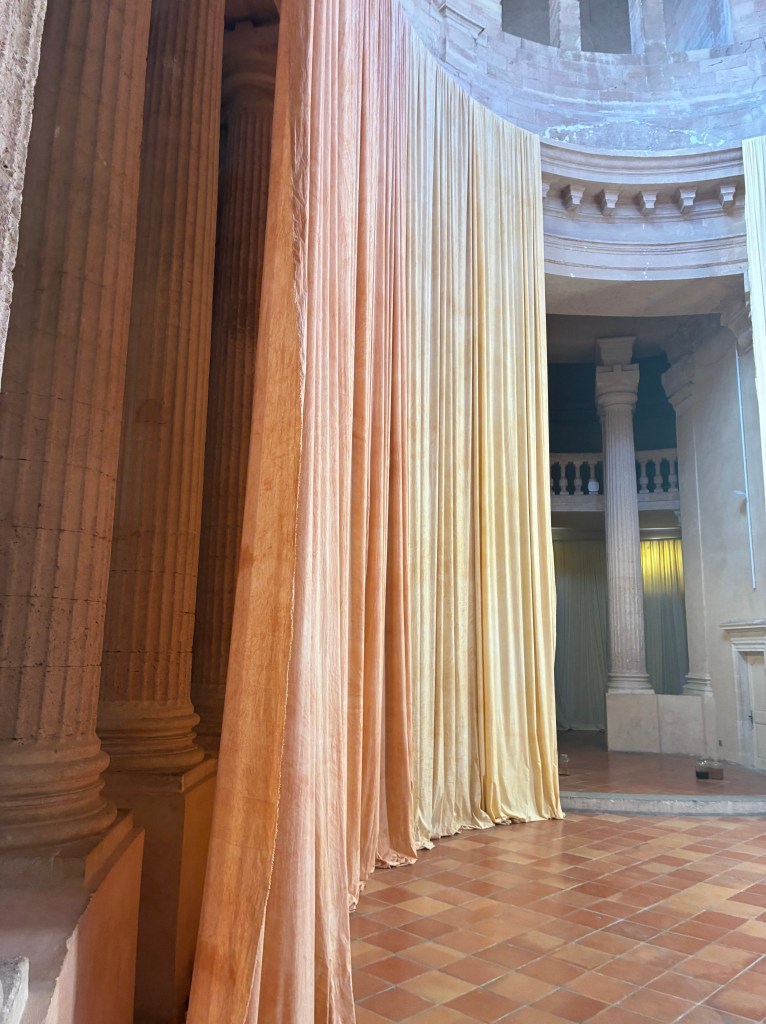

Images: “Dormir comme le soleil” d’Adrien Vescovi © Photos, Nicolas Smirnoff

