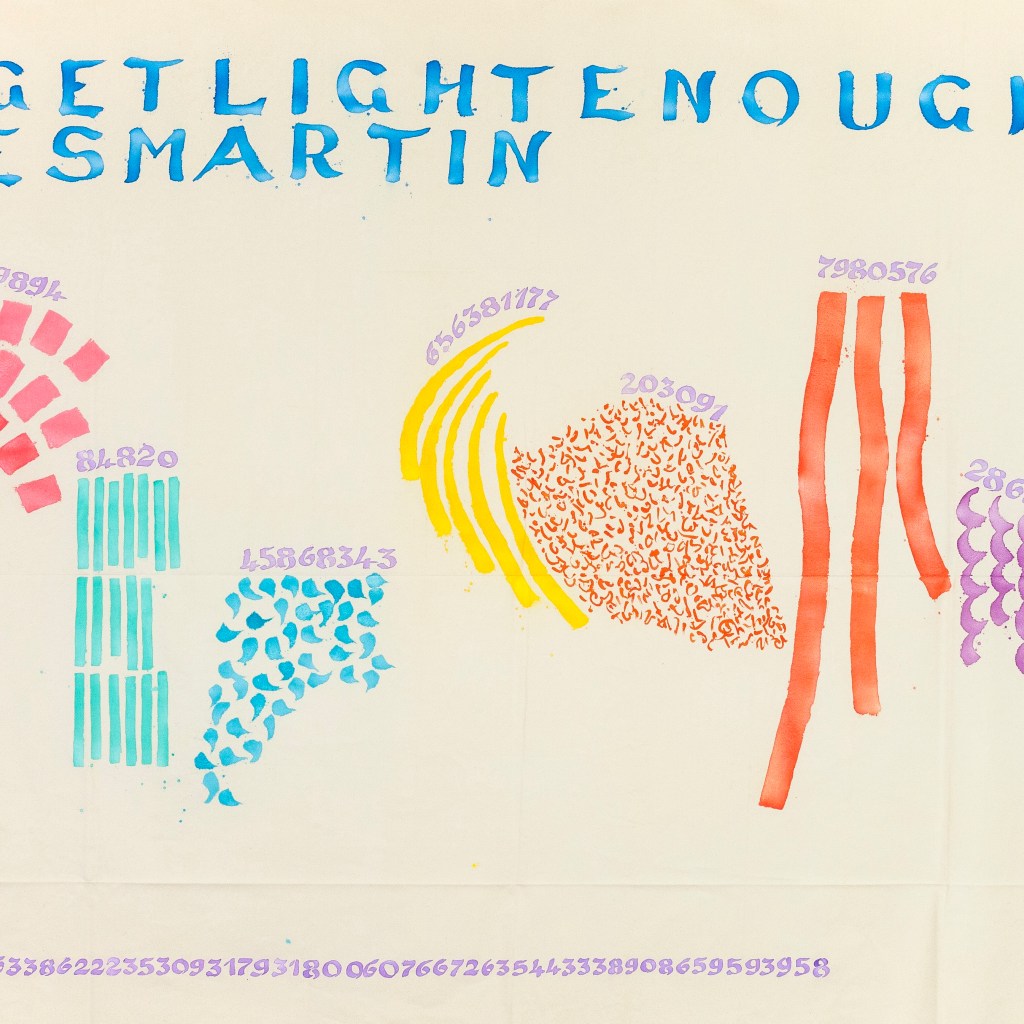
The Clark Art Institute will present Giorgio Griffa: Paths in the Forest from 13 June to 12 October, 2026, marking the artist’s first solo museum exhibition in the United States. The exhibition offers a focused look at nearly six decades of practice by Giorgio Griffa, whose distinctive approach to painting has quietly redefined the boundaries between abstraction, process, and material presence.
Griffa, born in Turin in 1936, he works with diluted acrylic paint on unstretched, unprimed canvas. He allows his surfaces to remain deliberately provisional. The canvases are often pinned directly to the wall and later folded for storage, leaving behind visible creases that become part of their history. For Griffa, these traces are not incidental but integral, evidence of a work that continues to live beyond any single installation. The resulting works are beautiful.
At the core of his practice is what he describes as “the intelligence of materials.” Rather than treating painting as either representation or pure abstraction, Griffa considers his works as material facts, structures that register time, gesture, and interruption. His marks, often repeating sequences of lines, numbers, or rhythmic patterns, evoke systems of writing or counting while resisting fixed meaning. He describes them as “impersonal marks that belong to any hand, with thousands of years of memory,” suggesting a language that precedes and exceeds the individual artist.
A defining aspect of Griffa’s method is his decision to stop before completion. He often “interrupts” a painting mid-flow, guided by the belief that continuation would impose closure on something inherently open. As he has noted, “in the meantime, life has moved on,” a reflection influenced by Zen thought and its acceptance of impermanence. In this way, each work remains suspended in a state of becoming, refusing the finality implied by a finished image.
Over the course of his career, Griffa has developed thirteen loosely connected cycles of work, each exploring variations on form, rhythm, and restraint. He describes these series as “different pathways through the same dark forest,” a metaphor that gives the exhibition its title. The forest becomes both a space of uncertainty and a model for thinking: a place where direction is not predetermined, and where attention replaces resolution. Across his canvases, his sensibility translates into a quiet but persistent invitation to look again, to follow traces rather than conclusions, and to remain attentive to what is still unfolding.
The exhibition is accompanied by a catalogue featuring four scholarly essays, a newly commissioned text by the artist, and extensive studio and installation photography.
Image: Giorgio Griffa, Canone aureo 958 (Agnes Martin) (Golden ratio 958 [Agnes Martin]) (detail) 2016, acrylic on canvas. Courtesy of Fondazione Giorgio Griffa, Turin, and Casey Kaplan, New York

