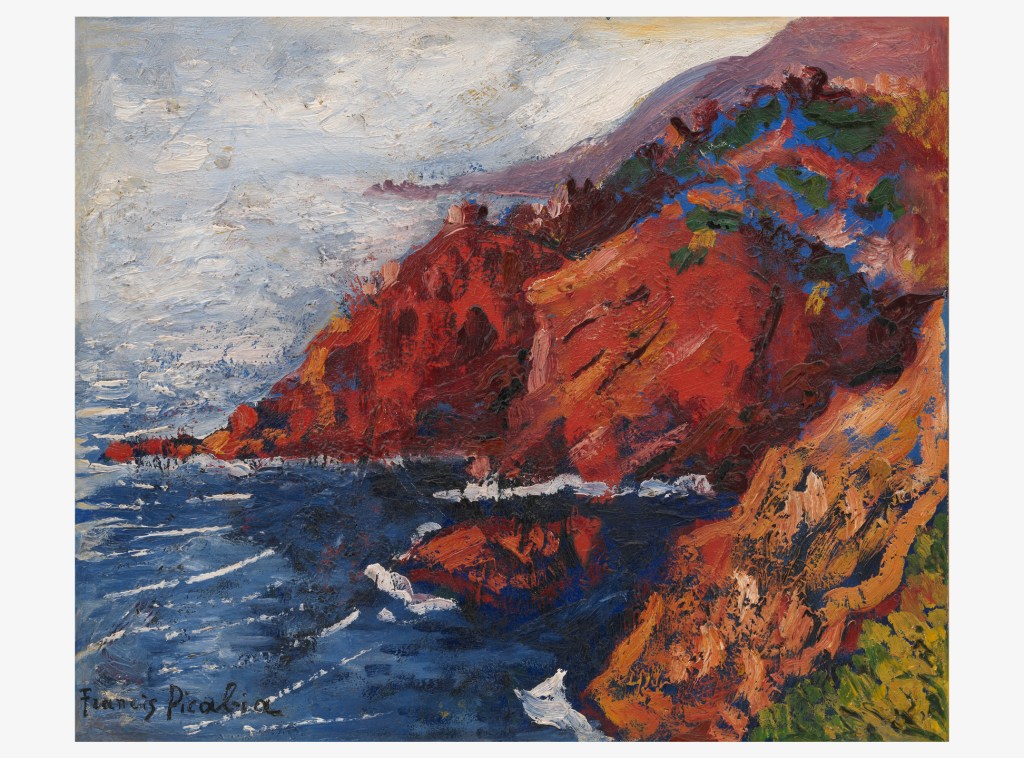
Francis Picabia: Expanding Horizons presented at Hauser & Wirth until 1 August 2026, offers a substantial overview of the artist’s long and deliberately non-linear career, foregrounding the extent to which Picabia resisted stylistic consistency in favour of continual reinvention. It’s one of the strongest private gallery show, this season.
Rather than presenting his practice as a progression through modernist movements, the exhibition is structured around discontinuity. Picabia’s work moves between Impressionism, Cubism, Dada, figuration and abstraction without settling into any single position.
The early works, drawn from the 1900s and 1910s, show an artist initially working within Impressionist and Neo-Impressionist conventions and inspired by Spanish folklore. Even here, however, there is a marked tendency towards rupture, with increasingly open handling of form and colour that begins to push beyond the boundaries of naturalistic description.
The Dada period marks a decisive break. Working across Paris, Zurich and New York, Picabia produced machine-based compositions that reject traditional painterly values in favour of impersonal imagery. Freedom! These works align him with broader anti-art strategies associated with Dada, particularly the work of figures such as Marcel Duchamp, although Picabia’s approach is notably less systematic and more deliberately inconsistent.
A key focus of the exhibition is the “Transparencies” of the 1920s and 1930s. These layered compositions combine multiple iconographic registers, classical references, figures, fragments of earlier works, within densely overlaid structures. Rather than resolving into unified compositions, they operate through accumulation and interference. The works resist hierarchy between images, producing ambiguous spatial and temporal relationships.
The exhibition also gives significant attention to Picabia’s wartime and immediate post-war production, particularly his return to figuration in the 1940s. Works from this period draw heavily on popular imagery, including photography and printed ephemera, often producing explicit or stylised depictions of the figure. These paintings have frequently been discussed in terms of appropriation and provocation, but the exhibition situates them more broadly within Picabia’s ongoing interest in collapsing distinctions between “high” and “low” visual culture.
The final section of the show focuses on late abstraction produced after Picabia’s return to Paris in the mid-1940s. These works are materially dense and often heavily reworked, with surfaces that suggest multiple revisions over time. While abstract in appearance, they frequently retain traces of earlier figurative or symbolic content, complicating any straightforward reading of them as pure abstraction.
Taken as a whole, Expanding Horizons positions Picabia less as a figure aligned with any single modernist trajectory than as an artist consistently working against stylistic stability. The gallery space plays an important role in presenting these rare works. The exhibition shows his role in challenging distinctions between media, image sources and cultural hierarchies.
–
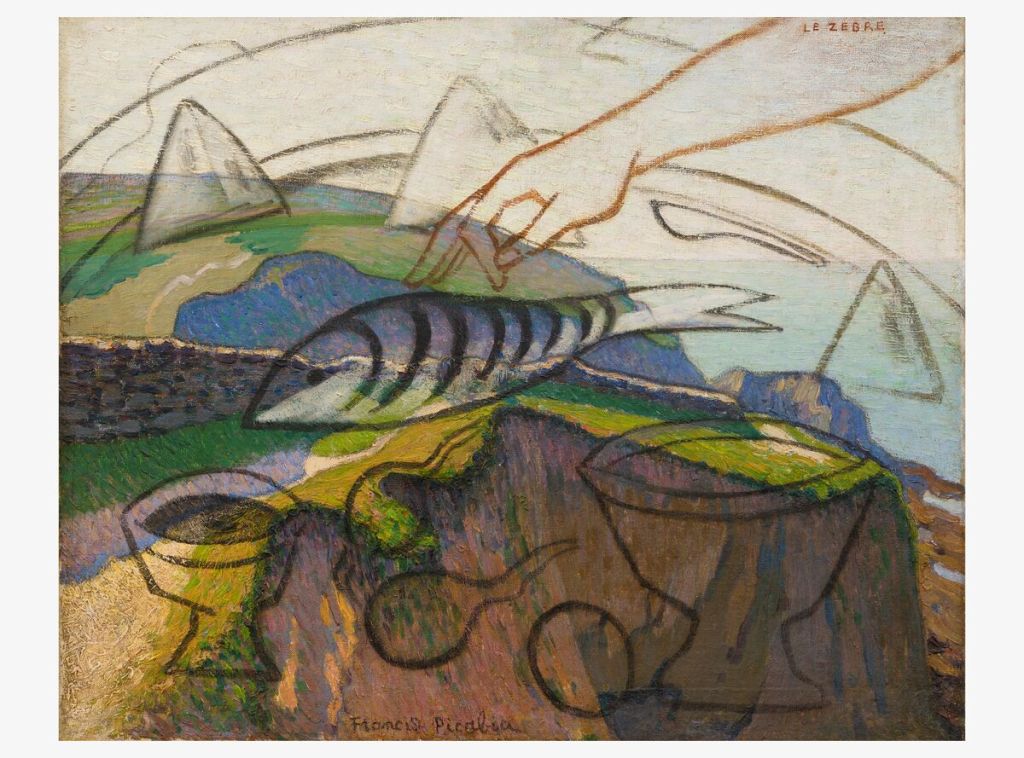
Image: Les rochers rouges (The Red Rocks), ca. 1942 – 1943, Oil on cardboard mounted on wood, Photo: Stefan Altenburger Photography Zürich and Le Zèbre (The Zebra) ca. 1909 – 1933, Photo: Damian Griffiths
 ART IS ALIVE