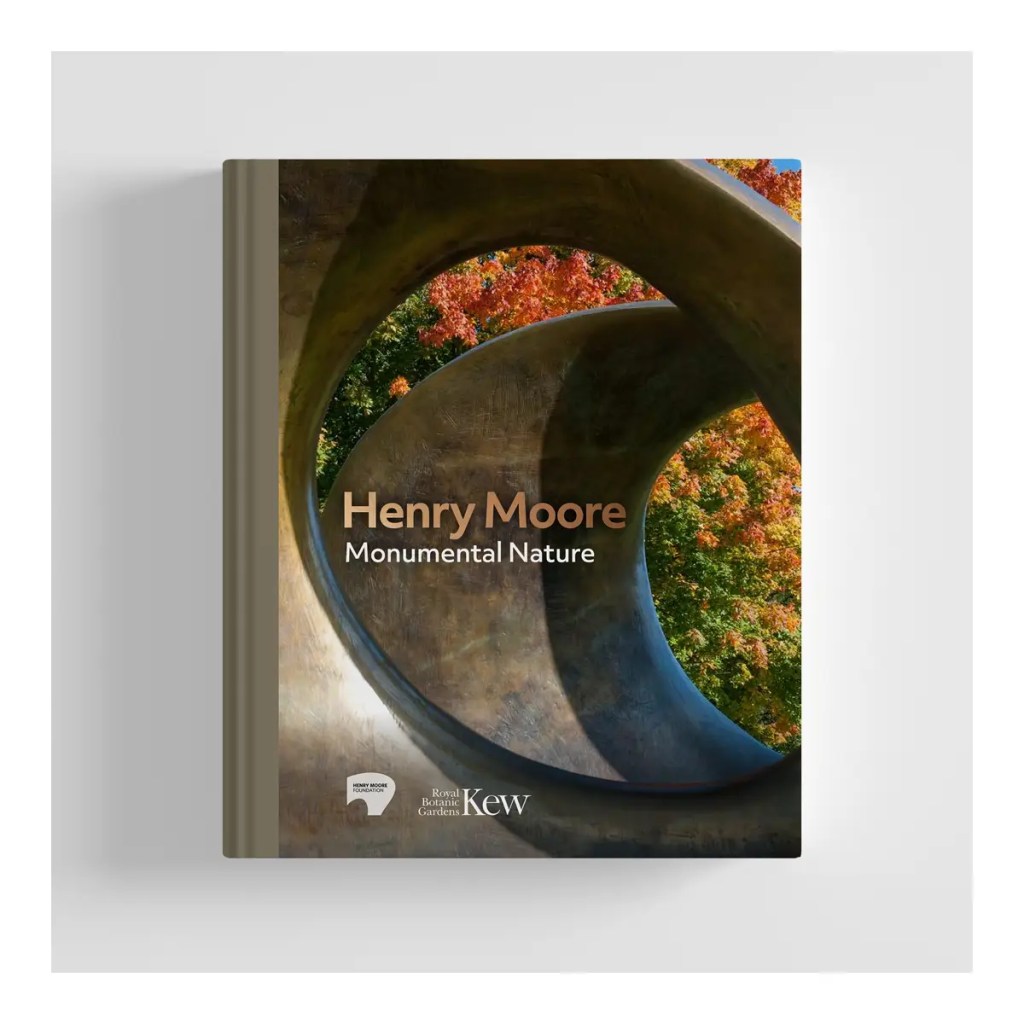
Henry Moore was one of the most influential sculptors of the twentieth century. Henry Moore: Monumental Nature, published by Kew Gardens, accompanies the major exhibition presented at the Royal Botanic Gardens, Kew, organised in collaboration with the Henry Moore Foundation. Bringing together sculpture, landscape, art and science, the exhibition offers a new perspective on one of the defining concerns of Moore’s practice: his profound and enduring dialogue with the natural world.
At the heart of Henry Moore’s work lies a fascination with the processes of nature. Throughout his career, he sought sculptural forms that resonate with growth, weathering, hardening, exposure and erosion. Nature was not, for Moore, a single source of inspiration or a repertoire of forms to imitate, but a system which he translated into material form.
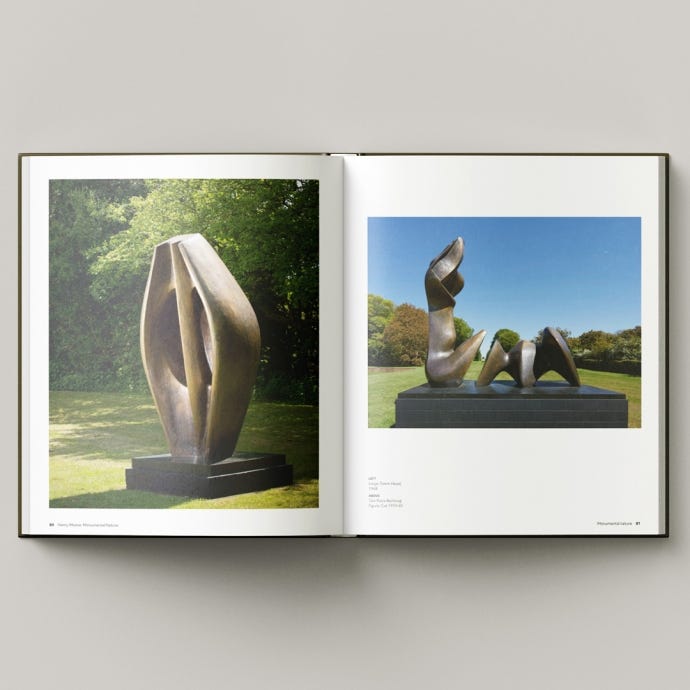
This understanding of nature as an active, evolving force is central to Monumental Nature. Set within the landscape of Kew, Moore’s sculptures can be encountered in direct dialogue with the living world that so profoundly informed his imagination. Trees, stones, bones, shells, landscapes and the human body all recur throughout his work, not as literal subjects but as evidence of a shared visual and structural language.
The connection between abstraction and nature was already recognised in Moore’s lifetime. Herbert Read, one of his most influential advocates, identified this distinctive quality in Moore’s work as early as 1934. In his seminal writing on Moore that year, Read observed that abstraction could “intensify rather than evade” nature, stripping away the incidental in order to reveal the underlying rhythms of organic growth. For Moore, abstraction was therefore not a departure from the natural world but a means of looking more deeply into it. This is also featured in this remarkable book.
The exhibition also asks a contemporary question: what does it mean to look at nature today? Moore’s work reminds us that the natural world is not simply something to observe or represent, but a complex system of relationships of which we are part.
Featuring contributions from leading art scholars and Kew experts, the publication expands this dialogue, examining Moore’s work through both artistic and botanical perspectives. Together, the exhibition and book invite us to reconsider the ways in which art can deepen our understanding of the living world, and how encounters with nature can, in turn, transform our understanding of art.
For the Royal Botanic Gardens, Kew and the Henry Moore Foundation, bringing Henry Moore: Monumental Nature to fruition has been an opportunity to bring these two worlds together. As Godfrey Worsdale OBE, Director of the Henry Moore Foundation, and Richard Deverell, Director of the Royal Botanic Gardens, Kew, write, the exhibition invites visitors to reflect on “the beauty and fragility of the natural world and to consider the responsibility we share in sustaining it.”
Their hope, through the show and the book, is that each visitor leaves with a renewed sense of “inspiration, curiosity and care for art and for the world we all inhabit”, a fitting response to an artist for whom nature was always an inspiration.
–
 ART IS ALIVE