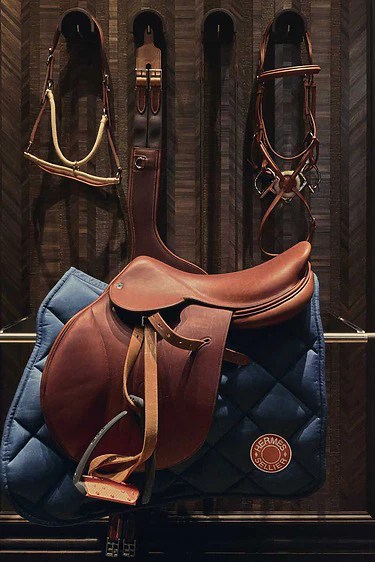
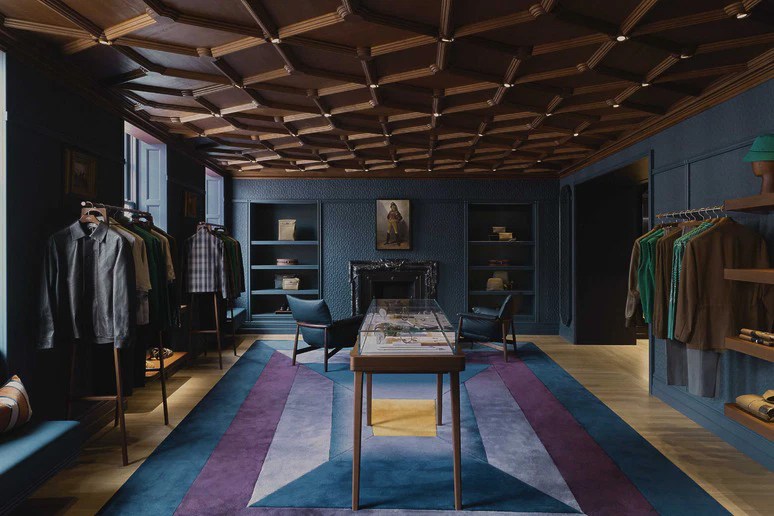
Hermès’ New Bond Street Maison reframes the idea of the flagship store as something closer to an architectural journey than a retail destination. Spanning six interconnected Georgian buildings in central London, the project unfolds across more than fifty rooms and five floors, transforming a complex historic site into a continuous but deliberately fragmented spatial experience. Impressive!
“Our grandfather always called Hermès the most British of French brands,” says Axel Dumas, a sixth-generation member of the founding family and the house’s CEO since 2013, as the new Hermès maison opens on London’s Bond Street. “He always referred to the elegance and know-how of British equestrian culture. So it’s quite intimidating for us to be here in London, paying homage to the country we admire so much.”
Conceived by RDAI under the artistic direction of Denis Montel and Pierre-Alexis Dumas, the design resists the logic of uniformity. Instead of imposing a single architectural language across the site, it embraces the irregularities of the existing buildings. Variations in ceiling height, shifting axes, and subtle discontinuities in circulation are left visible, becoming the organising principles of the visitor’s experience. Movement through the Maison is not linear but by spaces and themes, structured by contrast, transition and surprise.
Once an exposed, open-air pass, the ground level has been artfully enclosed beneath a high-tech steel and glass roof designed by Lord Norman Foster. Foster’s firm also masterminded the sweeping limestone staircase that anchors the atrium, while the floor below features a subtle nod to the brand’s Parisian origins: the signature Faubourg mosaic pattern, meticulously rendered here in muted shades of ivory and gray.
This sense of architectural narrative is central to the project. Each room is conceived as a distinct atmosphere, defined by material, proportion and light. Rather than presenting Hermès’ métiers in a standardised retail format, the Maison distributes them across a sequence of interiors that feel individually composed. The result is a rhythm of spatial encounters, where each threshold opens onto a new experience.
Materiality plays a key role in shaping this progression. Handcrafted surfaces, bespoke wall treatments, straw and horsehair marquetry, patinated metals and finely worked timber sit alongside preserved historic details from the original Georgian and Victorian structures. Rather than erasing the building’s past, the design incorporates it, allowing traces of earlier domestic and architectural life to remain legible. This creates a layered environment in which time is visibly sedimented.
The Maison also reflects a sustained dialogue between British architectural heritage and Hermès’ own craft traditions. References to London’s material history are embedded not as decorative gestures but as structural and atmospheric influences. The result is a building that feels both locally grounded and internationally attuned, where Parisian craftsmanship and London’s architectural eccentricities coexist within a single, evolving framework.
Staircases, corridors and transitional spaces are treated with the same level of attention as display rooms, reinforcing the sense that architecture itself is the primary medium of encounter. Retail becomes secondary to movement; objects are encountered within a broader spatial narrative rather than isolated presentation.
What emerges is a conception of luxury defined less by homogeneity than by specificity. The value of the space lies in its differences, in the way each room asserts its own identity while remaining part of a coherent whole.
Ultimately, the New Bond Street flagship positions Hermès within a broader architectural discourse about time, memory and adaptation. It is a building that operates as both restoration and reinvention, where the past is neither frozen nor erased but actively reworked into the present. In doing so, it reimagines the flagship not as a static container for commerce, but as a living architectural sequence, part archive, part atelier, part gallery (featuring Lee Miller’s works for instance) and part luxury promenade.
–