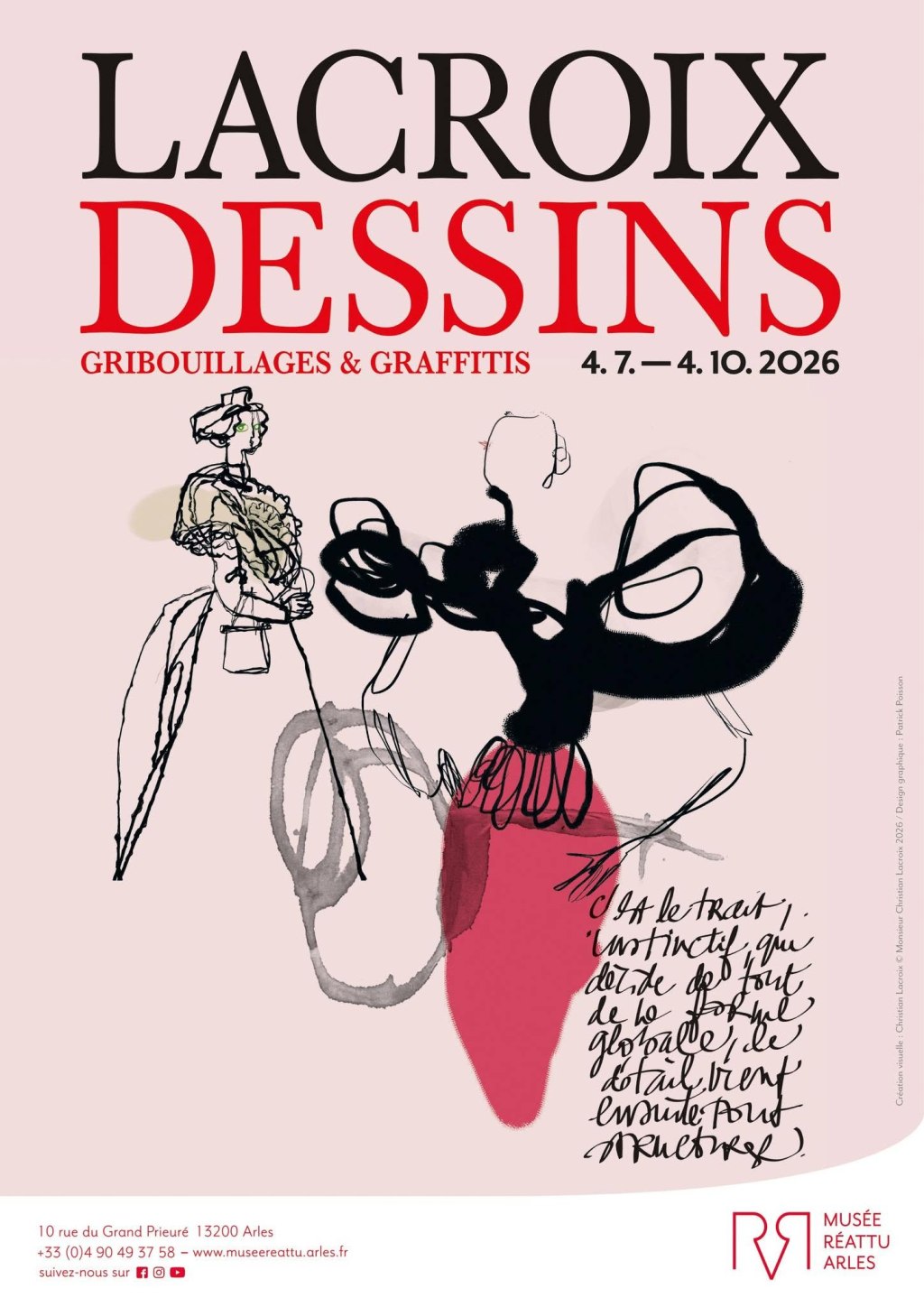
The Musée Réattu in Arles is presenting two exhibitions dedicated to Christian Lacroix, “Dessins, gribouillages et graffitis” and “Collectionneur de photographies,” until 4 October 2026. Born in Arles, Lacroix has worked across fashion, costume, illustration and design, and the two exhibitions examine his practice as a draughtsman and his long-standing interest in photography. This dual, compelling exhibition reveals a lesser-known side of Lacroix’s creative practice, beyond his celebrated career in fashion.
“Dessins, gribouillages et graffitis” brings together more than 60 years of Lacroix’s graphic work, from drawings made during childhood to recent pieces. The exhibition includes sketches, illustrations, graphic studies and more informal works, demonstrating the role drawing has played throughout his career.
For Lacroix, drawing has always been a significant part of his creative process. His influences range from illustrators to painters. Asked about the artists he admires, he cites Sempé, Kiraz and Ronald Searle, as well as Picasso. He particularly refers to Picasso’s “carcasses and saltimbanques” period, which he associates with his memories of growing up in Arles, including its ruins and bullfighting culture. His own drawings similarly move between observation, humour and darker imagery. Picasso has been shown at Musée Réattu several times. As he puts it, “I love darkness, and I love drawing monsters, but nicely wicked ones.”
The exhibition also provides context for the relationship between Lacroix’s drawing and his approach to fashion. Although his couture is known for its extensive use of colour, Lacroix describes his interest less in individual colours than in their combinations: “I love mixtures, when one tone sits next to another.” He recalls his attraction to polka dots, stripes, checks and different fabrics, while noting that his couture collections actually contained more black and white than is often assumed. His drawings tend to be similarly restrained, often using no more than three colours, with black added over them. “Black is all colours at once,” he explains, adding that there are, in his view, many different shades of black.
The exhibition also highlights drawing as a process rather than simply a means of producing finished images. Lacroix says that the part he enjoys most is “starting”, while finishing is more difficult for him. He describes the same tendency in his fashion career, where he would begin working on the next collection before completing the previous one. His former workshops even nicknamed him “Mister More”, reflecting his tendency to continue adding ideas rather than stopping at a fixed point.
As visitors enter this section, a ceramic plate featuring Lacroix’s hand, made by Atelier Ravel in Aubagne, introduces the breadth of his creative practice across different media.
The display includes his projects for opera and theatre, as well as drawings made on letterheads, hotel notepads and other everyday materials. Towards the end of the show, highlights include an illustration for Philippe Utz, alongside numerous other works that demonstrate the range and spontaneity of Lacroix’s graphic practice.
The second exhibition, “Collectionneur de photographies,” focuses on Lacroix’s passion as a collector. Over approximately three decades, he has assembled a personal collection of photography that includes works by photographers such as Sarah Moon, Katerina Jebb, Annie Leibovitz and Paolo Roversi.
Annie Leibovitz’s 1990 portrait of Lacroix welcomes visitors as they enter the exhibition, immediately establishing its focus on the designer as both subject and collector. Nearby, Erwin Wurm’s 2004 photograph of Lacroix at Café de Flore is displayed alongside a sculpture of the lion that adorns the fountain on Place de la Mairie in Arles. The juxtaposition creates a particularly direct connection between Lacroix and his native city, bringing elements of his personal and professional life into dialogue with the museum’s surroundings.
Later in the exhibition, Paolo Roversi’s vibrant photograph of a model in Lacroix’s studio, set against a striking green background, is presented alongside a drawing of an ‘Arlésienne’ by Léopold Lelée. The pairing brings together two distinct approaches to the representation of women and fashion, while reinforcing the exhibition’s recurring connection between Lacroix’s visual world and the artistic traditions of Arles.
One of the exhibition’s most effective installations brings together Jacques Réattu’s La Vision de Jacob, both the large scale painting and the smaller preparation work, with Michael Roy’s photograph of a young man from 2007. The works, separated by more than two centuries and created in very different media, are placed in direct dialogue. Their similarities and contrasts create a strong visual relationship and demonstrate how the exhibition uses unexpected juxtapositions to connect Lacroix’s photographic collection with the Musée Réattu’s historic collection.
The photography exhibition shifts the focus from Lacroix’s own production to the images and artists that have interested him as a collector. It provides an additional perspective on his visual references and on his longstanding relationship with photography and portraiture.
Presented together, the two exhibitions examine complementary aspects of Lacroix’s relationship with images: his own work as a draughtsman and illustrator, and his role as a collector of photography. They also place his fashion career within a broader creative practice that encompasses illustration, costume, theatre and the visual arts.
For the Musée Réattu, the exhibitions also represent a return to Lacroix’s native Arles. Rather than presenting his connection to the city solely as biographical, the exhibitions demonstrate how elements of his early visual environment have remained part of his artistic vocabulary.
“Dessins, gribouillages et graffitis” and “Collectionneur de photographies” are on view at the Musée Réattu in Arles until 4 October 2026. This is one of 2026’s most important exhibitions.
–
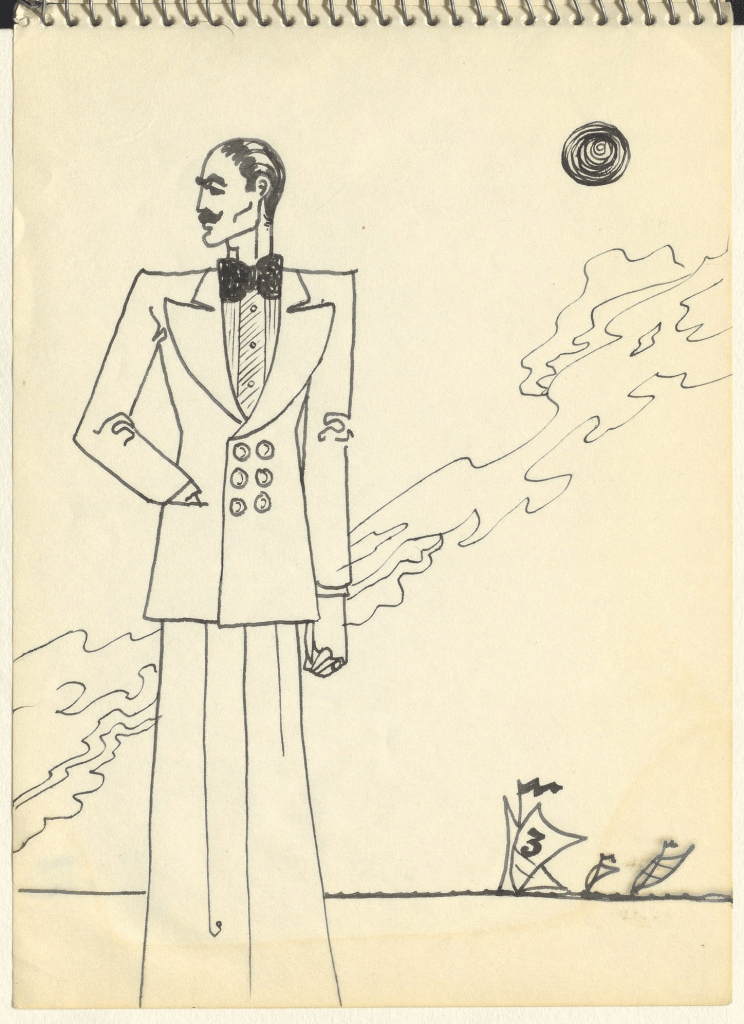
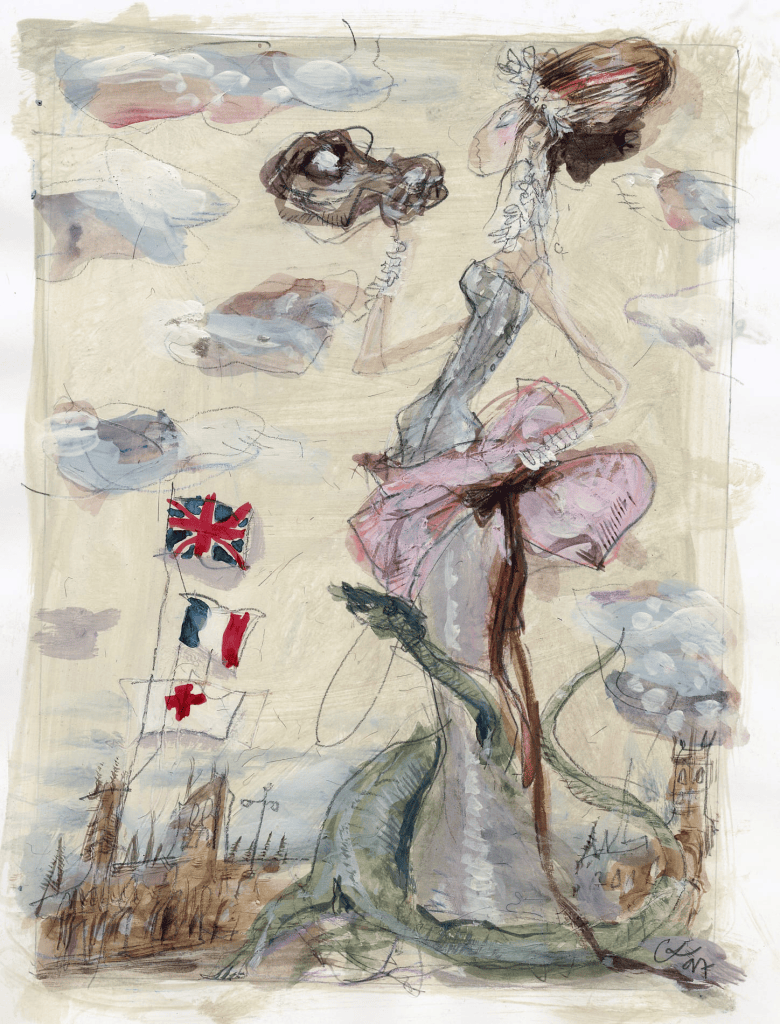
Images: Views of the exhibition and Christian Lacroix, Sans titre, années 1970. © Monsieur Christian Lacroix, 2026 and Christian Lacroix, Sans titre, c.1997. © Monsieur Christian Lacroix, 2026.

