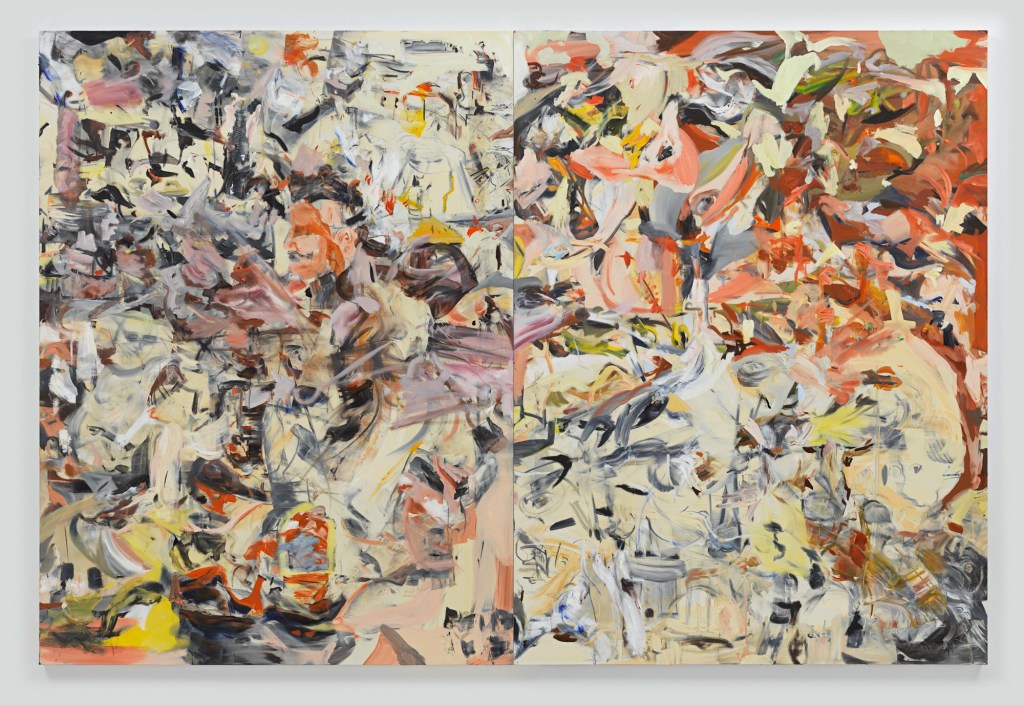
Naples’ particular mixture of beauty and disorder, the intense light across the Bay, ancient ruins, crowded streets and the constant collision between past and present, has long provided a natural counterpart to the restless energy of Cecily Brown’s paintings. Her fourth exhibition with Thomas Dane Gallery, A sunset, a ruin, a crowd, and a battle, runs from 29 September to 19 December 2026 at the gallery’s Naples space on Via Francesco Crispi. It will follow an important exhibition of recent and new works at Serpentine, in London.
A sunset, a ruin, a crowd, and a battle brings together around thirty new paintings and drawings in which the artist considers the European summer as both an idyllic fantasy and a scene of increasing congestion. Historic cities, sunsets and outdoor cafés become settings for figures, while fragments of mythology, archaeology and art history surface within the compositions. The result is a series of paintings in which the distinction between the ancient and the contemporary is deliberately unstable.
Brown first visited Naples in the early 1990s, before moving from London to New York. She was struck by the city’s energy, the clarity of its light and the way shadows move across the Bay. She returned in 2019 for her first exhibition at Thomas Dane Gallery in Naples, Naples, We Didn’t Mean to Go to Sea, which drew on the tradition of Romantic shipwreck painting while addressing contemporary migration.
For A sunset, a ruin, a crowd, and a battle, Brown turns her attention from the sea to the land. The title comes from a 2025 painting that brings together references spanning centuries of European history. Figures appear and disappear within the composition, while multiple perspectives seem to collapse into one another.
The same tension is evident in Sorrento Sunset (2025–26), a painting almost four metres wide that depicts a crowded European resort at the height of the summer season. The traditional imagery of the Mediterranean holiday, sunset, sea, aperitivo and picturesque views, is disrupted by the sheer number of people competing for the same experience. Brown’s dense brushwork mirrors the movement of the crowd, transforming an apparently idyllic scene into something more uneasy.
Across these large-scale paintings, Brown returns to a subject that has long informed her work: the possibility of finding the monumental within the everyday. The tourists in her scenes become participants in a new form of history painting, their contemporary rituals, taking photographs, drinking cocktails, searching for the perfect view, placed alongside references to mythology and the history of European art.
The smaller paintings offer more intimate episodes. Angelina, the waitress at the pizzeria (2025), for example, can be read in relation to three depictions of Pandora, the mythological first woman created by the gods. Other works suggest parts of Naples and its surrounding cities that remain outside the conventional tourist experience, while drawing on the tradition of Belle Époque boudoir painting to evoke a more private and opulent world.
The exhibition extends beyond painting to include drawings and etchings. Brown reimagines the sparse piazzas and statues associated with Giorgio de Chirico as crowded contemporary spaces, while beaches become almost entirely obscured by their visitors. Two new etchings, Tequila Sunrise and Tequila Sunset (both 2026), made in collaboration with Two Palms, incorporate hand-painted colour inspired by the ombré tones of the cocktails associated with European summer resorts.
In Naples, where layers of history are visible almost everywhere, Brown’s paintings find an appropriate setting. A sunset, a ruin, a crowd, and a battle brings together mythology, tourism, art history and contemporary life, treating the Mediterranean summer not simply as a landscape of escape but as a place where different versions of Europe, ancient, modern, beautiful and chaotic, continue to meet.
–
Image: Cecily Brown, A sunset, a ruin, a crowd, and a battle, 2025 © the artist. Photo: Genevieve Hanson.

