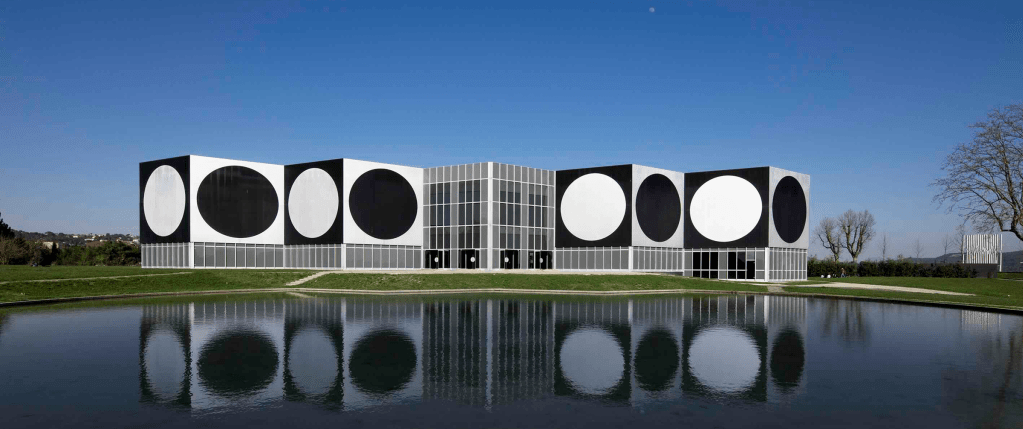
On the outskirts of Aix-en-Provence, a building unlike any other rises from the landscape: the Fondation Vasarely, Victor Vasarely’s radical vision of what art could become when freed from the confines of the museum. Opened in 1976, the ‘Centre architectonique’ remains the culmination of the artist’s lifelong research, a remarkable environment filled with site-specific works, movable displays and its distinctive octagonal, black and whiet architecture. Here, the space itself becomes an experience. It’s very fitting for a city, known for giving birth to another giant artist: Cezanne!
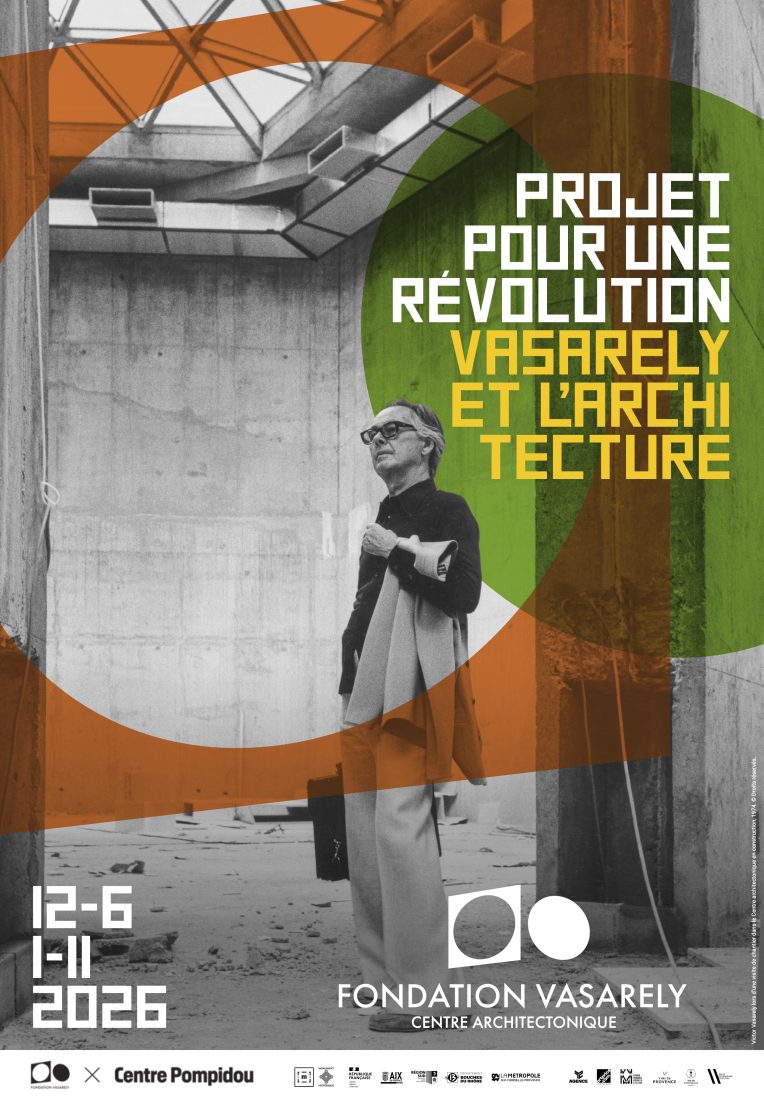
And what better place to consider the relationship between art and architecture than the Fondation Vasarely, which currently presents Projet pour une révolution. Vasarely et l’architecture, an exhibition exploring the artist’s vision of architecture as a vehicle for social and artistic transformation.
Described as the “Sistine Chapel of optical and kinetic art”, the foundation is both museum and manifesto. Its monumental architecture, composed of geometric forms and bold patterns, was conceived by Vasarely himself, as a total work of art in which painting, sculpture, tapestry and architecture could merge into a single environment. It demonstrates how profilic the artist was.
The exhibition, presented on the occasion of the 120th anniversary of Vasarely’s birth and the 50th anniversary of the inauguration of the Centre architectonique, turns its attention to the origins of this remarkable building. Classified as a historic monument in 2013 and recognised as a Musée de France in 2020, it stands today as a rare surviving expression of Vasarely’s architectural and social ideals.
Through exceptional loans from institutions including the Centre Pompidou, the Médiathèque du Patrimoine et de la Photographie, the Musée national Fernand Léger in Biot, the Musée de Grenoble and the Frac Centre-Val de Loire, the exhibition follows Vasarely’s determination to bring art out of galleries and into the heart of the city. Alongside his own research are projects by architects and visionaries who shared his interest in reshaping the built environment, including Carlos Raúl Villanueva’s studies for the University City of Caracas and Yona Friedman’s celebrated concept of the Ville spatiale. Downstairs, the exhibition also features an artist close to Vasarely’s heart, Fernand Léger.
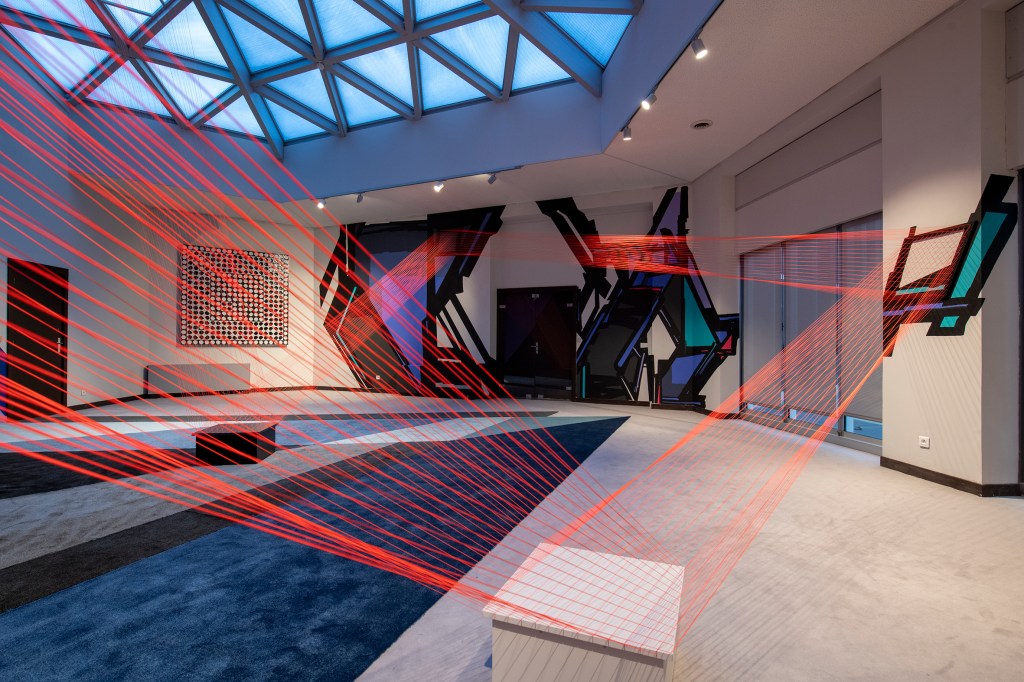
At the centre of Vasarely’s thinking was the conviction that art, architecture and design should no longer exist as separate disciplines. For the artist, integrating art into architecture was not merely an aesthetic gesture, but a social project. By transforming the spaces in which people lived, worked and moved, art could become accessible to everyone, enriching the everyday rather than remaining the privilege of the museum visitor. A domestic display and paintings on buildings’ facades demonstrate this noble ethos. Art to improve lives.
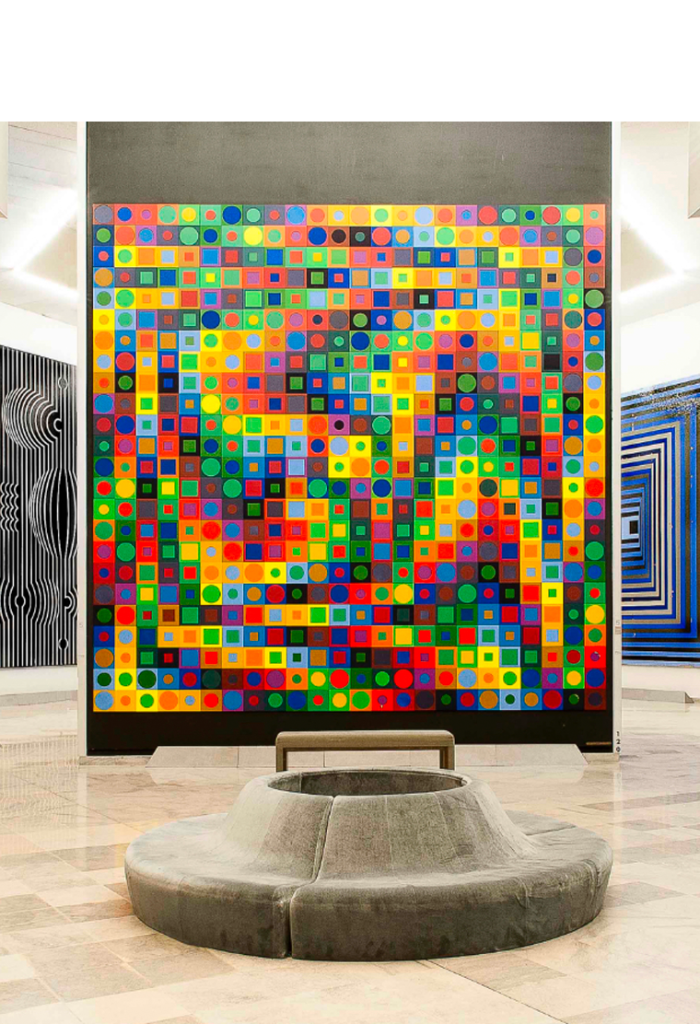
This idea is perhaps nowhere more clearly expressed than within the foundation itself. Its monumental integrations, 42 works measuring approximately five metres wide and eight metres high, are inseparable from the architecture. Rather than hanging on the walls, they become the walls, transforming the visitor’s perception of space through an intricate choreography of geometric forms, colour and repetition.
Vasarely’s visual language is deliberately elemental. Circles, squares, hexagons and cubes are reduced to pure form, while strong blocks of colour are subjected to processes of repetition, displacement and gradual distortion. The result is deceptively simple: surfaces appear to swell, recede, vibrate and move. Architecture becomes optical experience.
The visitor is therefore not simply an observer and in an era when social media dominates life, Vasarely was once again a pioneer. Walking through the foundation activates the work. Perspective shifts, patterns seem to oscillate and volumes appear to change depending on where one stands. It is precisely this instability that gives Vasarely’s art its enduring fascination: the work exists somewhere between the physical and the perceptual.
Alongside the architectural integrations, the foundation presents a substantial journey through Vasarely’s career, from his early years as a graphic designer to the development of his mature abstract language and his ambitious vision of a cité polychrome du bonheur. Nearly 250 works and original documents trace the evolution of an artist who sought to make visual art universal, reproducible and inseparable from modern life. David Bowie understood how modern it felt at the time, and the artist’s biographical elements, upon arrival, showcases him in front of one of Vasarely’s environments. Striking!
A dedicated room, named after collector Lucien Arkas, further explores the continuing fascination with Vasarely’s work through a selection of twelve works from his collection.
Yet perhaps the most compelling aspect of the Fondation Vasarely is that the artist’s utopian ideas have not remained confined to history. The building still proposes a question that feels remarkably contemporary: what happens when art ceases to be an object placed within architecture and instead becomes architecture itself?
Vasarely imagined a world in which visual beauty could inhabit the streets, buildings and spaces of everyday life, a world in which colour and geometry could counter what he called visual nuisances and contribute to a more harmonious environment. His dream of a “polychrome city of happiness” may have been utopian, but in Aix-en-Provence it acquired a concrete form. His work pushed the boundaries of perception and art history forever.
Fifty years after its opening, the Fondation Vasarely remains an extraordinary monument to that idea: part museum, part laboratory, part architectural experiment. More than a place to see Vasarely’s art, it is a place to experience it and in one of the most beautiful cities of the south of France. It should be on every art aficionado and collectors’ journey.
–