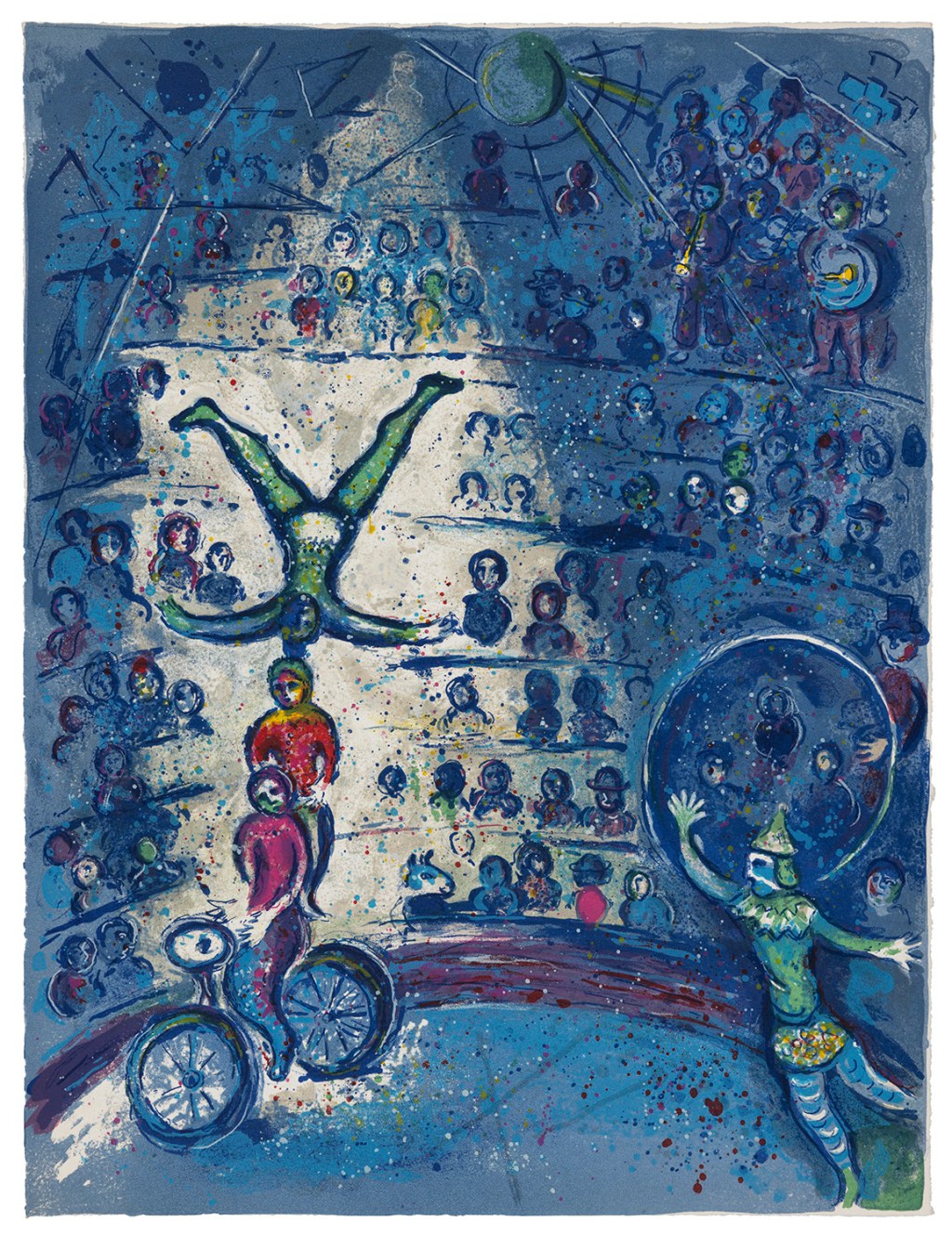
From November, The Hepworth Wakefield will present Marc Chagall: The Circus, a major exhibition exploring the artist’s lifelong fascination with the world of the circus and its cast of acrobats, clowns and dreamlike performers. Bringing together more than 50 works created between the 1920s and the 1980s, the exhibition reveals how Chagall transformed the circus into a powerful metaphor for the fragility of human life.
‘For me a circus is a magic show that appears and disappears like a world. A circus is disturbing. It is profound.’ Marc Chagall said.
At the heart of the exhibition is Le Cirque, the celebrated suite of lithographs Chagall produced in 1967. Originally published alongside a personal essay reflecting on the significance of the circus, the text has now been translated into English in its entirety for the first time and appears in the accompanying exhibition catalogue.
Across his prolific career, Chagall repeatedly returned to circus imagery, creating vibrant lithographs, paintings and works on paper infused with memory. The exhibition traces this enduring theme through a rich selection of works and archival material, illuminating the artist’s unique visual language and the deeply personal experiences that shaped it.
Chagall’s experiences of revolution, war, antisemitism and exile, first from Russia to France and later to America, imbued the circus with deeper emotional resonance, its performers becoming poetic figures through which he explored displacement and hope.
The exhibition will also look at Chagall’s important collaborations with the theatre. Highlights include The Dance and The Circus (1950), generously lent by Tate and originally conceived as a mural for London’s experimental Watergate Theatre, alongside costume, poster and set designs created for the Metropolitan Opera’s acclaimed 1966 production of The Magic Flute in New York.
Another section explores Paris as a recurring source of inspiration, from the exuberant Cirque Vollard gouaches of 1927, created after renowned art dealer Ambroise Vollard invited Chagall to sketch from his private box at the Cirque d’Hiver, to works produced following the artist’s return to the French capital after the Second World War.
The exhibition also focuses on the performers who most captivated Chagall, including clowns, acrobats, trapeze artists, bareback riders and musicians, presenting these figures alongside excerpts from his Le Cirque writings to reveal how they allowed him to navigate the space between joy and melancholy, spectacle and vulnerability, and what he described as “other horizons.”
Eleanor Clayton, Head of Collections and Exhibitions at The Hepworth Wakefield and curator of Marc Chagall: The Circus, said: “By examining many of Chagall’s circus lithographs in dialogue with related paintings and writing, the exhibition offers visitors a unique insight into the creative process and poetic imagination of one of the greatest masters of modern art.”
The exhibition will run from 21 November 2026 to 25 April 2027.
Image: Marc Chagall, Le Cirque, 1967, Lithograph. Collection of Kunstmuseum Pablo Picasso, Münster. © 2025 ADAGP, Paris and DACS, London.

