
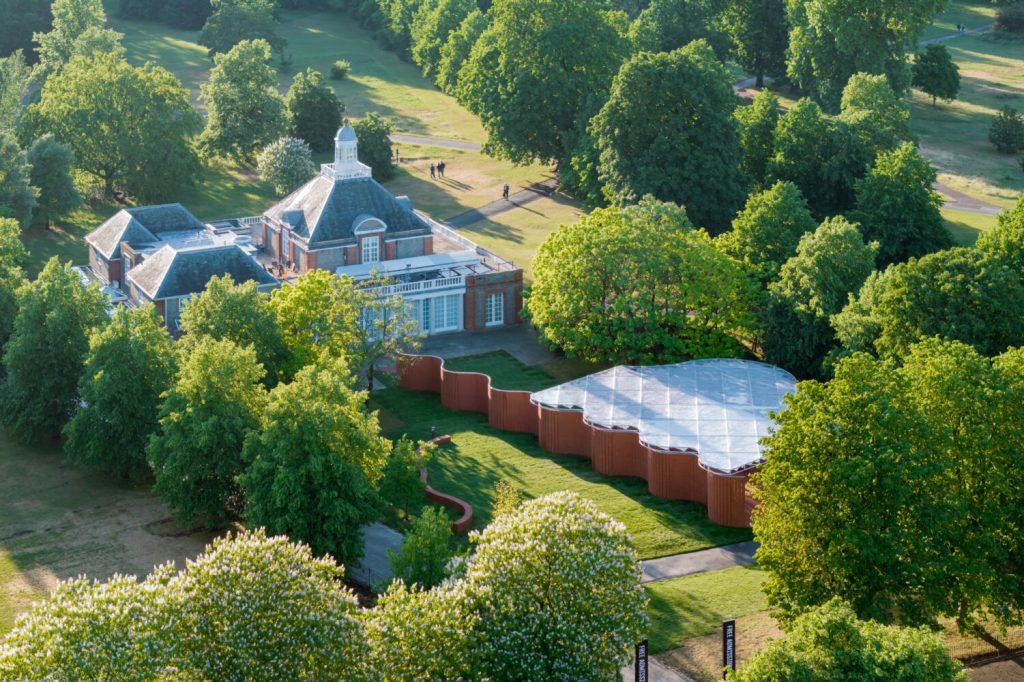
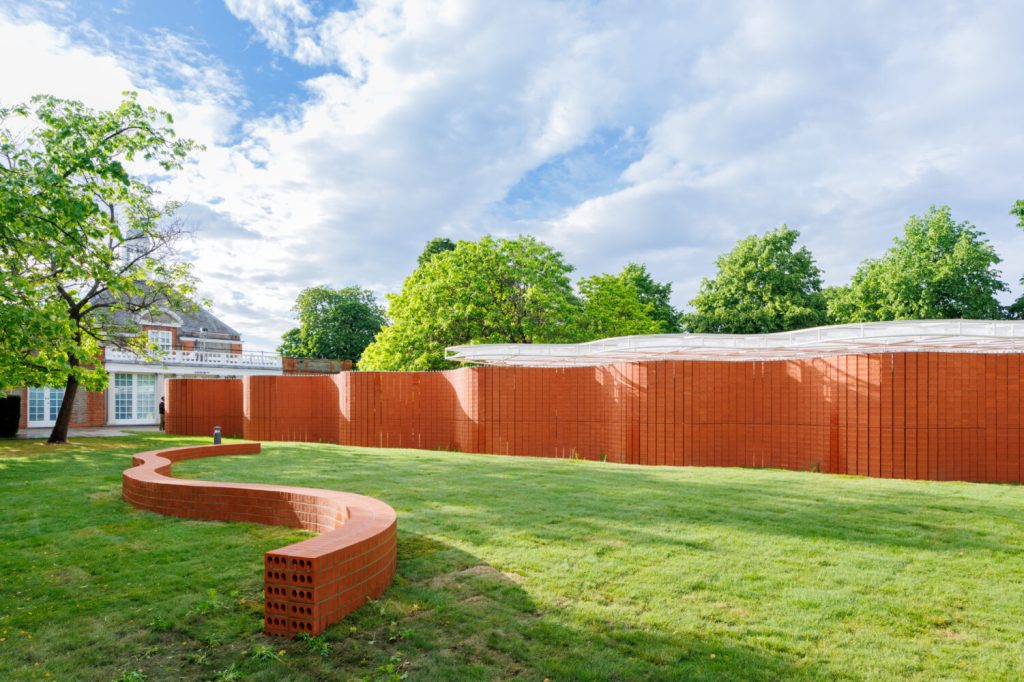
For the 25th Serpentine Pavilion, Mexico City–based LANZA atelier has transformed one of architecture’s oldest elements, the brick wall, into a contemporary framework for gatherine. Titled a serpentine, the project reinterprets the historic crinkle-crankle wall, a centuries-old masonry typology found in Suffolk gardens, as a porous and dynamic social space.
Rather than treating the wall as a boundary, architects Isabel Abascal and Alessandro Arienzo deploy it as a tool that shapes movement, and encourages interaction. An elegant gently curving brick structure, paired with a translucent canopy and rhythmic colonnades, creates an environment where light, air and people flow freely between cocooning and landscape.
Opening at the Serpentine last week, the Pavilion reflects LANZA atelier’s longstanding interest in vernacular forms, craft traditions and collective experience. Founded in 2015, the Mexico City practice has built a reputation for projects that explore the relationship between material culture, climate and social life, often revisiting historical typologies through a contemporary lens. And promoting beauty!
At a moment when architecture is frequently defined by spectacle, a serpentine offers a quieter proposition. Drawing inspiration from England’s winding fruit walls, structures designed to create shelter, regulate climate and support growth, the Pavilion foregrounds the environmental and social intelligence embedded within traditional construction methods.
More than a temporary structure, a serpentine proposes architecture as a relational condition rather than a static object. In an age marked by social fragmentation and environmental uncertainty, LANZA atelier suggests that architecture’s most radical gesture may not be spectacle, but openness: a wall that connects rather than divides, and a space that invites people to come together. A gesture.
What was your reaction when you were first asked to design the Serpentine Pavilion?
We were deeply honoured for the opportunity to share our work with a wider audience and advance the commission’s legacy of experimentation. We also felt committed to showcasing architecture as a tool to improve our surrounding.
We see this commission as an opportunity for the wider public to focus on architecture. We would like visitors to relate to the idea that we all dwell and are all somehow connected to architecture, and therefore we can all reflect on what kind of architecture we need amidst the world’s ecological crisis to foreground gathering and collective experience.
When did you first become aware of the Pavilion Commission and what did you think about it?
IA: I first heard of the Serpentine Pavilion in 2002, the year I started architecture school. Toyo Ito had completed a fully aluminum-framed house a couple of years prior and I had come across it in a magazine so I became interested in Toyo Ito’s work, especially the Médiatèque in Sendai and the Pao for the Tokyo Nomad Girl. Soon after I discovered his design with Cecil Balmond for the 2002 Serpentine Pavilion.
AA: For me, Frank Gehry’s Pavilion in 2008 was the first one I was aware of. I didn’t know much about architecture at the time. I will always remember how astonished I was by the complexity and the ugliness… Now I can relate to the pursuit of beauty behind Gehry´s concepts and vision. RIP.
The Serpentine Pavilion is a much-anticipated landmark in London each summer. How does it feel to be designing a structure so central to The Royal Parks?
Being in such an idyllic context as Kensington Gardens we feel it is the perfect time to discuss what the idea of a garden means and how an English garden is related to historical elements of architecture and ancient materiality.
Many authors refer to the etymology of paradise which comes from the Avestan word pairidaeza. Theyinterpret this term, which is composed of pairi (around) and daeza (wall), as refering to a garden surrounded by walls. Instead, we like to consider that in the encounter between around and wall, a compelling concept arises: the place that happens around a wall. From our architectural perspective, paradise arises in the balance between human intervention and the natural context around it.
Each Serpentine Pavilion is unique. What makes your Pavilion unique? Tell us about your inspiration.
As we were working on our proposal for the Serpentine Pavilion, we naturally came across an English architectural feature also called serpentine. This is the crinkle-crankle wall, a type of brick wall with alternating curves that originated in Ancient Egypt and was brought to the UK by Dutch engineers as far back as the 17th century. By virtue of its sinuous shape, the serpentine wall is recognized for requiring fewer bricks than a straight wall, as its winding geometry introduces lateral support to an otherwise flimsy one brick wide structure. In the hands of gardeners and built on an East-West axis, these elements become fruit-walls that soak up the heat from the southern exposure and release it at night, providing a warm agricultural environment. The structure employs less while providing more, which is a timely lesson for our current era of overconsumption.
It’s quite magical that the same word gives name to a water feature, a lake, to a place, Serpentine, and to an architectural element, a wall. Especially considering the powerful place that the serpent holds in Mesoamerican cosmology. This is the first time that a Serpentine Pavilion actually revolves around the serpentine.
How does your design for the Serpentine Pavilion relate to other projects that you’re working on, to your previous projects?
We started our practice doing exhibition design. These were ephemeral projects with a high degree of freedom for material and structural experimentation because we were putting up structures that were going to be taken down after some months, so the museums and cultural spaces felt comfortable letting us do things that had not been done before. Since then, we have pursued a certain degree of experimentation through our more permanent projects as well. We try to push the boundaries of our practice with every project. a serpentine is definitely inscribed in this line of thinking.
In recent years, we have accomplished several projects using brick, like the Forest House (2019) in which an organic white brick wall adapts to the positions of pre-existing trees and sometimes operates as a corridor and sometimes as a lattice to delimit an area within nature; and the 1973-2021 installation at Concéntrico (2021) in which we worked with exposed red brick, a material representative of social interest architecture in Spain, stacked without using mass so that at the end of the festival more than 90% of the bricks were dismantled and effectively reused. We like how brick is made of earth, of clay, its thermal mass and how it is just the right size to fit in one hand so it ultimately refers to the human body.
What materials have you used in your Pavilion and why?
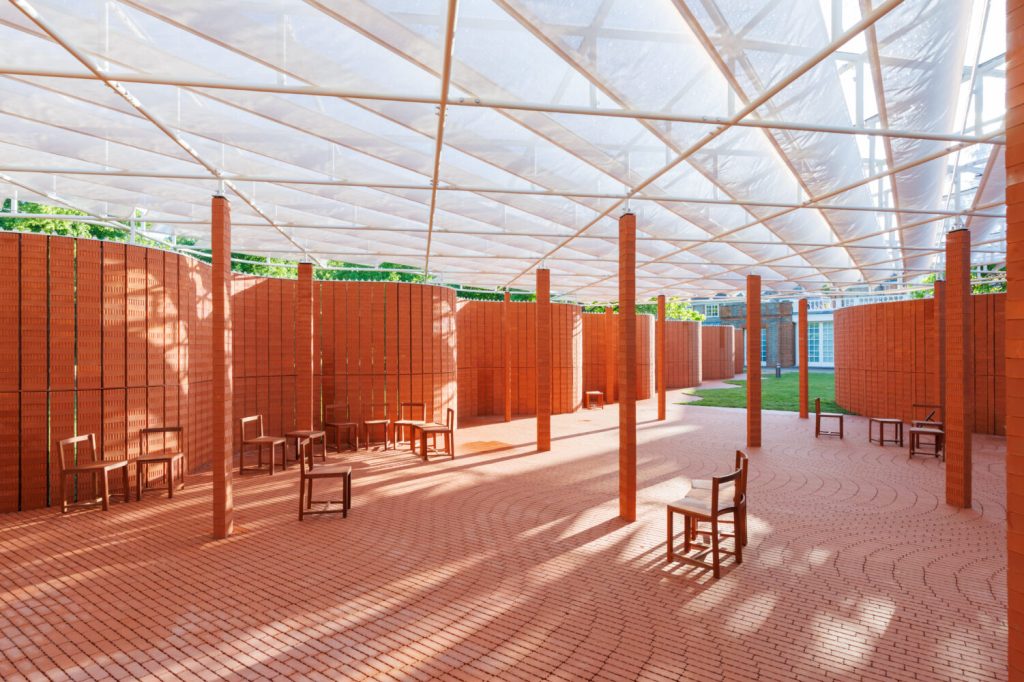
We are using brick walls, made from clay, to highlight artisanal construction methods as tried-and-true technologies for our collective present. But these walls, rather than monumental and opaque, are permeable and unapologetically graceful. They reveal the power of walls not to divide, but to bring together. For instance, the brick columns that constructs these walls, hasat least a 10mm gap between them so people can see through a surface that is traditionally opaque, and eventually gazes can connect.
Brick is an ancient material that carries the history of the first cities humanity built. The earliest examples of large-scale religious, institutional, and residential architecture were created with earth in Mesopotamia. Those sun-dried mud bricks, and later fired clay bricks, have lasted for millennia. This is a material with an extremely long lifespan that can consequently reduce the amount of debris we produce.
We extend the use of brick from the walls to the floor, which for us is a surface just as important as the vertical ones. The built-in furniture, such as the café bar and public bench, is also created by stacking bricks to demonstrate the versatility of the module. We try to focus on one primary material for each project, to explore all possible uses.
The roof is translucent to allow for sunlight, so it is created with a spatial steel grid plus polycarbonate, and filtered with composite fabric Eco-Bau fins. The marriage of traditional artisanal craft with high-performance technological materials is a contrast we welcome.
What is your preferred way of working: do you draw, make models and use CAD?
AA: We use all three. We always start by drafting the site by hand, and during this process we get intuitive about certain things. In our process this initially naive intuition is fed with more complexity: programme, materials, climate and of course the client’s input. We always make simple physical models too, which suffer a bunch of modifications while the projects mature. Having the drawings and models present at the studio we can closely observe them and realise what element is missing or, even more importantly, which element is superfluous. We like to find one idea that can organise the whole project. At a certain point we start drawing in CAD and then print and trace again. We are very cautious with what we draw. As architects we should be able to build less and simpler, I think. The drawings we produce should express these concepts. For us, the drawing is as important as the building.
IA: We love to have material samples around the studio and play around with 1 to 1 prototypes. We also do onsite research which is mainly based on field drawings and annotations, later transformed into written essays. Thus, we see everything we do as essays or explorations through which we keep expanding.
How do you anticipate people using the Pavilion, what do you hope visitors will take away from their experience?
IA: While we have planned for some places to sit or observe, we know that visitors will surprise us with their interaction with the space and that is exciting. We very much look forward to the Live Programme consisting of Park Nights, Family Days and other events. We can’t anticipate how the performers, musicians, poets, and artists will use the space and that is one of the beautiful things that architecture can accomplish, being able to host the unpredictable.
AA: I wish for the unexpected… I do think the brick material is going to be well received well; it’s a material we all have a relation to. But the way we are using it this time is so specific that we expect people to resonate with it. Materiality will be very present and we are excited about that.
Do you feel that being commissioned by the Serpentine will strengthen the international visibility of your practice? And could we also discuss what designing a Serpentine Pavilion means to you, in particular, the significance or relevance of creating a building in the UK?
We know this commission will allow our practice to grow in many different ways. We hope to reinforce LANZA’s presence in Europe and beyond. The opportunity to work in new and challenging contexts excites us. Working in London for the first time means establishing a connection between our Latin American context and European and Ancient Egyptian architectural heritage.
Your Pavilion will be the 25th Pavilion – how do you feel about this iconic moment in history?
We believe this iconic anniversary can amplify some of the implicit messages of our Pavilion. We would like to encourage the global architectural community to be as clever as the Serpentine wall by virtue of its unexpected shape which employs fewer materials than a straight wall and is stronger, more stable.
We are also adding our own voice to 24 previous voices that have left their mark on the Serpentine lawn, thereby creating a collage of the architecture of the first quarter of the 21st century and that is very beautiful.
–
Images: Isabel Abascal and Alessandro Arienzo of LANZA atelier. Photo: © Pia Riverola. and Serpentine Pavilion 2026 a serpentine, designed by Isabel Abascal and Alessandro Arienzo, LANZA atelier. Exterior view © LANZA atelier, Photo Iwan Baan, Courtesy Serpentine.

