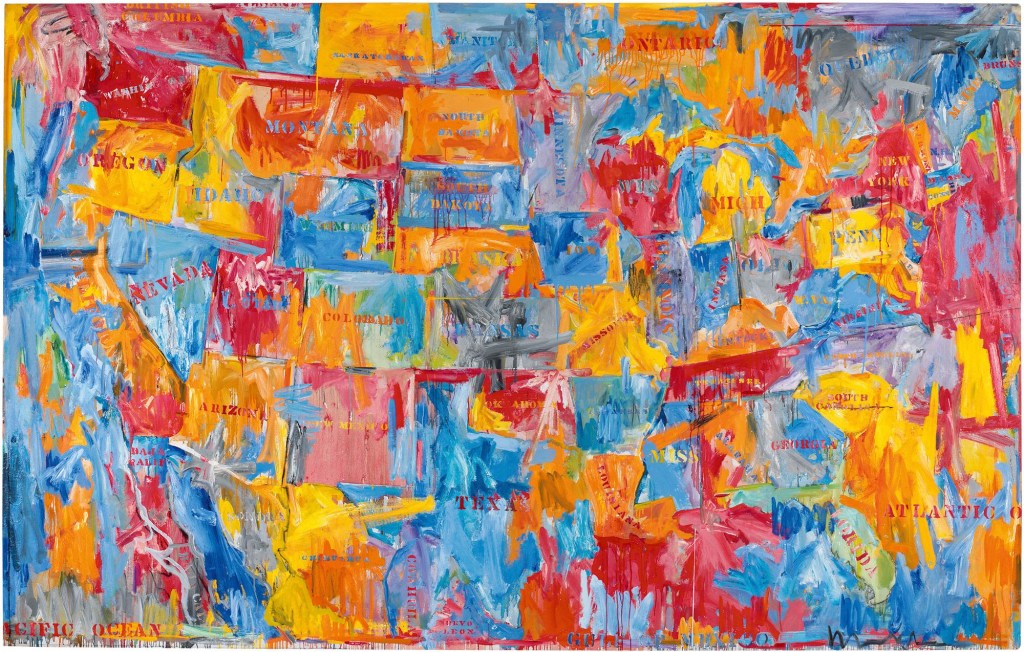
The Guggenheim Museum Bilbao presents Jasper Johns: Night Driver, a major retrospective dedicated to one of the defining figures of post-war art, on view until 12 October 2026.
Taking its title from a 1960 drawing Johns once described as his first work grounded in a personal feeling, the exhibition gathers nearly 140 works, paintings, sculptures, drawings, prints, an artist’s book, and a stage design, tracing a practice that has persistently returned to its own motifs, as if circling an idea until it shifts.
Organised chronologically, the exhibition sets out Johns’s trajectory from the mid-1950s onward, separating works on paper from paintings and sculpture to reveal the different registers of his thinking.
Born in Augusta, Georgia, in 1930 and raised in South Carolina, Johns arrived in New York in 1953, where his proximity to Robert Rauschenberg, John Cage, and Merce Cunningham placed him at the centre of a radical redefinition of American post-war culture, one shaped as much by collaboration as by individual authorship.
The early works, flags, targets, numbers, maps, letters, are all on view and recast the familiar as something unstable, suspended between sign and object. First shown at the Leo Castelli Gallery in 1958, they brought immediate recognition and now stand as pivotal to the emergence of Pop Art.
The exhibition moves through the crosshatched paintings of the 1970s and 1980s, the reflective logic of the Seasons works, and a series of compositions where fragments of art history, memory, and anatomy drift across the surface. It concludes with works from the 1990s and 2000s, including the Catenary series, where structure itself becomes a way of thinking.
Resistant to the rhetoric of expression, Johns’s practice is defined by restraint, repetition, and the slow unfolding of meaning. Often aligned with Minimalism and Conceptual Art, his work nonetheless remains insistently image-based—where thought and perception never fully separate, and where looking becomes its own form of delay.

