At the 61st Venice Biennale, national pavilions reflect on the instability of the world, placing archives as a space where memory is actively produced. From broadcast television and postcard accumulations to participatory performance and extreme body experiences, this year’s presentations repeatedly return to questions of who is allowed to speak, what is recorded, and how institutional frameworks shape visibility.
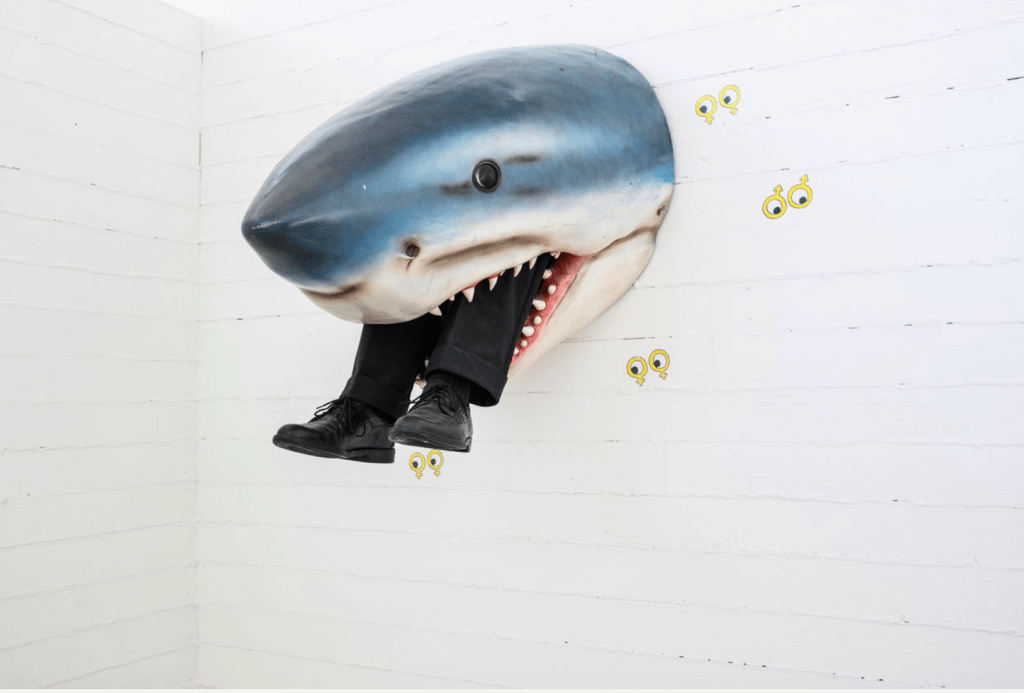
The Japan Pavilion presents Grass Babies, Moon Babies by Ei Arakawa-Nash, curated by Mizuki Takahashi and Lisa Horikawa. Marking the pavilion’s 70th anniversary, the project transforms the space into a shifting, participatory environment structured around performance and collective authorship.
Rather than a fixed installation, the work unfolds as an open-ended space involving performers, children, and visitors, with an emphasis on LGBTQI+ rights and the place of children in today’s challenging world, exploring themes of fragility, care, and the unstable boundaries between public and private experience. What appears ‘fun’ at first, reveals deeper traumas and societal questions. It’s one of the most striking pavilions this year.
In contrast, the Spanish Pavilion stages what its protagonists describe as an “anti-museum.” In Los restos (The Remains), artist Oriol Vilanova and curator Carles Guerra construct an immersive installation built from more than two decades of collected postcards sourced from flea markets and informal networks, some from Venice itself.
Removed from their original contexts, the images accumulate into dense fields of repetition and fragmentary narrative. The pavilion becomes a space in which the archive is not stabilised but overwhelmed, offering a reading of cultural memory as excess rather than coherence. The result is less a linear history than a materialisation of circulation itself, of images detached from origin, yet still carrying affective residue.
The Swiss Pavilion, The Unfinished Business of Living Together, curated by Gianmaria Andreetta and Luca Beeler with British artist Nina Wakeford, turns to broadcast media as a site where public discourse and institutional framing collide.
The project takes as its starting point a 1978 episode of Swiss television programme Telearena, in which homosexuality was debated live on air, one of the first instances in Swiss television history in which gay participants spoke for themselves on mainstream broadcast television. This material is reactivated through a spatialised video installation combining archival footage with new recordings, re-enactments, and fragmented televisual structures.
Rather than treating the archive as evidences, the pavilion exposes it as constructed and partial, shaped by editorial control, censorship, and the conditions governing what becomes historically legible. Extending into the garden, the installation also considers how queer memory attaches to space, and how intimacy and vulnerability sit uneasily within archival regimes.
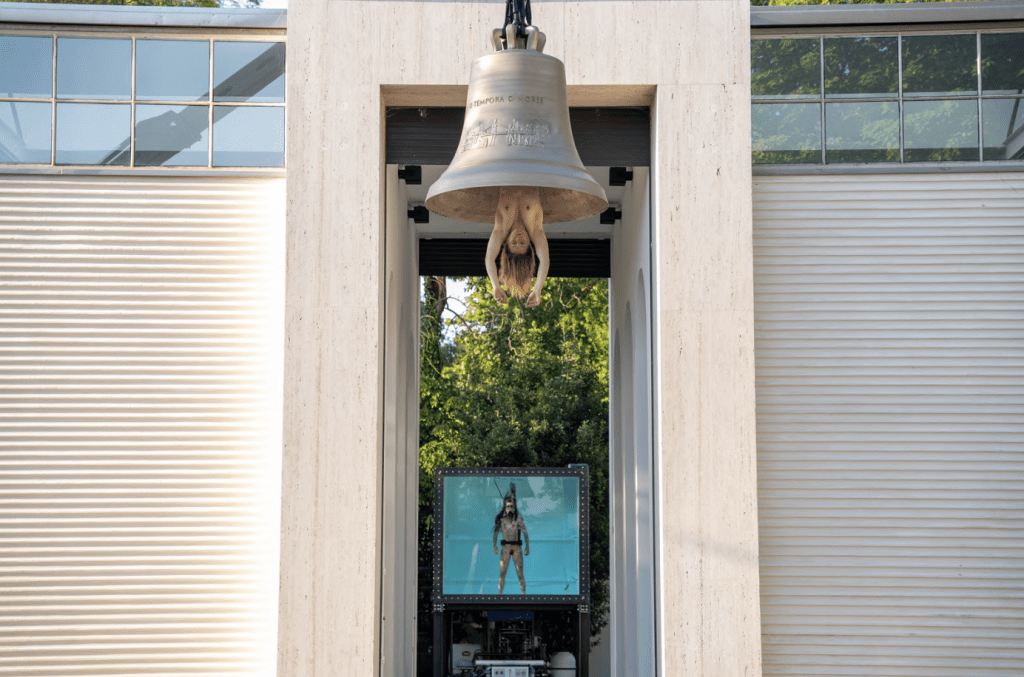
Alongside these, the Austrian Pavilion presents one of the most materially and conceptually ambitious commissions of this edition. Austrian choreographer and performance artist Florentina Holzinger represents Austria with SEAWORLD VENICE, curated by Nora-Swantje Almes. It was the talk of the vernissage week in Venice!
The pavilion is reconceived as a hybrid organism: part sacred architecture, part submerged amusement park, part waste-processing infrastructure. Within this system, bodies, fluids, and technologies are integrated into a continuous feedback loop, with visitors’ bodily matter incorporated into the work’s operational ecology and the environment itself. However, we all remember Anne Imhof’s poetry. Is this theatricality working this time?
Holzinger’s installation extends her long-standing investigation into the limits of corporeal agency. Here, performance is embedded within an environment defined by rising water, mechanical systems, and ritualised gestures. Within the pavilion, elements including robotic figures navigating flooded interiors, a continuously circulating jet ski, and ritualised architectural interventions produce a space in constant transformation. In the courtyard, a performer inhabits a water tank sustained by visitors’ urine, reframing cycles of consumption and waste as both infrastructure and critique. Historical references, from religious iconography, Hieronymus Bosch, to the reclining nude, are reworked through conditions of exhaustion and material exposure.
The site-specific installation of the Canada Pavilion by Abbas Akhavan reconfigures the space around a central installation of giant Victoria water lilies, presented within a custom environment designed to support their growth and visibility. The plants are cultivated in collaboration with the Royal Botanic Gardens, Kew and the Botanical Garden of the University of Padua before being brought to Venice for display during the Biennale Arte 2026. The Pavilion is modified with glass panels to allow external visibility of the installation, which is accompanied by additional sculptural works inside and in the courtyard.
The project references historical exhibition structures and botanical circulation, including the Wardian case and the Crystal Palace, while situating the water lily, named in honour of Queen Victoria, within a contemporary institutional context. The work is framed by the title Entre chien et loup, a French expression describing the ambiguous light between day and night.
Across these materially distinct but conceptually aligned projects, a broader tendency emerges. The Japanese Pavilion explores questions of family life; the Spanish Pavilion constructs an overdetermined field of archival excess; the Swiss Pavilion interrogates the politics of broadcast speech and historical record; The Canada Pavilion explores ecologies through the Crystal Palace ideals, and the Austrian Pavilion stages a total environment in which bodies, systems, and infrastructures are rendered inseparable.
Taken together, these presentations reflect a Biennale increasingly preoccupied with the instability of the world. A very political Biennale.
–