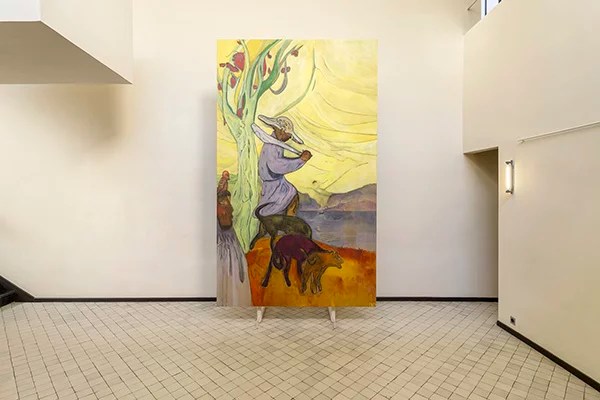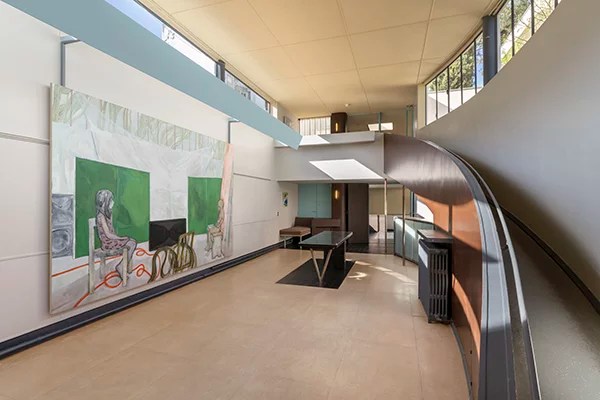
The exhibition of paintings by Peter Doig at Maison La Roche, presented by the Fondation Le Corbusier from 10 April to 30 May 2026, brings together a focused selection of approximately fifteen works by the artist who was the subject of a recent show at Serpentine in London, exploring his relationship with music.
Installed within one of Le Corbusier’s earliest domestic projects (1923–25), this spectacular exhibition places Doig’s paintings in direct relation to a canonical example of early modernist architecture.
Overall, the exhibition situates Doig’s work within a historically significant architectural setting, offering a concise presentation that highlights both continuity and development within his practice. Recent works in the exhibition indicate a continued loosening of structure in Doig’s painting, with increased emphasis on colour and surface. Across the selection, recurring motifs, such as water, architecture, and solitary figures, are revisited in varying configurations.
The works on view span recent production alongside previously unseen paintings. Doig’s practice is characterised by an engagement with landscape, often derived from photographic sources, film stills, and personal recollection. His compositions frequently balance figurative elements with more abstract painterly passages, resulting in images that resist precise spatial or temporal definition.
The brilliant presentation at Maison La Roche explores all the connections between painting and architecture. The building, originally conceived as both a private residence and gallery, is structured around a carefully orchestrated promenade. Within this context, Doig’s paintings are displayed across the interior, introducing shifts in scale, colour, and atmosphere that contrast with the building’s formal clarity.
The exhibition also reflects an earlier connection between the artist and Le Corbusier’s architecture. In the 1990s, Doig spent time at the Unité d’Habitation in Briey, an experience that informed aspects of his thinking around built environments and landscape. While not the explicit focus of the exhibition, this reference provides context for the current installation. It’s a must-see!
–