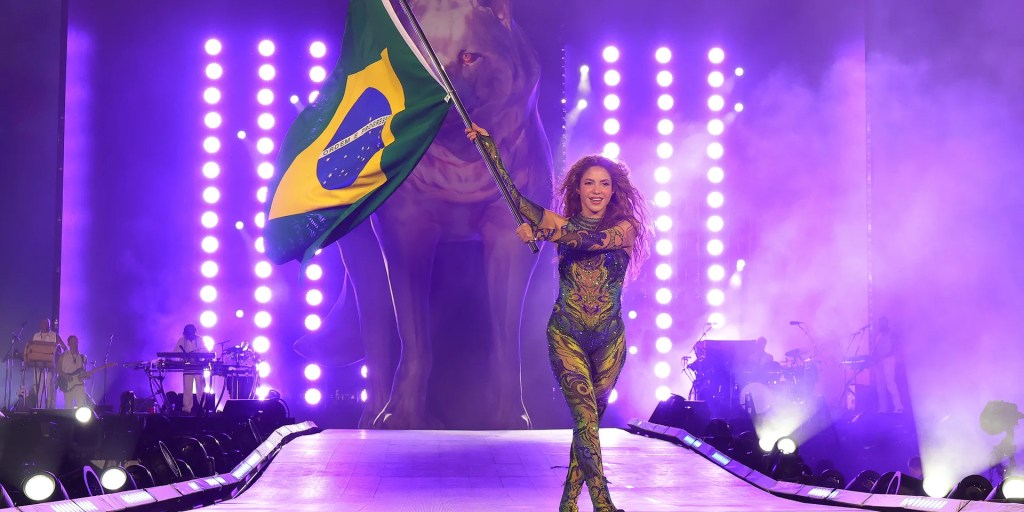
On the evening of 2 May 2026, Shakira transformed Copacabana Beach into one of the largest concert venues in history. What unfolded was a mass cultural moment: an estimated two million people gathered along the shoreline, making it the biggest show of her career and one of the largest ever staged by a solo artist. All for free and organised by the Mayor of Rio de Janeiro.
The concert, held as part of the city-backed Todo Mundo no Rio programme, reflects a growing ambition to position Rio de Janeiro as a global stage for large-scale cultural events. Following landmark performances by Madonna (always the pioneer) in its first years, Shakira’s appearance confirmed the series as a defining fixture in the international music calendar.
From the outset, the scale of the production matched the magnitude of the crowd. A coordinated drone display lit up the sky, forming symbolic imagery above the Atlantic as Shakira addressed the audience in Portuguese, declaring her affection for Brazil. She’s fluent in Portuguese. The gesture set the tone for a performance that balanced spectacle with intimacy, an artist speaking directly to a vast, collective audience.
Over the course of a nearly three-hour set, she moved through decades of music, blending global hits such as Hips Don’t Lie, Bzrp Music Sessions, Vol. 53, and Waka Waka (This Time for Africa) with newer material from her recent album Las Mujeres Ya No Lloran. The concert also became a powerful celebration of Brazilian music. Appearances by Anitta with whom she recently launched a duet titled Choka Choka, Caetano Veloso, Maria Bethânia, and Ivete Sangalo brought distinct generations and styles onto the same stage, ranging from tropicalismo to contemporary pop, turning the concert into a rare moment of cross-cultural and intergenerational exchange.
Yet the significance of the event extended beyond music. Economically, the concert delivered a major boost to the city, generating hundreds of millions of reais and driving tourism, hospitality, and local business activity across Rio. Socially, it demonstrated the enduring power of free, public events to bring together vast and diverse audiences, many of whom travelled long distances or camped overnight to secure a place on the beach.
In cultural terms, the concert marked a defining moment in Shakira’s career. Already one of the most successful Latin artists of all time, she now holds the distinction of having delivered the largest free concert ever by a Latin performer. More broadly, the event reinforced the idea of the pop concert as a civic experience, one that reshapes public space and temporarily redefines the relationship between artist, audience, and city.
For one night, Copacabana became something more than a beach. It became a stage for collective memory: two million voices moving in unison, turning a global pop catalogue into a shared language.
Image: Shakira performs in Rio de Janeiro (Getty Images)

