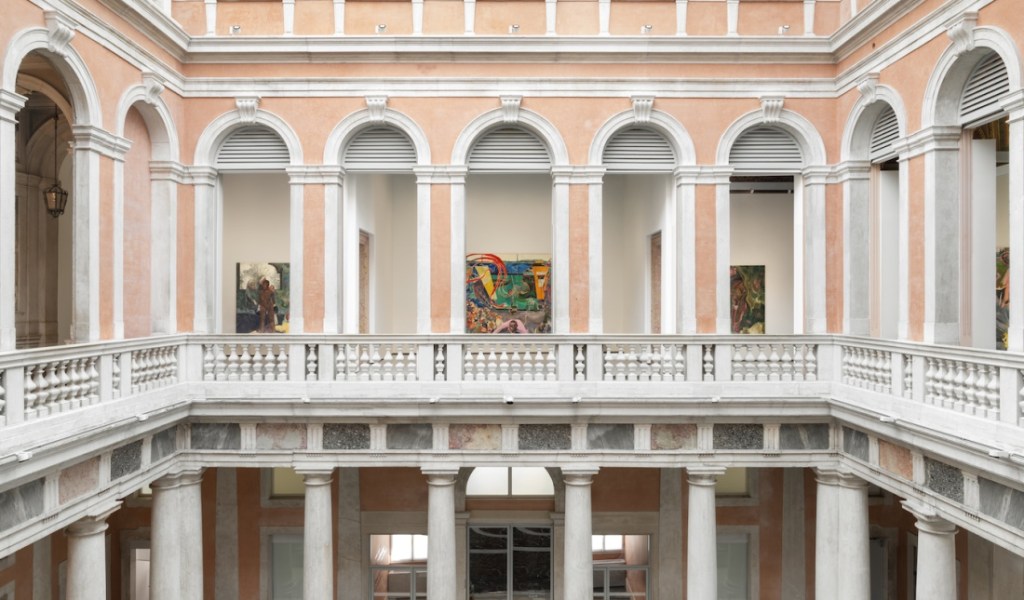
The 61st edition of the Venice Biennale, sponsored by Bulgari, spreads across the whole city, not just the main sites at the Giardini and Arsenale. Many of the most interesting exhibitions take place in Venice’s palaces, museums, and foundations, where contemporary art is shown in dialogue with historic spaces. Together, these exhibitions explore the best of the best of contemporary art.
At the Gallerie dell’Accademia, Marina Abramović presents work alongside Renaissance paintings. Her focus on the body, duration, and presence creates a strong contrast with the historic setting, encouraging visitors to slow down and become more aware of their own experience as viewers.
At the Fondazione Giorgio Cini, Georg Baselitz, who recently died, shows large paintings with his well-known upside-down figures. The works feel both powerful and unsettled, reflecting on ageing, memory, and the weight of art history. This show promises to be highly emotional
Painting is also reconsidered in David Salle’s exhibition at Palazzo Cini. By mixing AI-generated images with traditional painting, Salle questions what it means to be an author today, and how much control an artist really has over an image.
One of the key exhibitions is Michael Armitage at Palazzo Grassi. His show brings together paintings and drawings from the past decade, offering a broad view of his practice. Armitage combines personal stories with political events, often focusing on East Africa. His paintings are layered and complex, moving between reality and imagination, and addressing themes like conflict, migration, and identity.
Shown inside the grand rooms of Palazzo Grassi, the work takes on an added tension. The richness of the building contrasts with the difficult subjects in the paintings, making the experience more striking. The exhibition also includes drawings and studies, giving insight into how his larger works are developed.
Elsewhere, Erwin Wurm turns sculpture into something playful and temporary, often involving the viewer directly. Amar Kanwar uses film and archival material to reflect on politics and memory, creating immersive and thoughtful installations. His show at Palazzo Grassi will precede his Serpentine exhibition, scheduled for Autumn 2026 in London.
At Punta della Dogana, Lorna Simpson presents work that looks at identity, gender, and history. Using a mix of media, she explores how images shape the way we see ourselves and others.
An exhibition curated by Dries Van Noten at Palazzo Pisani Moretta brings together art, fashion, and design. It suggests that beauty is not just decorative, but can also be challenging and unexpected. Dries Van Noten recently opened his Palazzo.
Finally, Anish Kapoor’s exhibition at Palazzo Manfrin focuses on form, space, and perception. His works often play with reflection and depth, changing the way viewers experience their surroundings.
Overall, these exhibitions show how the Venice Biennale extends across the city, offering different perspectives.

