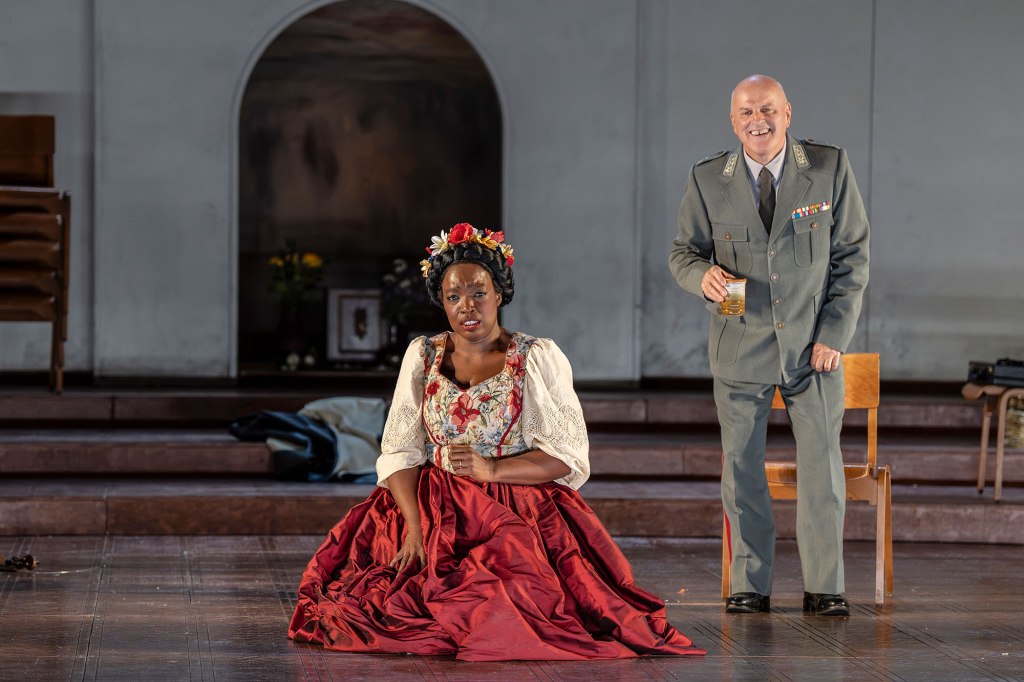
Few operas capture the intensity of human passion and the horror of wars, quite like Puccini’s Tosca. At the English National Opera in London, this timeless masterpiece is transformed into a wonderfully dynamic theatrical experience, full of movement, unexpected staging and moments of extraordinary visual impact. It is a production that never seems to stand still, constantly shifting its energy and perspective while keeping the audience completely engaged.
One of its greatest strengths is the fluidity of the staging. Rather than relying on traditional operatic conventions, the production makes inventive use of the entire theatrical space, with the singers moving constantly and the action unfolding in various places. The beginning of the second act is particularly striking: with the curtain still down, the performers appear in front of the stage, bringing the drama directly into the auditorium. It is an arresting theatrical gesture that immediately changes the relationship between audience and performers, creating a sense of modernity and anticipation before the action even moves back onto the stage.
The children also play a surprisingly significant role, adding another dimension to the production. Their presence brings an interesting contrast to the darker political and emotional undercurrents of the story, while contributing hope to the narrative.
At the heart of the opera are three exceptional central performances. Axelle Fanyo is magnificent, bringing tremendous presence and emotional intensity to the stage. The chemistry with Chaz’men Williams-Ali as Mario Cavaradossi, and Christopher Purves as the sadistic and horrible Baron Scarpia, gives the drama its extraordinary force, as love, jealousy, betrayal and political intrigue move towards their inevitable and devastating conclusion.
Then comes the finale. Spectacular is hardly enough to describe it. The use of real fire on stage creates an astonishing theatrical moment, transforming the final scenes into an almost overwhelming spectacle of destruction and tragedy. It is visually breathtaking, emotionally charged and an extraordinary demonstration of how opera can still surprise and astonish a contemporary audience.
What makes this Tosca particularly memorable is its refusal to remain static. The inventive use of space, unexpected entrances and exits, and the interplay between the performers and the audience give the production a remarkable vitality. Combined with Puccini’s unforgettable score and the strength of the three leading performances, it becomes an evening in which music, theatre and spectacle are inseparable.
A triumph for ENO: emotional, inventive and visually exhilarating.
Image: Axelle Fanyo, Christopher Purves, ENO’s Tosca 2026 © Ellie Kurttz

