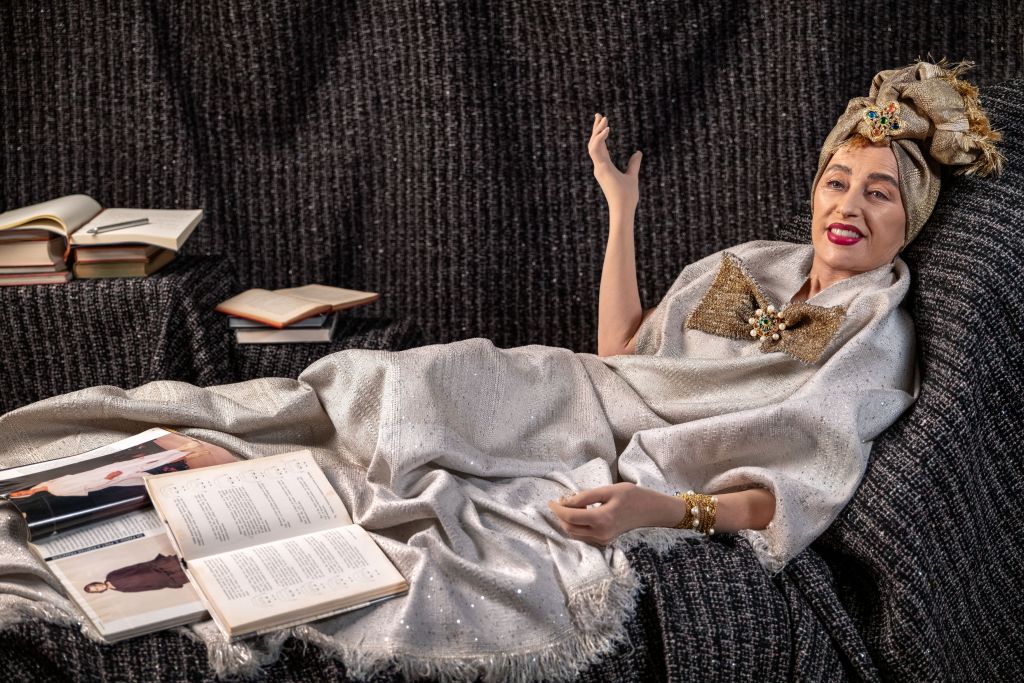
Cindy Sherman has spent more than four decades asking what it means to be seen. Across her photographs, identity is never fixed but performed, constructed and endlessly revised, a mask that can be put on, altered and discarded. This autumn, at Hauser & Wirth London, Sherman turns her attention once again to the image of womanhood, presenting a new body of photographs from her Fabric Matrons series, in which fabric becomes both costume and camouflage. The show will be presented in London from 13 October – 23 December 2026.
The figures that inhabit these new works seem to emerge from, and disappear into, elaborately arranged textiles. Draped, folded and layered across their bodies, the fabrics obscure as much as they reveal, creating an unsettling tension between visibility and concealment. Faces become partially hidden; bodies dissolve into their surroundings. What might initially recall the sumptuous language of fashion photography gradually becomes something more ambiguous: a meditation on the ways women are looked at, presented and perceived throughout their lives.
For Sherman, glamour has always been inseparable from artifice. Her carefully staged photographs expose the machinery behind the image, revealing femininity not as a fixed condition but as something continually manufactured and performed. In Fabric Matrons, that performance takes on a particularly poignant dimension. The protagonists suggest women at different stages of life, confronting the expectations attached to beauty, femininity and visibility, and the persistent pressure to construct a public image that can withstand the passing of time.
There is something deliberately theatrical about these photographs. Sherman draws upon the visual language of the fashion editorial (Marc Jacobs anyone?), but rather than surrendering to its seductions, she unsettles them. The sumptuousness of the styling becomes almost excessive, the elegance deliberately fabricated.
The relationship between Sherman and fashion is long-standing. Many of the works in the London exhibition incorporate fabrics and elements drawn from the Chanel archives, extending a dialogue with the fashion house that began with her Ominous Landscapes series of 2010–12, in which her characters were dressed in archival garments and accessories. Here, however, fashion becomes less a subject than a material through which Sherman can examine the construction of identity itself.
The resulting images occupy an intriguing space between portraiture, fashion and theatre. They are sumptuous but strange, seductive yet resistant. Beneath the layers of fabric lies a familiar Sherman question: who are we when we are being looked at? And how much of the person we present to the world is ever truly our own?
With Fabric Matrons, at Hauser&Wirth, Sherman turns the conventions of beauty and fashion inside out, using their most seductive ingredients, costume, styling, glamour and spectacle, to question the demands they place upon us. The photographs remind us that identity is never quite finished. It is something we continue to dress, perform and reinvent for as long as we remain visible. A show that will lead on the Frieze London season for sure.
–
Image: © 2026 Cindy Sherman / Artists Rights Society (ARS), NY, Courtesy the artist and Hauser & Wirth

