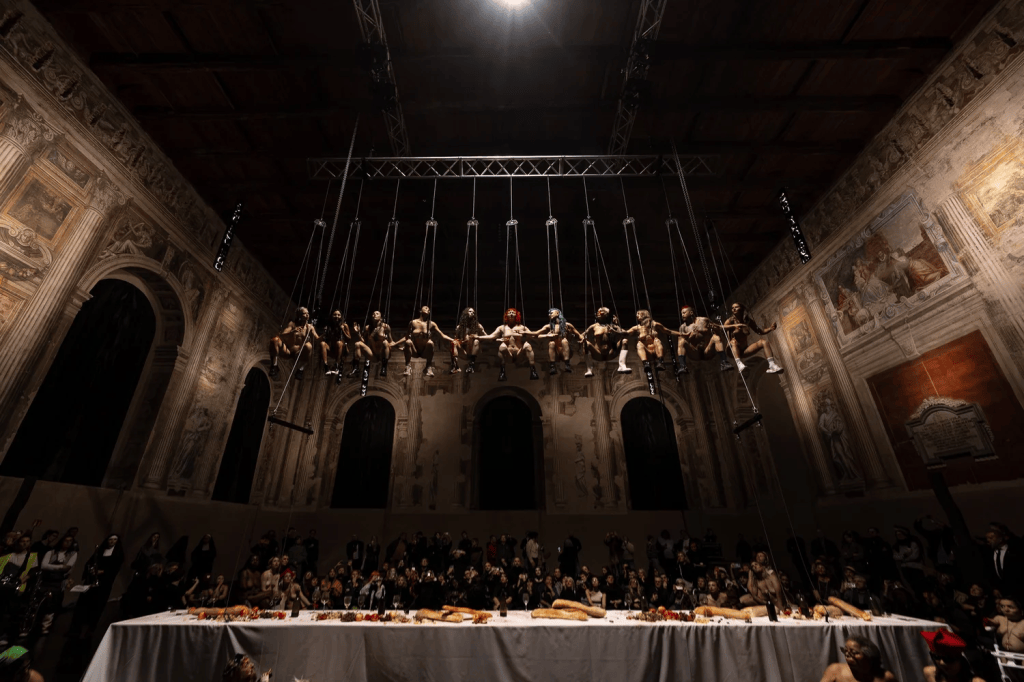
21 November 2026 marked the conclusion of Florentina Holzinger’s SEAWORLD VENICE, Austria’s Pavilion to the 61st International Art Exhibition – La Biennale di Venezia, with a spectacular final performance and a striking ritual of transformation.
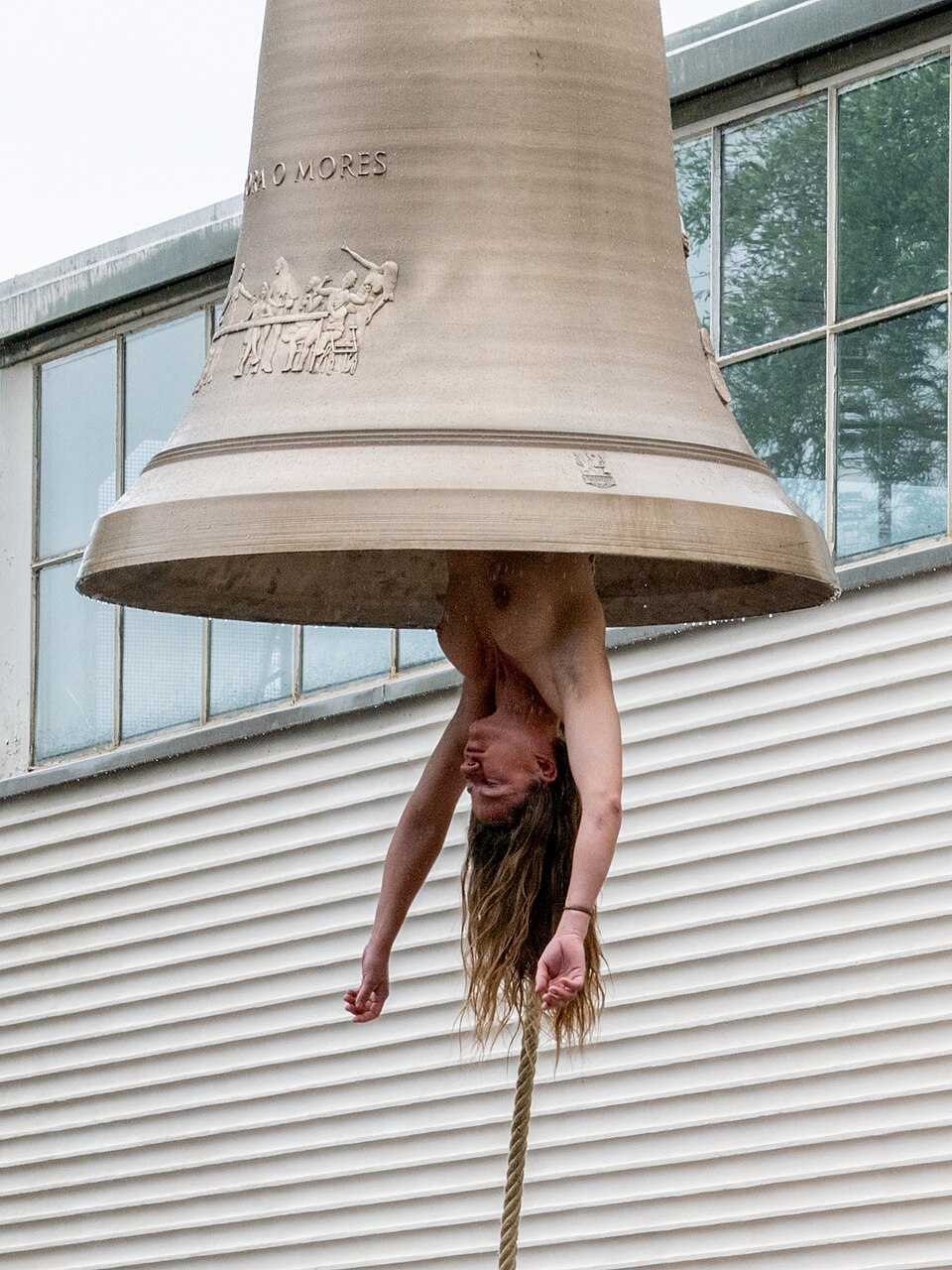
Presented at the historic Scuola Grande della Misericordia, Closing Étude brought the seven-month project to an end through a final collective ceremony, bringing together bodies, performance. Curated by Nora-Swantje Almes, SEAWORLD VENICE transformed the Austrian Pavilion into an immersive environment centred on water, ritual and the physical presence of its visitors. One of its most distinctive elements was a bell retrieved from the Venetian lagoon during the project’s Opening Étude. Throughout the Biennale, the bell rang every hour at the pavilion, becoming a recurring presence within the installation.
For the closing ceremony, the bell was carried in a ceremonial procession to the Scuola Grande della Misericordia, where it was melted and transformed from a solid object into a vessel. The gesture brought Holzinger’s exploration of cycles of transformation and purification to its conclusion, creating a final relic from the project’s central symbolic object.
Perhaps the most provocative aspect of SEAWORLD VENICE was its use of bodily waste as an artistic material. Over the seven months of the Biennale, visitors contributed urine to the installation, which was purified through reverse osmosis and used to sustain the work. The distilled remains were presented outside the now-closed Austrian Pavilion on the final day of the Biennale, accompanied by an epitaph reflecting on the project’s unusual relationship with its audience.
Addressing visitors directly, the text described how they had arrived with their hopes, fears, cameras and catalogues, bringing not gold but their own bodily offerings. Its repeated declaration, “I make all things new”, framed the work as a meditation on renewal and mortality.
The final words offered a fitting conclusion to Holzinger’s unconventional intervention: “The world is not ending, their world is ending.” The text closed with the image of a woman rising from the water, laughing as the bell began to ring once more. In this final gesture, the end became a beginning, reinforcing the artist’s interest in transformation as an ongoing process rather than a definitive conclusion.
The project will continue beyond Venice, with adapted versions scheduled to be presented at Gropius Bau in Berlin in April 2027, Kunsthalle Wien in Vienna in June 2027, and Amant in Brooklyn, New York, in spring 2028.
Florentina Holzinger is internationally recognised for her boundary-pushing performance practice, which brings together choreography, theatre, physical endurance and visual art. Her productions have received the Nestroy Award for TANZ (2020) and the DER FAUST Award for Ophelia’s Got Talent (2023). Since 2021, she has been an associate artist at Volksbühne am Rosa-Luxemburg-Platz in Berlin.
–