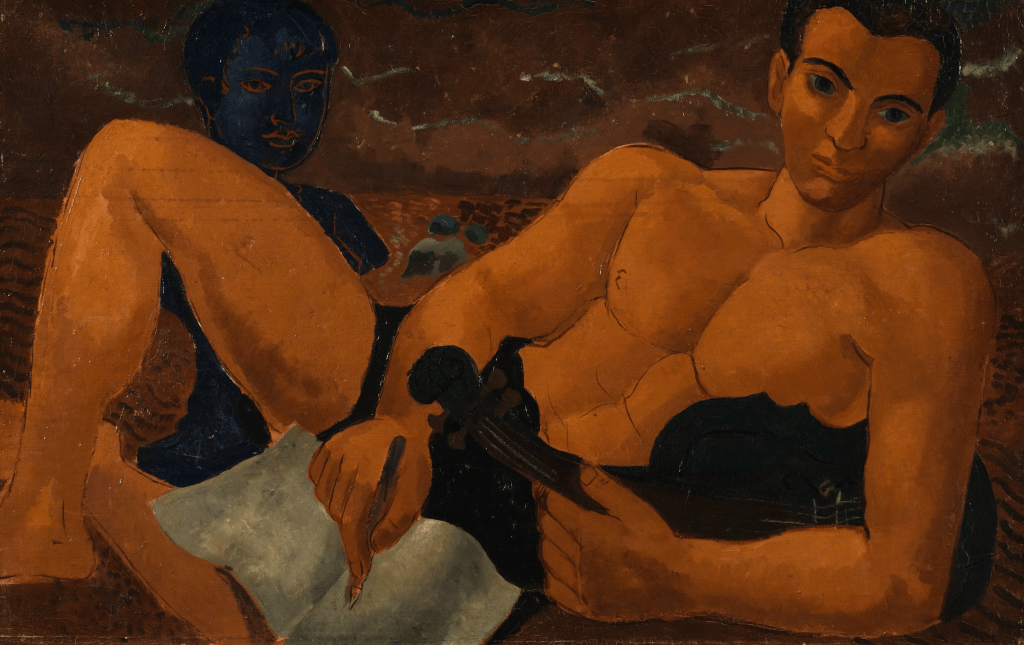
From 13 February to 27 June 2027, Kettle’s Yard in Cambridge presents Christopher Wood: In Love, a major exhibition bringing together more than 80 paintings and drawings to explore the personal relationships, friendships and passions that shaped the life and work of British artist Christopher Wood (1901–1930).
Opening Kettle’s Yard’s 70th anniversary year, the exhibition offers a fresh perspective on an artist whose career, though tragically short, left a significant mark on British modernism. “He painted […] in order to put down in his enthusiasm the reality of the thing he saw; it was an expression springing directly from the desire to say, ‘I love this’.” Jim Ede, founder of Kettle’s Yard said.
Moving beyond Wood’s celebrated landscapes, the exhibition examines the connections between his artistic development and his complex personal life. Drawn from public and private collections, the selection includes numerous rarely exhibited works, tracing his journeys between London, Paris, the Mediterranean and North Africa, alongside the people and creative circles that influenced him.
Arranged chronologically and geographically in a series of acts, the exhibition follows Wood’s remarkable artistic evolution between 1921 and 1930. Portraits, intimate scenes, drawings and theatrical designs reveal his encounters with some of the most influential cultural figures of his time, including Jean Cocteau, Pablo Picasso and Sergei Diaghilev. His association with Cocteau’s Parisian circle, in particular, introduced him to new artistic ideas and inspired his designs for the Ballets Russes production of Romeo and Juliet.
The exhibition also explores Wood’s relationships with the Chilean diplomat José Antonio de Gandarillas Huici, artist Meraud Guinness, and fellow painters Ben and Winifred Nicholson. His travels and friendships continually reshaped his artistic language, leading him towards the more expressive, imaginative and surreal qualities of his later paintings. His time in Cornwall and Brittany, where he became fascinated by local landscapes and folk traditions, produced some of his most distinctive works, including Ulysses and the Sirens (Mermaids) (1929) and Sleeping Fisherman, Ploaré, Brittany (1930).
The final years of Wood’s life were marked by increasing personal difficulties and opium addiction, which coincided with an increasingly experimental approach to painting. His involvement in the ballet Luna Park in 1930 brought together his interests in theatre, costume and visual storytelling.
Alongside the main exhibition, Kettle’s Yard will present archival material, including letters, photographs and personal objects, exploring Wood’s posthumous reputation and his relationship with Jim Ede, the founder of Kettle’s Yard. Particularly significant is a group of overpainted canvases belonging to Wood, discovered in a sealed shed at Kettle’s Yard in 2024. Their conservation analysis has revealed previously hidden works beneath the painted surfaces, offering new insight into the artist’s practice.
Curated by Inga Fraser, Christopher Wood: In Love will be accompanied by an illustrated publication featuring contributions from an international group of writers and researchers. The exhibition design, by P. Joseph, draws inspiration from Wood’s studios in Paris and London, while a collaboration with bio-based paint company Atelier Ellis has resulted in a bespoke palette of five colours inspired by the artist’s work.
–
Image: Christopher Wood, Constant Lambert (1927) Gift of Lucy Wertheim. On loan from Towner Eastbourne

