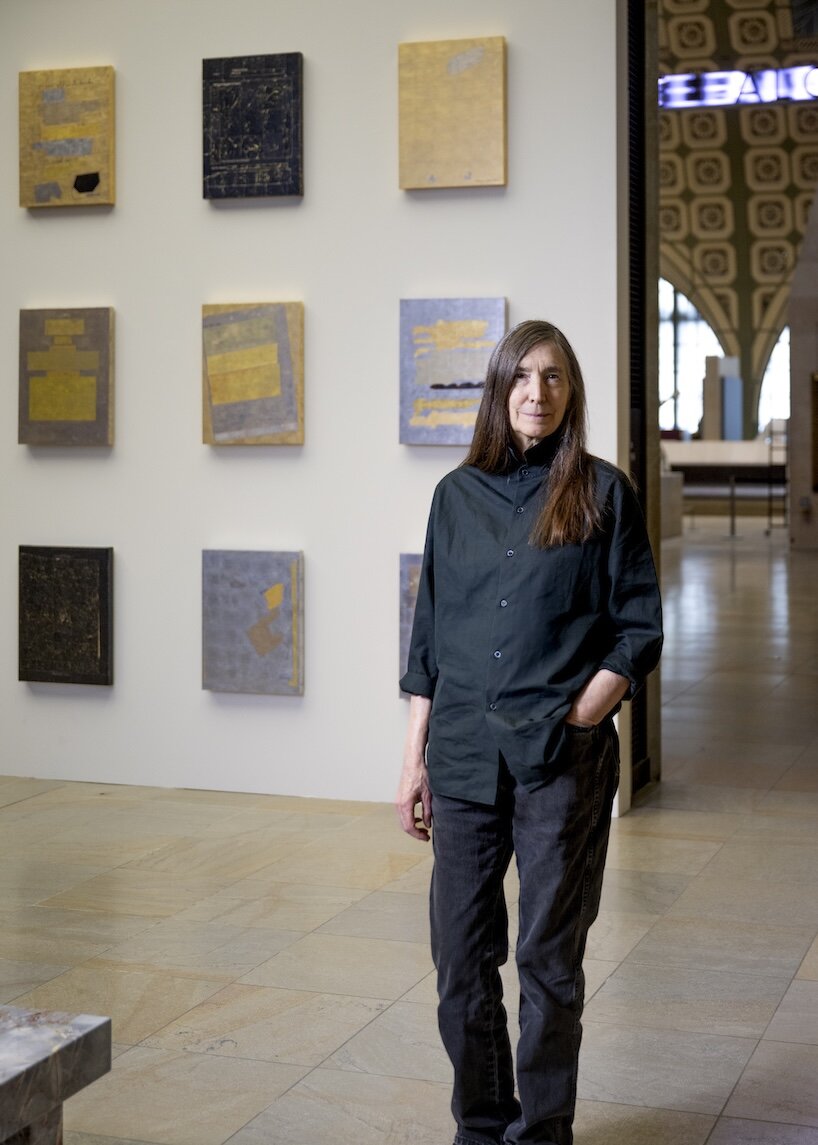
Jenny Holzer turns the Musée d’Orsay into a living archive with J’ai Vu, which opened yesterday. Drawing on historical correspondence, political documents and literary texts, the American artist explores the enduring relationship between language and society.
The exhibition extends beyond the museum’s walls with ÉCLAIRÉ, a series of monumental light projections illuminating its Seine-facing façade until 22 October. Featuring excerpts from writers and artists including Vincent van Gogh, Paul Cezanne, Gustave Flaubert and Émile Zola, the projections transform the historic architecture into a public canvas of moving words.
Inside, coloured LED installations weave through four galleries, while 19 stone sculptures, comprising benches and columns engraved with historical texts, invite a more intimate encounter with language. In the history painting gallery, Holzer also presents metallic paintings made with gold, platinum and palladium leaf, incorporating partially redacted documents to examine war, censorship and the concealment of information.
Bringing together more than 750 texts from 73 authors, J’ai Vu spans subjects from the Paris Commune and colonialism to labour movements and military corruption. Through this vast historical panorama, Holzer reveals the continuing relevance of past conflicts and political struggles.
At the Musée d’Orsay, language becomes both material and monument. Holzer’s intervention challenges visitors to reconsider how history is recorded, whose voices endure, and how the past continues to shape the present.
–
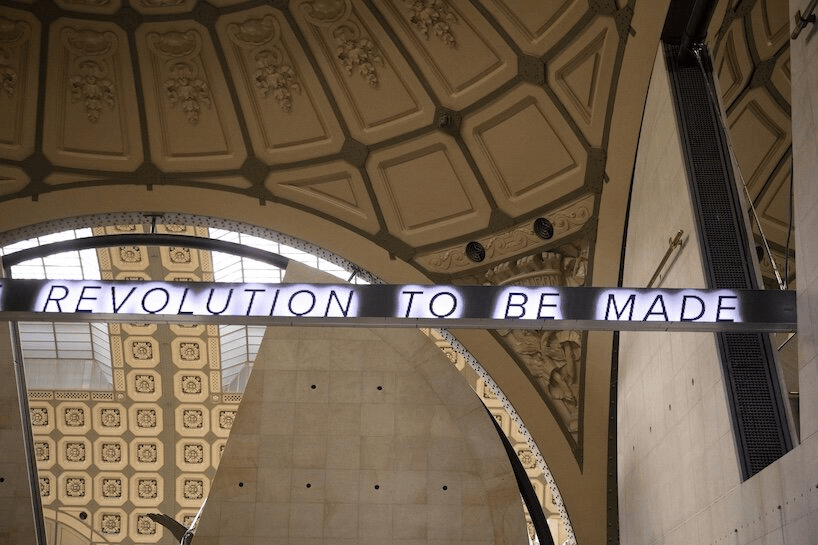
Images: Jenny Holzer | © 2026 Jenny Holzer, member Artists Rights Society (ARS), New York/ADAGP, Paris | image © musée d’Orsay – Laëtitia Striffling-Marcu and Jenny Holzer, ÉCRIT, 2026, LED sign with blue, green, and red diodes | © 2026 Jenny Holzer, member Artists Rights Society (ARS), New York/ADAGP, Paris | image © musée d’Orsay – Laëtitia Striffling-Marcu

