There is a persistent tension running through Anne Imhof’s practice between movement and physicality. Across performance, painting, sculpture and film, the body remains her primary subject, not simply as a physical presence, but as a site of projection, surveillance, vulnerability and resistance. These questions underpin Citizen, Anne Imhof’s new solo exhibition at Sprüth Magers London, presented during London Gallery Weekend and running until 1st August.
Bringing together a new body of paintings, sculptures, drawings and film, the exhibition extends concerns explored in her recent projects DOOM: House of Hope and Fun ist ein Stahlbad, both realised in 2025. If those works examined collective experience through choreographed encounters and charged environments, Citizen distills many of the same themes into objects that continue to pulse with latent movement.
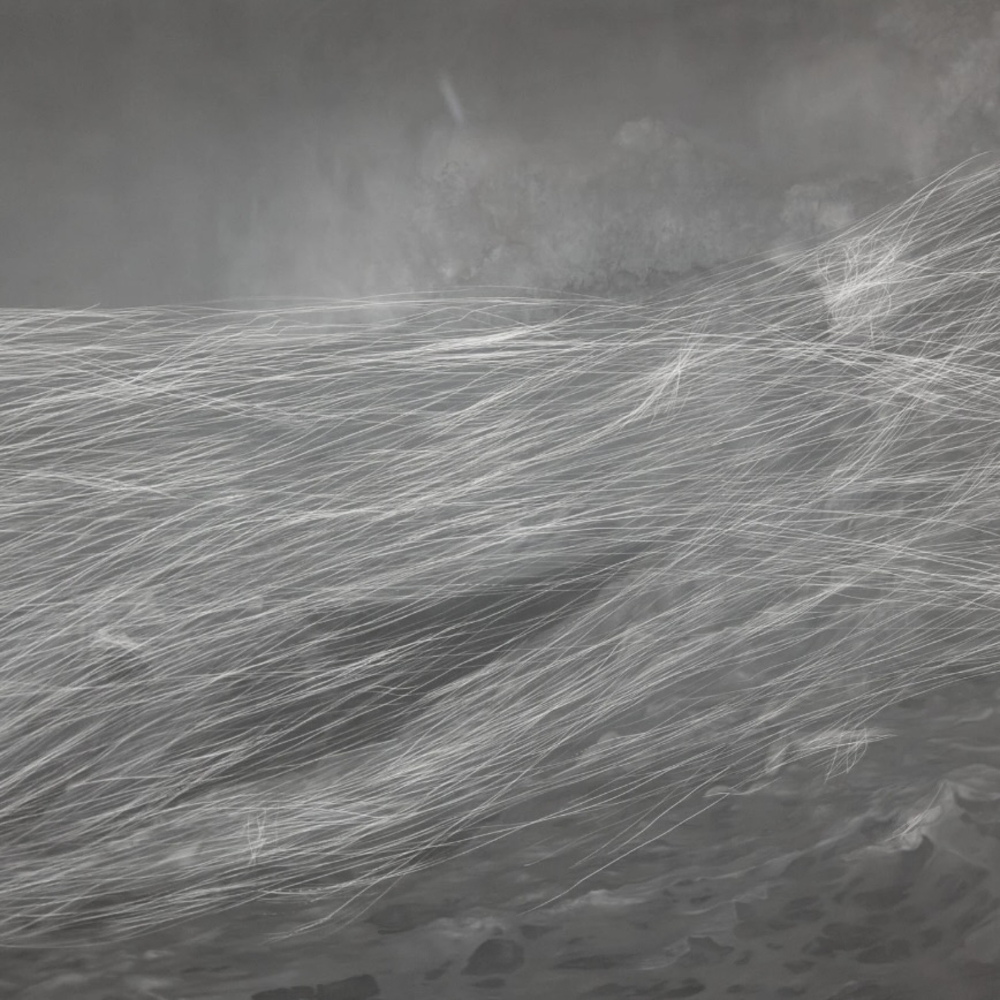
The exhibition is anchored by a series of large-scale Wave paintings, works that appear suspended between emergence and dissolution. Built through layers of accumulated marks, they resist fixed interpretation, their surfaces oscillating between abstraction and image. Like much of Imhof’s work, they seem to register a state of becoming rather than arrival, holding viewers in a moment of unresolved tension.
Elsewhere, site-specific sculptures made from crowd-control barriers introduce the language of public space and social organisation. Familiar as instruments of direction and restriction, these structures carry the memory of gatherings, demonstrations, concerts and queues. Removed from their functional context, they become charged symbols of access and exclusion, subtly shaping the movement of bodies through the gallery itself.
A new four-channel film expands these concerns, returning to Imhof’s long-standing interest in choreography, spectatorship and collective behaviour. The moving image has always occupied a complex position within her practice, acting not as documentation but as another arena in which bodies perform, linger and disappear. Here, the film resonates with the surrounding works, creating an environment in which the distinctions between object, image and action begin to blur.
Among the exhibition’s most striking works is a monumental diptych depicting a head. Enlarged from an earlier drawing and developed through dense layers of mark-making, the painting signals a significant shift within Imhof’s figurative vocabulary. The image emerges gradually from the surface, as though pulled from memory rather than observation. Its scale lends it an almost confrontational presence, yet it remains elusive, resisting psychological resolution.
These figures draw on a range of art-historical precedents, but one lineage feels particularly resonant: the danse macabre, the medieval tradition in which figures from every social class are led in a dance toward death. In those works, mortality functions as the great equaliser, collapsing distinctions of status and power. Imhof’s engagement with this history is less illustrative than atmospheric. Her figures appear caught between appearance and disappearance, presence and absence, embodying a contemporary awareness of impermanence.
Throughout Citizen, the question is not simply how to represent the body, but how to give form to what cannot be fixed. Imhof’s works remain animated by movement even when still, carrying traces of actions, encounters and emotions that have already passed. They operate as containers for experience while acknowledging the impossibility of fully preserving it.
In an age increasingly defined by images that circulate instantly and vanish just as quickly, Citizen offers a different proposition. It asks what remains after the event, after the crowd disperses, after the body leaves the room. The answer, Imhof suggests, may lie not in permanence itself but in the traces that persist: marks on a surface, barriers in space, a face emerging from darkness, and the lingering sensation of having witnessed something that refuses to settle.
Image: Anne Imhof, Grey Wave, 2025.

