The National Gallery’s landmark exhibition of Francisco de Zurbarán makes a compelling case for one of the most original painters of the Spanish Baroque. Bringing together an exceptional group of international loans, curators Francesca Whitlum-Cooper and Daniel Sobrino Ralston present not simply a long-overdue monographic survey, but a reassessment of an artist whose startling modernity has too often been overshadowed by his contemporaries, Velázquez and Murillo. Rather than arguing for Zurbarán’s historical importance alone, the exhibition demonstrates that he was arguably the most radical painter working in Seville during the second quarter of the 17th century. A revelation!
Bringing together more than 40 paintings from the Museo del Prado, the Musée du Louvre, the Art Institute of Chicago and major collections across Europe and the United States, the exhibition traces the full arc of the artist’s career, from monumental commissions for religious orders to the most intimate works of private devotion. It is the first major UK exhibition devoted to Zurbarán, and the scale of the loans alone would make it a historical moment. What distinguishes it, however, is the clarity with which it restores coherence to an artist too often compartmentalised as a specialist in Spanish mysticism.
Highlights include the spectacular Monumental Altarpiece. Displayed together for the first time in almost 175 years, these three monumental paintings once formed part of an immense altarpiece commissioned by the Carthusian order for its monastery of Nuestra Señora de la Defensión, near Jerez de la Frontera in southern Spain. Created for an architectural structure measuring approximately 15 metres high by 10 metres wide, Zurbarán’s cycle comprised twelve canvases arranged across three tiers, interwoven with sculptural elements and columns. The altarpiece was dismantled in the early 19th century, leaving scholars to debate its original configuration. The exhibition adopts a proposed reconstruction in which The Virgin of the Carthusians occupied the central position, flanked by scenes from Christ’s infancy. Reuniting these paintings offers a rare opportunity to appreciate both the ambition of the commission and the theatrical coherence of Zurbarán’s original design.
The most significant section might be “The Fabric of Saints”, which gathers works such as Saint Casilda and Saint Apollonia, where Zurbarán’s command of surface reaches an almost obsessive intensity. Velvet, brocade, wool, and embroidered silk are rendered with a tactile appearance that seems to exceed representation. The catalogue notes that the artist’s father was a haberdasher; one leaves the room persuaded that Zurbarán understood cloth not as ornament but as structure, an instrument through which sanctity becomes visible. His saints do not dissolve into abstraction: they stand, weighty and present, their divinity articulated through folds of fabric and calibrated falls of light.
Among Zurbarán’s greatest achievements are these monumental paintings of individual saints, whose serene, contemplative presence is matched by an extraordinary attention to the textiles they wear. Created both as independent devotional images and as part of larger cycles for churches and monasteries, these figures may originally have been intended to evoke a solemn procession of saints when displayed together.
On loan from the Bilbao Fine Arts Museum, Saint Elizabeth of Portugal (c.1640) is thought to depict the late 13th- and early 14th-century Queen of Portugal in the guise of a saint, exemplifying the Spanish tradition of retrato a lo divino, in which a real sitter is portrayed as a sacred figure. Tentatively identified as Saint Elizabeth, she is shown holding a book and a martyr’s palm while dressed in sumptuous courtly attire. Her flowing green cloak frames an exquisitely detailed floral bodice adorned with luminous pearls, demonstrating Zurbarán’s remarkable ability to capture the textures and opulence of luxurious fabrics.
This material precision generates the exhibition’s centre. Deeply indebted to Caravaggist naturalism, Zurbarán never remains at the level of observation. Instead, empirical detail is consistently transfigured into spiritual scenes. In The Crucified Christ with a Painter, one of the Prado’s key loans, the artist’s self-insertion before the crucifix is a meditation on the act of looking itself. Witness, maker, and sacred image merge into a single field of attention with a conceptual clarity that feels unexpectedly modern.
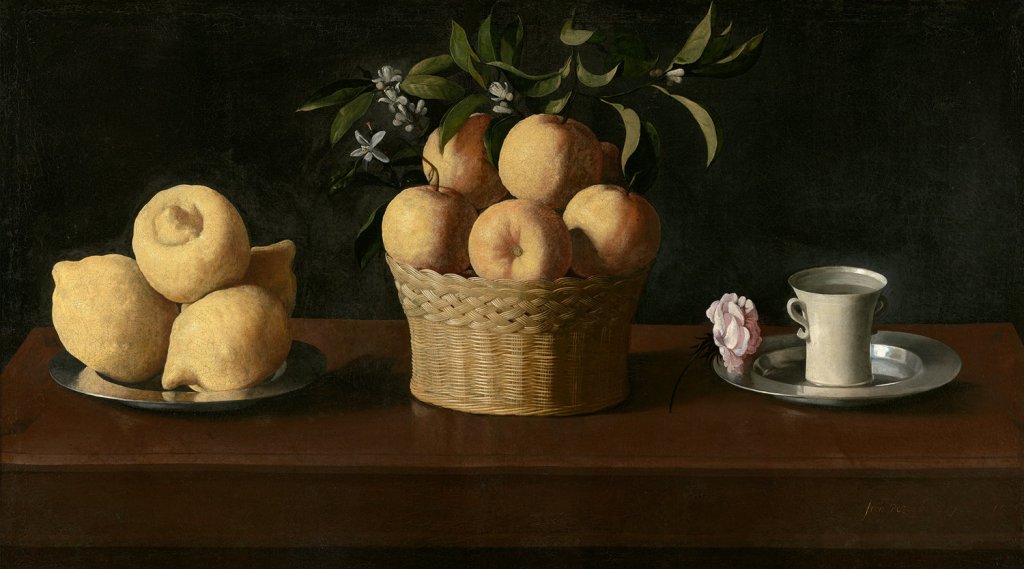
If there is a single revelation, it is Still Life with Lemons, Oranges and a Rose. Hung alongside the National Gallery’s A Cup of Water and a Rose, it initially appears disarmingly simple: fruit and objects arranged across a ledge, stripped of narrative. The fruit seems to hover in an emptied pictorial space, while the rose and cup of water assume the gravity of liturgical objects. Alcarrazas on a Plate (c.1650 or earlier) offers one of the exhibition’s most remarkable discoveries. Unseen in public until their rediscovery in 2023, these exquisitely observed studies of alcarrazas, the porous ceramic vessels traditionally used in Spain to cool drinking water, provide unprecedented insight into Zurbarán’s working process. Rather than sketching directly into finished compositions, the artist created meticulous life-size studies of individual objects before incorporating them into larger paintings, including the monumental still life displayed nearby. Technical analysis has also uncovered hidden symbols and inventory numbers, confirming that the panels once belonged to the Spanish royal collection. Following extensive conservation and scholarly research, they have now been securely attributed to Zurbarán.
The adjoining still life room, which includes works by Zurbarán’s son Juan, resists treating him as a mere painter. Juan’s paintings are elegant, even precocious; Francisco’s, by contrast, carry a metaphysical density that resists inheritance. The curators’ decision to place these works at the centre of the exhibition is one of its most effective recalibrations.
The following section devoted to the Buen Retiro commissions places Zurbarán within the royal orbit. The Hercules cycle reveals an artist capable of grand mythological register, though the psychological voltage is notably diminished. Here, the exhibition’s broader thesis encounters its limit: Zurbarán’s imagination was not expansively versatile. His power lies instead in religious constraint, in solitude, suspension, and the threshold between material fact and spiritual charge.
In the final rooms, devoted to private devotional works such as The Family of the Virgin, the cumulative effect becomes clear. Zurbarán’s achievement lies not in invention but in his ability to charge the ordinary, cloth, fruit, lamb, veil, with an a density of meaning.
For decades, Velázquez has dominated British writing on the Spanish Baroque. This exhibition does not seek to displace him, but it quietly proposes another register of experience altogether. In an image-saturated present, Zurbarán’s paintings insist on stillness, concentration, and the moral weight of looking.
The National Gallery has mounted a compelling argument for Zurbarán as one of the most original, talented and fantastic painters of the 17th century.
–


