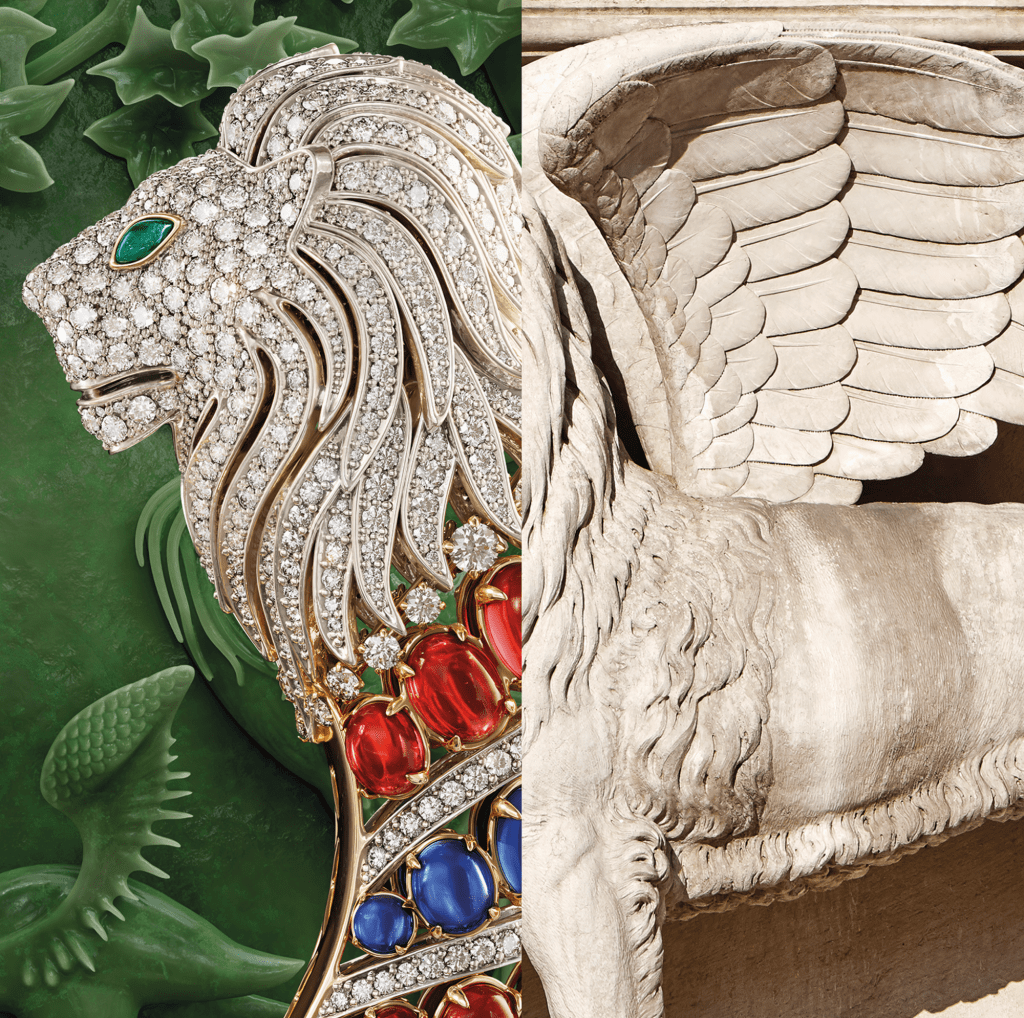
Bvlgari’s new role as Exclusive Partner of the International Art Exhibition of the Venice Biennale, until 2030, marks a significant step in the Maison’s long relationship with art.
Bvlgari’s involvement in the Biennale builds on a broader commitment that connects past and present. Alongside supporting contemporary artists, the Maison has been involved in major restoration projects in Italy, from the Scala d’Oro in Venice to landmarks in Rome such as the Spanish Steps and the Baths of Caracalla. At the same time, it has continued to invest in new artistic production through initiatives like the MAXXI Bvlgari Prize and partnerships with international institutions.
“Bvlgari is honored to be the Exclusive Partner of the International Art Exhibition of the Venice Biennale for the next three editions. This partnership represents the renewal of a tangible commitment to supporting art, embraced as dialogue, innovation, and the pursuit of a universal language that conveys beauty. It is an opportunity to celebrate the power of creativity and to reaffirm the Maison’s dedication to artistic excellence, where inspiration meets mastery,” commented Laura Burdese, Bvlgari Deputy CEO.
For La Biennale, at the Spazio Esedra in the Giardini, Canadian artist Lotus L. Kang presents a new installation created especially for the Biennale. Her work moves between sculpture, photography, and installation, often using materials that remain unstable and responsive to their surroundings. Nothing feels fixed: surfaces shift, images evolve, and forms seem to exist in a constant state of change. For the Biennale, she continues this exploration, thinking about time.
A second project takes place at the Biblioteca Nazionale Marciana, as part of the Biennale’s Collateral Events. This exhibition, organised by Fondazione Bvlgari, brings together Lara Favaretto and Monia Ben Hamouda, each responding to the historic setting in different ways.
Favaretto’s work, shown in the Salone Sansovino, is the final chapter of her long-running series Momentary Monument – The Library. Her practice often questions ideas of permanence and memory, creating works that feel temporary or in the process of disappearing. In a place traditionally associated with preservation, her installation introduces a sense of fragility and change.
In the vestibule spaces, Ben Hamouda presents Fragments of Fire Worship, a work that brings together spiritual, cultural, and political references. Her sculptures and installations often carry a strong physical presence, while also suggesting deeper layers of meaning. Positioned at the entrance to the library, her work feels both like a threshold and an invitation. Together, these projects reflect a shared interest in transformation.
 ART IS ALIVE