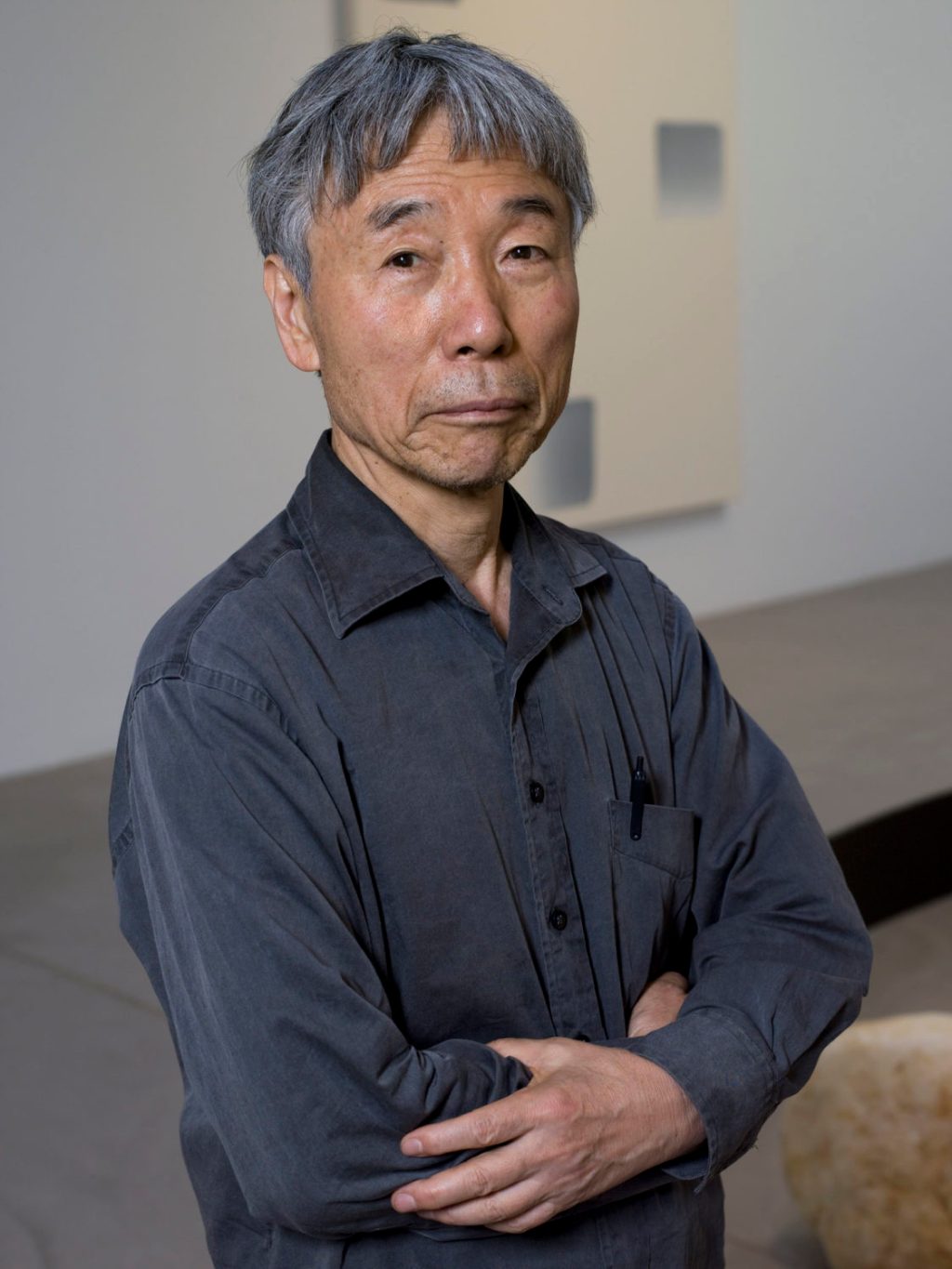
This year, the San Marco Art Centre in Venice will host a major survey of Lee Ufan, the South Korean artist whose seven-decade practice has quietly reshaped contemporary art. Presented as one of the official collateral events of the 59th Venice Biennale (9 May–22 November 2026), the exhibition spans painting, sculpture, and installation, offering an unparalleled opportunity to witness the evolution of an artist whose work is defined by the interplay of material, perception, and philosophy.
Curated by Jessica Morgan, director of the New York–based Dia Art Foundation (who recently curated ‘Minimal’ a stunning show at Bourse de Commerce in Paris), the show traces Lee’s trajectory from the late 1960s, when he emerged as the leading theorist and practitioner of the Japanese Mono-ha (“School of Things”) movement.
Morgan emphasises that the exhibition fills a long-standing gap in the understanding of his career, explaining that “what has been missing is a story of the trajectory of his work. He’s an artist philosopher, a thinker, and I would say his movement through the different series of painterly works has been very clearly conceptualised. It felt appropriate to take [visitors] through his painterly journey, so to speak, from the late 1960s through to the present day.”
The exhibition will unfold almost like a spatial narrative, tracing Lee’s movement across media and time. Early expressive works from From Line gradually lead to the kinetic and meditative Wind series, while the Correspondance series from the late 1980s and early 1990s illustrates his sustained investigation of gesture, time, and space. Morgan frames this progression as “an overview of these different movements and painting, which actually are quite literally movements, from the expressive series From Line to where movement comes in with the Wind series.” The exhibition concludes with Lee’s most recent paintings, where large-scale brush strokes create depth and dimensionality in a way not previously seen in his practice: “It ends with these new paintings, large-scale strokes using incredible colour which also have a dimensionality that has not been part of his practice previously, where the brush strokes almost act like building blocks, creating a sense of depth on a canvas.”
Sculptural works are equally central to the exhibition. Relatum (1969/2019), drawn from the Dia collection, exemplifies Lee’s relational approach to materials and space. Visitors can also walk across Mirror Road, composed of polished steel plates that creates the impression of walking on water, blending reflection, movement, and perception into a subtle sensory experience.
In parallel, Dia Beacon in upstate New York will present a display of Lee’s paintings and sculptures in May, including eight works recently donated by the artist. Marking Lee’s 90th birthday, the Venice and Dia Beacon exhibitions together will offer a panoramic view of an artist whose work asks the viewer to inhabit a space between material and void, gesture and silence. His paintings, sculptures, and installations are exercises in perception, inviting a meditative encounter with time, space, and the poetic intelligence that has defined one of contemporary art’s most enduring voices.
 ART IS ALIVE