Last days to visit Regards d’un collectionneur, an ambitious exhibition at the majestic Hôtel de Caumont – Centre d’Art in Aix-en-Provence. Bringing major works to southern France for the first time, the show invites visitors into an intimate dialogue with art history through the singular vision of collector Oscar Ghez.
Far from a standard survey of modern painting, the exhibition traces the movements that shaped French art from the late 19th century to the 20th-century avant-garde, guided by Ghez’s instinctive and often prescient eye. Born in Sousse in 1905, Ghez devoted himself fully to collecting from the mid-1950s onward, eventually opening Geneva’s Petit Palais Museum in 1968 to share his collection with the public.
The setting is integral to the experience. The 18th-century hôtel particulier, built “between courtyard and garden” in the Mazarin quarter, frames the exhibition with its ornate gate, meditative courtyard and serene formal gardens (the café is chic and great too). A short film on Paul Cezanne at the entrance prepares visitors for a journey as much about perception as about art.
The narrative of Regards begins with Impressionism’s radical rethinking of light and modern life. Gustave Caillebotte’s Le Pont de l’Europe provides a monumental opening: a psychologically charged urban scene that signals a new attention to space and everyday experience. The balance of the painting is remarkable with a loving couple on the left-hand, a man starring at the horizon on the right-hand side, and a dog in movement in the middle. Nearby, works by Pierre-Auguste Renoir and Théo van Rysselberghe expand the dialogue, while canvases by Henri Edmond Cross and Maximilien Luce reveal Ghez’s early commitment to artists once marginal to the canon. A (scary) portrait by Édouard Manet anchors the transition toward modernity.
From pointillist precision, the exhibition moves into liberated colour. Raoul Dufy’s vibrant Le Marché à Marseille (1903) dissolves outlines into radiant sensation, while Henri Charles Manguin and Auguste Chabaud anticipate Fauvism’s bold expressiveness, even if sadly no Henri Matisse is in sight.
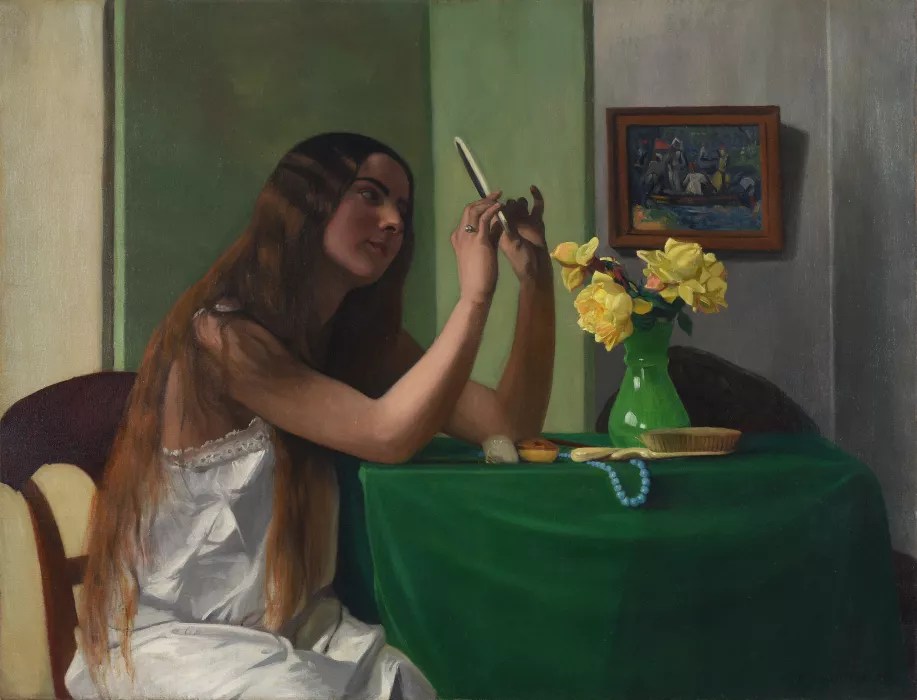
The Nabis and decorative modernity follow. Félix Vallotton and Louis Valtat redefine surface and depth, while Marie Laurencin’s La Funambule (1920) offers lyrical restraint. Ghez’s particular passion for portraiture comes into focus in works by Jeanne Hébuterne, Suzanne Valadon and Nathalie Kraemer, women artists long sidelined by institutions yet championed here decades ahead of broader reassessment.
A highlight is Tamara de Lempicka’s Perspective (Les Deux amies) (1923), a defining statement of Art Deco modernity. Another surprising and vital piece in the show is Édouard Vuillard’s café tea‑room panels. Commissioned in August 1917 by designer Francis Jourdain, these oval-shaped works were meant to mirror and amplify the very space they adorned. Furniture, glowing lacquered walls, light fixtures, and women’s cloche hats come to create an immersive sense of Parisian café society after the Great War. A soldier in a sky‑blue uniform coat quietly references the past. Here, Vuillard captures not just a moment but a milieu, decorative modernity as social reflection.
The final galleries turn toward Cubism and late modernism. Pablo Picasso’s monumental L’Aubade (1965) is the culmination of the exhibition. Pablo Picasso’s L’Aubade (1965) stands as the highlight of this show. Painted late in the artist’s life, the vibrant large-scale painting synthesises decades of experimentation, sexuality, and a refined command of colour and gesture, into a powerful, theatrical scene. Opposite, sits another magnificent yet smaller work by Picasso. Rooted in the artist’s “magic paintings” period (1926–1930).
Across the halls of Caumont, the coherence of Ghez’s vision is unmistakable. He collected with conviction, often embracing figures such as Théophile Steinlen, Charles Angrand and Leopold Survage before critical consensus caught up.
In recent years, the Hôtel de Caumont – Centre d’Art has established itself as one of the South of France’s most ambitious platforms for modern art, with exhibitions devoted to Nicolas de Staël, Niki de Saint Phalle and Yves Klein. Regards d’un collectionneur advances that trajectory, not simply presenting masterpieces, but staging a broader cultural conversation about taste, history and a keen eye for emerging artists.
Installed with chronological clarity, the exhibition traverses Impressionism, Pointillism, Fauvism, the Nabis, Art Deco and Cubism in a story shaped by dedication and passion. Another great exhibition will follow, devoted to Henri de Toulouse-Lautrec, and opening on 24 April.
–
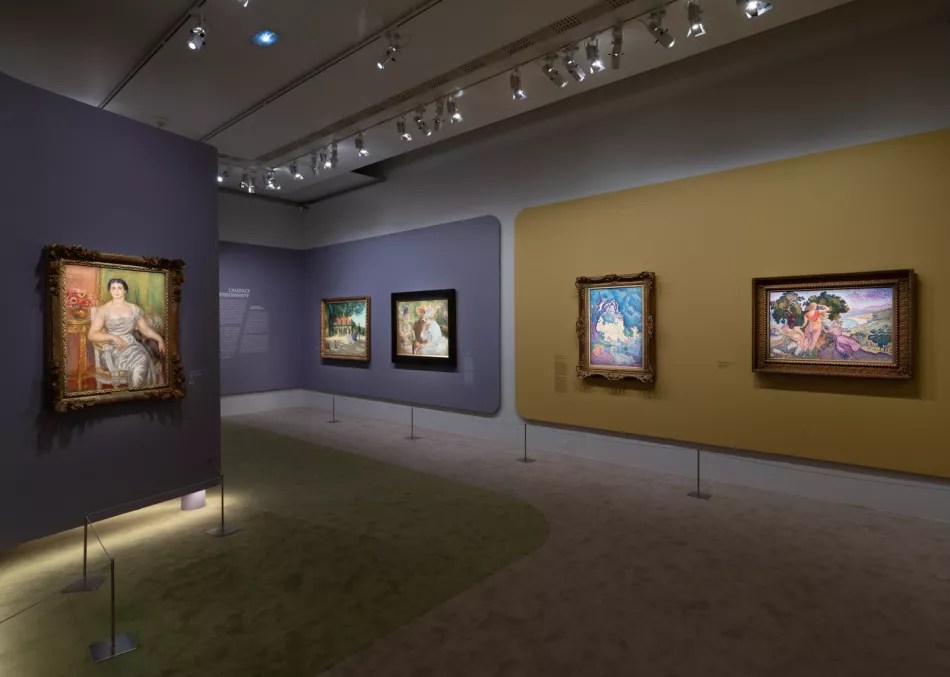
Image: Félix Édouard VALLOTTON, La toilette, 1911, Huile sur toile, 81 x 116 cm. Collection : Association des Amis du Petit Palais, Genève. Photo : Maël Dugerdil, Genève and © Culturespaces / Thomas Garnier
 ART IS ALIVE