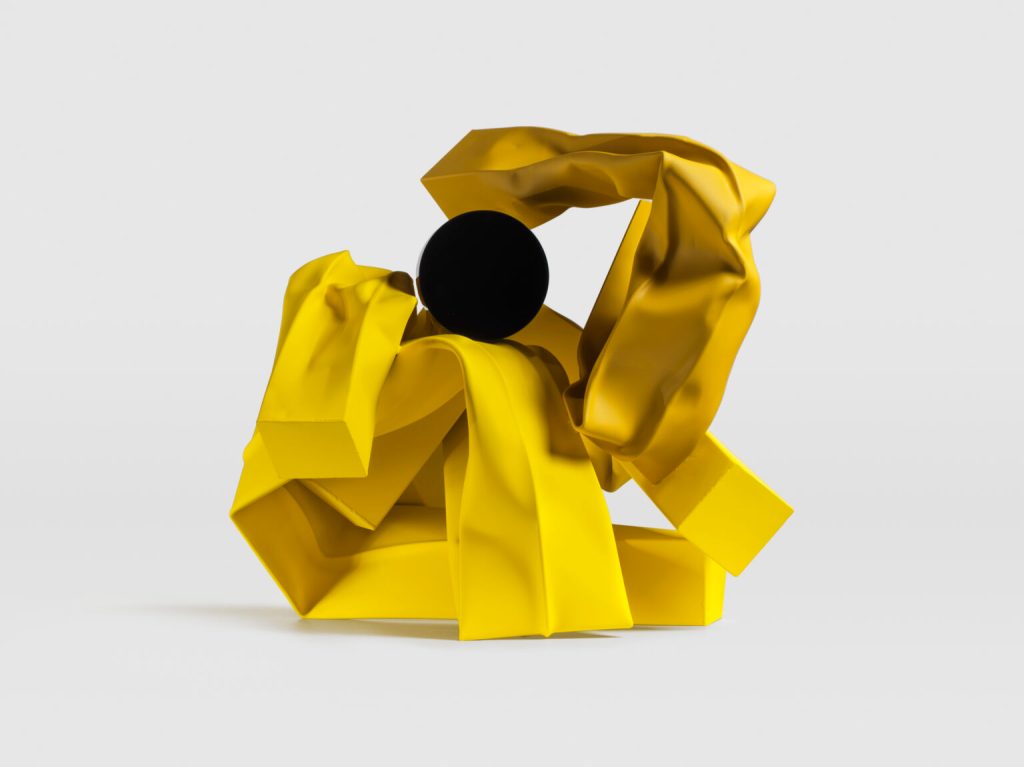
From March 5 to August 2, 2026, the Solomon R. Guggenheim Museum presents a major survey of Carol Bove, the artist’s first full museum retrospective and largest exhibition to date. Installed along the spiraling rotunda of Frank Lloyd Wright’s landmark building, the exhibition traces more than two decades of Bove’s practice, foregrounding her sustained investigation into the interdependence of artworks and their contexts.
Since the early 2000s, Bove has examined how objects accrue meaning through display, architecture, and historical framing. Working across found materials, industrial construction hardware, publications, and monumental steel forms, she embraces the language of modernist formalism as a point of departure, probing its blind spots and reopening overlooked narratives within twentieth-century art history. Her recent large-scale metal sculptures, with their sweeping arcs and tensile gestures, amplify this inquiry, transforming heavy industrial material into compositions that feel at once muscular and improbably light. The works are stunning!
Born in Geneva in 1971 and raised in Berkeley, California, Bove moved to New York in 1993 and earned a BS from New York University in 2000. Her first major museum exhibition took place at Kunstverein Hamburg in 2003, and she later taught at NYU’s Steinhardt School between 2009 and 2013. These early institutional contexts parallel her long-standing interest in how intellectual and cultural histories circulate.
Bove’s early assemblages frequently incorporated books tied to the intellectual currents of the 1960s and ’70s, juxtaposed with natural elements such as stones and feathers. In one 2002 installation referencing the seminal 1969 exhibition When Attitudes Become Form, wooden shelves displayed art catalogues alongside volumes on psychedelic culture, collapsing temporal and ideological distance. Elsewhere, Bove has folded the work of other artists into her own sculptural constellations: in Shrine to Eris (2010), she inserted reproductions of paintings by Hans Hofmann amid peacock feathers and found materials; in “setting” for A. Pomodoro (2014), she incorporated a sculpture by Arnaldo Pomodoro, complicating authorship and display.
At the Guggenheim, these conceptual concerns unfold in dialogue with Wright’s architecture. The works resonate with NY itself. As visitors ascend the ramp, Bove’s works, ranging from intimate, idea-driven constructions to commanding steel abstractions, activate the building’s curves and voids.
The exhibition reveals an artist deeply attuned to history yet unwilling to accept it as fixed, using sculpture not simply as form in space, but as a critical tool for re-seeing the structures, material, institutional, and ideological, that shape how art is experienced.
 ART IS ALIVE