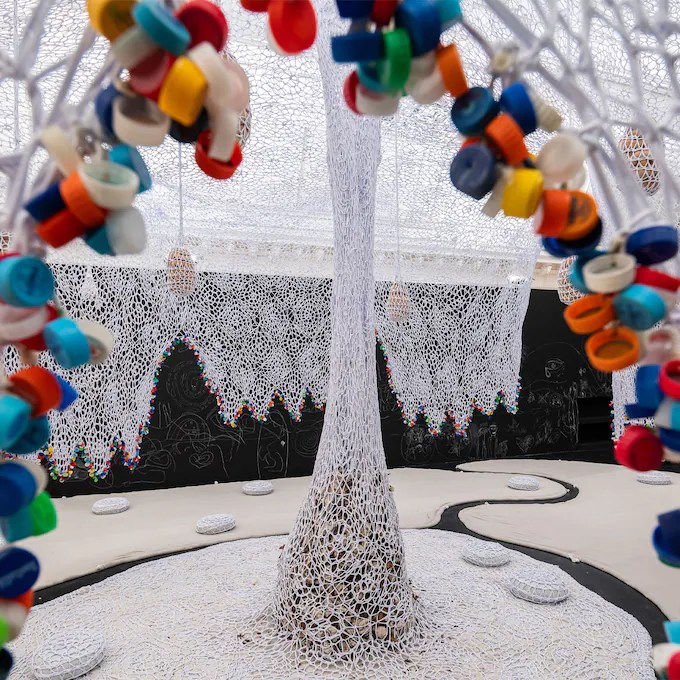
This January, Le Bon Marché Rive Gauche welcomes a monumental installation by Brazilian artist Ernesto Neto. As Paris moves indoors for winter, the legendary department store features a work shaped in the sinuous shape of a serpent.
Neto revisits the myth of Adam and Eve, offering a radically different reading. For him, the serpent is not a symbol of evil, but of life and possibility. Without it, he suggests, there would be no humanity, no culture, no desire. Paradise, in this version, is not lost, it is left behind so that life can begin.
Suspended beneath the glass roofs of Le Bon Marché, the sculptures wind through the architecture, introducing movement into the space. As with much of Neto’s practice, the body is central: you do not simply observe the sculpture, you move alongside it.
Born in Rio de Janeiro in 1964, Ernesto Neto has long approached art as a living system. His installations often evoke skin, organs, shelters, or ritual spaces, blending references to nature, and spirituality. Fragility is key, not as something to protect from life, but as something that defines it.
Presented in a space dedicated to objects and consumption, Neto’s work subtly shifts perspective. Rather than rejecting material culture, he reframes it.
The serpent itself carries particular meaning. Long associated with fear and blame, it is reclaimed here as a figure of knowledge and transformation. In Brazilian Portuguese, the word for snake is feminine, a detail that quietly challenges the traditional narrative around Eve and guilt. Playfulness also runs through the installation. Neto believes art should be a place of freedom and experimentation.
Ernesto Neto, Le La Serpent is on view at Le Bon Marché Rive Gauche, Paris until 23 February 2026
 ART IS ALIVE